
Asymmetry from chewing on one side: assessment and approach

- Muscle
- Highlighted area
Quick facts
- Concern
- One side of the face fuller or wider, linked to chewing more on one side
- Hypothesis
- Unilateral masseter hypertrophy from uneven use
- Confirm
- Palpation during contraction, teeth and joint, resting frontal photo
- Refer
- Pain, clicking, malocclusion or tooth loss belong in the conversation with dentistry
A patient arrives with the classic concern: "one side of my face is bigger," and in conversation admits that they chew on only one side, out of habit, pain, a missing tooth or a bite adjustment. The clinical question is whether that habit has produced visible asymmetry, through hypertrophy of the masseter on the working side, and what to do about it.
This page gathers the assessment reasoning and the options that fall within HOF, with clear limits. It complements larger masseter on one side, asymmetric jaw and botulinum toxin in the masseter.
Does one-sided chewing change the face?
The masseter is a power muscle that responds to use: the more it works, the more volume it tends to gain. When a person chews predominantly on one side, the muscle on that side may develop more, and the jaw angle on that side becomes fuller and more evident. In some patients, the difference is noticeable in the frontal photo, mainly in the lower third.
But the relationship is not automatic, and the cause must be confirmed. The asymmetry can also come from:
| Origin | How to tell it apart | Note |
|---|---|---|
| Unilateral muscle hypertrophy | The fuller side hardens and enlarges when the teeth are clenched | Usually the target of toxin |
| Fat in the area | Soft consistency, does not change with contraction | Different approach |
| Bony jaw asymmetry | Palpation and radiograph show a bone difference | Refer to orthodontics or surgery |
| Deviation from malocclusion or tooth loss | Chewing on the side with more teeth present | The cause is dental |
| Temporomandibular joint disorder | Pain, clicking, limited opening | Specialist assessment |
One-sided chewing is usually a consequence of a dental or joint problem before it is a cause of asymmetry. That is why looking only at the muscle means looking only at the symptom.
How to assess
The examination is quick, but it needs method. Begin with the conversation and end with palpation.
The relationship with bruxism comes in here: patients who clench their teeth also have a bulky masseter, and the page botulinum toxin for bruxism covers that angle. The associated square contour is covered in square face from bruxism.
What HOF can do
The approach depends on the cause, and it is worth repeating that the decision belongs to the licensed professional, in line with the rules of their professional council in Brazil.
Botulinum toxin in the masseter. When hypertrophy is the main cause, toxin can reduce the activity and, over time, the volume of the muscle. In asymmetry, the plan is usually deliberately asymmetric, with greater treatment on the hypertrophied side, and reassessment is essential. There are risks of altering chewing, of causing smile asymmetry through diffusion to neighboring muscles and of reducing volume too much. See the muscle map for botulinum toxin.
Filler for the smaller side. When the smaller side lacks structure, jawline filler can balance the contour in soft tissue, without correcting the muscle on the other side. In general, the plan tries to combine reduction of the larger side with reinforcement of the smaller one, in stages.
Dentistry. If one-sided chewing comes from missing teeth, an inadequate prosthesis, pain or malocclusion, treating the cause is what prevents the pattern from returning. A partnership between HOF and dentistry is part of good practice. See crossbite and asymmetry.
Risks and limits
The risks of toxin in the masseter include temporary changes in chewing, smile asymmetry from diffusion, skin laxity when volume is reduced too much, and headache. For jawline filler, they include swelling, bruising, nodules, asymmetry and, less often, vascular complications. Hyaluronidase must be available in procedures with hyaluronic acid.
The most important limit is expectation: HOF does not change bone and does not correct chewing. If the asymmetry is skeletal, the path is an orthodontic and surgical assessment.
How to show the patient in Harmy
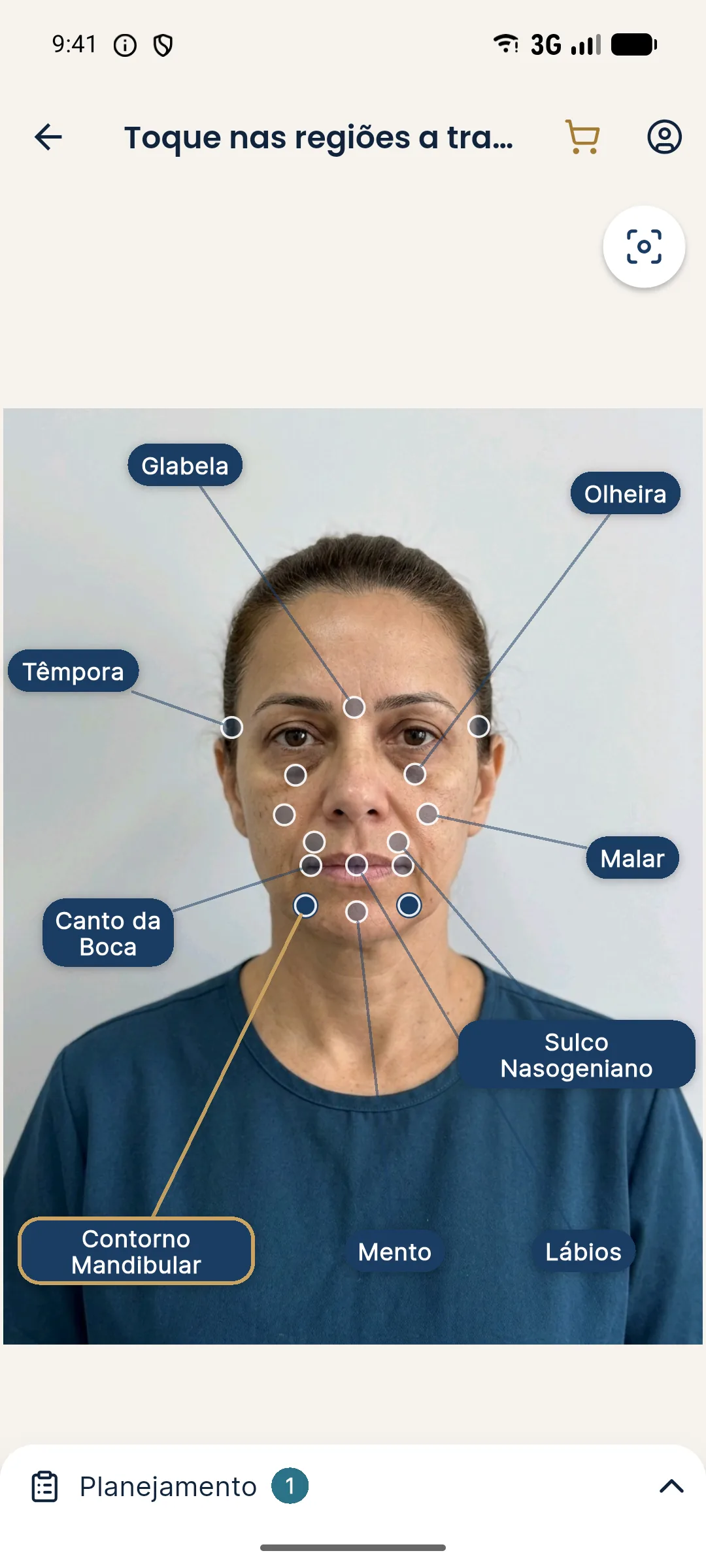
In Harmy, the Jawline point simulates the definition of the jaw line, but does not simulate muscle reduction. The marking serves to show how reinforcing the side with less structure changes the perception of balance, and the projection changes only what was marked. Because in bilateral areas the ml is the total split between the two sides, asymmetry between sides needs a verbal explanation.
Habits that keep the pattern going
Even with the muscle balanced, habit can bring the asymmetry back. Some behaviors deserve a conversation: chewing gum on one side only, always resting the face on the same hand, sleeping on one side with the face compressed, holding the phone between shoulder and chin, and biting nails or pens on one side. None of them changes the bone, but all keep the muscle working unevenly.
It is worth advising the patient to consciously alternate chewing sides for a few weeks, especially after treating the dental cause. In people with nocturnal bruxism, the muscle-relaxing splint prescribed by the dentist is part of the plan, and toxin comes in as a complement, not a substitute. Record this advice in the patient record and return to the subject at the follow-up, because the most stable result appears when the muscle and the behavior change together.
Closing
Record the chewing side, the palpation, the photos and what was agreed. Asymmetry from one-sided use is usually better managed when the cause is treated and the muscle is balanced with caution. For planning reasoning, see jaw and masseter: combining in the plan and plan for an asymmetric face.
Frequently asked questions
Does chewing on only one side make the face asymmetric?
It can contribute. Uneven use can enlarge the muscle on the preferred side and, in long-term cases, change the perceived width of the lower third. The cause can also be dental, joint-related or bony, and should be investigated.
Does botox in the masseter fix the asymmetry?
Toxin can reduce the activity and volume of the masseter, and in some cases balance the width. The indication requires assessment, because the smaller side should not be treated the same way, and the cause must be understood.
Do I need to treat the bite before treating the face?
Often yes, or in parallel. If one-sided chewing comes from pain, a missing tooth or malocclusion, treating only the muscle ignores the cause, and the pattern tends to return.
How do I know whether the larger side is muscle or fat?
By palpation with the teeth clenched and relaxed. Muscle hardens and enlarges when the teeth are clenched; fat keeps its consistency. If in doubt, imaging can help, at the professional's discretion.
Harmy images are illustrative simulations generated by AI from the patient's photo to support the conversation between practitioner and patient. They are not a promise of results. Indication, technique, product and volume are solely the decision of the licensed practitioner. This content is for information only and does not replace a clinical assessment.