
Nose Off the Midline: Real Deviation or Illusion
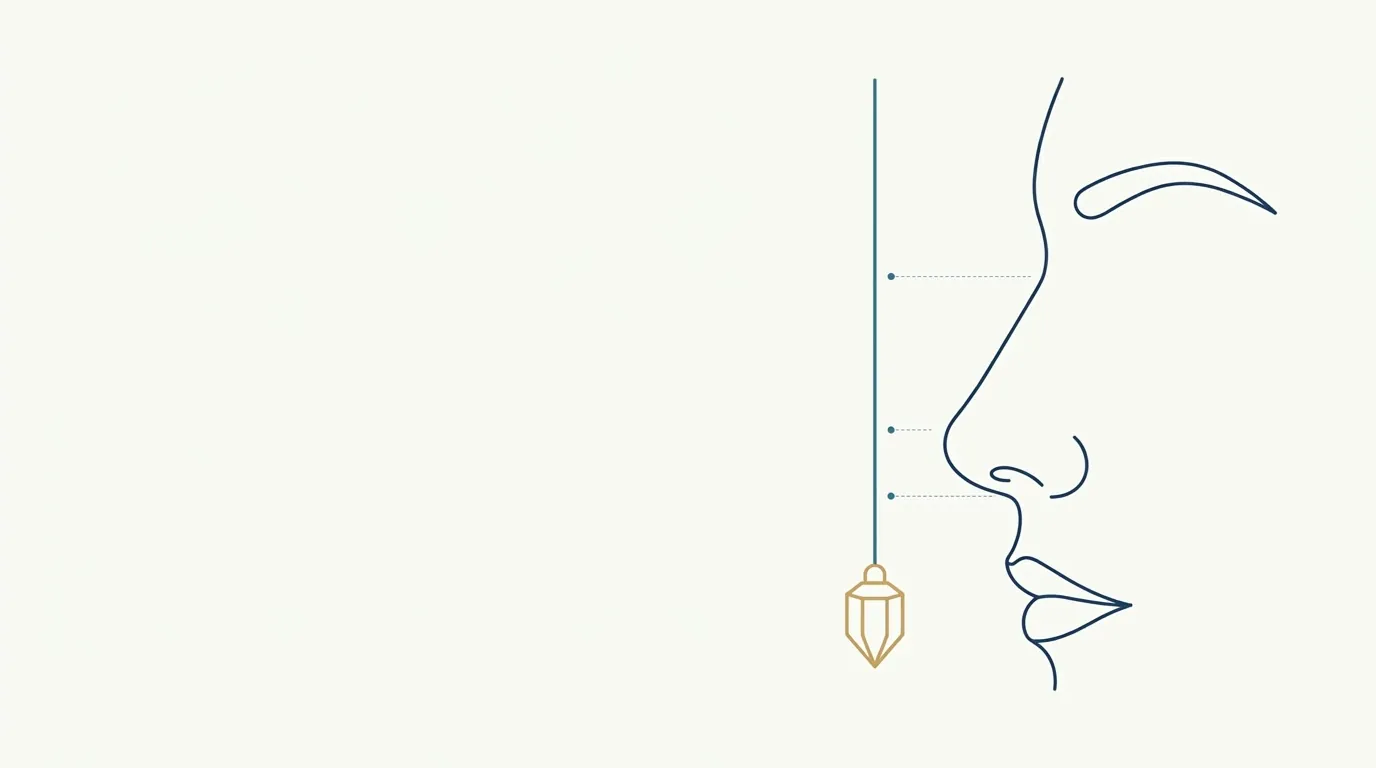
- Nerve
- Highlighted area
Quick facts
- Concern
- The nose seems shifted to one side relative to the center of the face
- Key question
- Is the nose off the axis, or is the axis of the face (eyes, mouth, chin) the one that is deviated?
- Plan risk
- Trying to correct with volume a deviation that is bony or that comes from the rest of the face
- First step
- Draw the midline through the glabella, tip, philtrum and chin on an aligned front photo
The patient looks at themselves from the front and sees the nose leaning to one side. Often that is true. At other times, it is the rest of the face that is off the axis, and the nose merely follows. And at others still, the photo misleads. The starting point is to find out which of the three situations is in front of you, before thinking about any approach.
This page helps separate real nasal deviation from the illusion caused by the eyes, mouth or photography. For the case of structural deviation of the nose itself, see also crooked nose, and for the face that goes along with it, deviated midline.
What is the midline and how do you draw it?
The facial midline is a vertical reference that passes through the glabella, the tip of the nose, the philtrum and the central point of the chin. In real faces, it is rare for all points to align perfectly, and small differences are normal. What matters is the pattern.
| Finding | Likely interpretation |
|---|---|
| Nose off the line, other structures aligned | True nasal deviation |
| Nose, mouth and chin deviated to the same side | Deviation of the lower third or of the face |
| Nose aligned, but eyes at different heights | Illusion from ocular asymmetry |
| Deviation disappears when the head is realigned | Photo artifact |
| Straight dorsum, deviated tip | Cartilage or caudal septum problem |
The midline should be drawn on a standardized photograph, with the head in the Frankfurt plane, a neutral face and the camera at eye level. The rule is in reference lines on the front photo and in how to measure facial symmetry.
Where nasal deviation begins
The dorsum of the nose has a bony part (the nasal bone) and a cartilaginous part (the nasal cartilages). A deviation can originate in either of them, in the septum or in a combination. Trauma, birth, asymmetric growth and previous surgery are among the most frequent causes.
Palpate the dorsum from the nasion to the tip, with the patient facing forward and then with the head tilted. Observe whether the deviation is C-shaped, S-shaped or only of the tip. The more complex the curve, the greater the chance that the cause is structural and the case is surgical.
When the nose looks crooked because of the face
The nose is read in relation to the eyes, eyebrows and mouth. If one eyebrow is higher or if one eye is on a different plane, the perceived center changes. So an aligned nose can look deviated. Assess eyes at different heights, asymmetric eyebrow and mouth off the midline before fixing attention on the nose.
Another possibility is skeletal facial asymmetry. In those cases, the whole face tilts, and the nose follows. Showing this reading to the patient often changes the conversation: what they see as a "crooked nose" is a face with its own axis. For the conversation, see explaining natural asymmetry to the patient.
What HOF can and cannot do
HOF does not align bone or cartilage. What may exist, in selected cases, is camouflage of small irregularities of the dorsum with hyaluronic acid, with a limited effect. For visible deviations, volume tends to enlarge the nose on one side and does not solve the axis.
Safer is usually to treat what is around it:
- If the chin is off the axis, balancing the lower third can change how it reads (see chin off the midline).
- If the eyebrow is asymmetric, toxin or other approaches can reduce the difference.
- If there is cheekbone asymmetry, volume on one side can compensate for part of the perceived tilt.
Dynamic and functional assessment
Ask about breathing. A deviation with nasal obstruction calls for an otolaryngologist, and the aesthetic concern becomes secondary. Also ask the patient to smile and speak while you observe the tip: if it deviates with expression, there is a muscular component. See nose that drops when smiling.
An old photo helps
Ask for a photo of the patient from a few years ago. If the deviation is new, the event (trauma, procedure, surgery) should be investigated. If the deviation has always existed, it is probably structural. The same goes for childhood photos: asymmetric growth sometimes shows early. See old patient photo as a reference.
Simulation and expectations
Harmy has no marking point for the nose and the simulation uses only the front photo. It does not show alignment or correct the deviation. It can be useful for other areas, such as the chin or eyebrow, which influence how the axis reads. The image is always an illustrative simulation, and changing the nose is not part of it.
When to refer
Refer to a nose surgeon or an otolaryngologist when there is:
- a visible deviation in standardized photos;
- a breathing complaint;
- previous surgery or trauma with sequelae;
- an expectation of alignment that only surgery can offer.
Explain to the patient that your role is to help decide whether the case is for HOF or not. See referring patients in HOF.
Summary for the decision
A nose off the midline can be a true deviation, a facial asymmetry or a photo illusion. Draw the midline on a standardized image, observe the eyes, mouth and chin, investigate the history and refer what is structural. In selected cases, discreet camouflage is possible, but with a limit and vascular risk. All at the discretion of the qualified professional, according to the rules of their professional council in Brazil, without promising results.
Frequently asked questions
How can I tell whether the nose is really deviated?
Compare the line that passes through the glabella, the tip of the nose, the philtrum and the chin. If the nose strays from that line while the other structures respect it, there is a nasal deviation. If they all stray together, the deviation is of the face.
Does filler correct a deviated nose?
Generally not. The deviation is in bone and cartilage. In selected cases volume can change how it reads, but the effect is limited and the area carries a high vascular risk.
Can the photo make the nose look off-center?
Yes. A tilted head, a turned face and a lens that is too close create apparent deviations. Standardize the photography before assessing.
Who actually treats a deviated nose?
Structural correction is surgical and is done by a nose specialist. The HOF professional assesses, advises and refers when appropriate.
Harmy images are illustrative simulations generated by AI from the patient's photo to support the conversation between practitioner and patient. They are not a promise of results. Indication, technique, product and volume are solely the decision of the licensed practitioner. This content is for information only and does not replace a clinical assessment.