
Mouth Off the Midline: Evaluating the Smile and Face

- Nerve
- Highlighted area
Quick facts
- Concern
- The mouth or philtrum is shifted relative to the center of the face
- References
- Glabella, tip of the nose, philtrum, dental midline and pogonion
- Origins
- Teeth, jaw, muscle, lip or head posture
- Caution
- Do not "center" the mouth with volume alone without understanding the cause
There is a concern that patients describe like this: "my mouth is crooked" or "my smile goes to one side." When the deviation is of the mouth relative to the center of the face, the professional first has to answer a question of method: relative to what? The facial midline is a reference that depends on the photo, the posture and which points you choose as an anchor. Without that, any correction starts from a measurement error.
This page proposes a way to measure, separates the origins of the deviation and shows what orofacial harmonization can help with. The smile topic is in smile asymmetry, planning is in midline deviation: how to plan and deviation of the whole face is in deviated midline.
How to define the midline
The facial midline is an imaginary vertical line that passes through the middle of the glabella, the tip of the nose, the center of the philtrum and the most central point of the chin. Rarely do all of these points coincide, and small differences are normal. What matters is the whole picture.
To measure reliably on the photo:
- Head in the Frankfurt plane, with no lateral tilt.
- Pupil line parallel to the floor (use a reference line in the photo editor).
- Draw the midline through the midpoint between the eyebrows and the base of the nose, not the tip, which may be deviated.
- Compare the other points to that line: philtrum, dental line, chin.
- Repeat with the patient at rest and smiling.
The importance of standardizing the photo is covered in reference lines on the frontal photo and standardized clinical photography.
Where does the mouth deviation come from?
| Origin | What you see | Likely approach |
|---|---|---|
| Deviated dental midline | Philtrum centered, teeth shifted | Dentistry |
| Jaw deviation | Chin and mouth follow the deviation | Orthodontics, surgery or observation |
| Muscle asymmetry | Mouth deviates only when speaking or smiling | Assess muscle balance |
| Lip asymmetry | Philtrum and bow shifted, different volumes | May respond to harmonization |
| Posture or habit | Head tilt or chewing on one side | Guidance and reassessment |
| Sequela of trauma, surgery or paralysis | Clear history | Refer for specific evaluation |
A clinical clue: if the deviation follows the jaw (chin and mouth together), the cause tends to be skeletal; if the mouth deviates but the chin is centered, the cause tends to be soft tissue or dental. For the connection with the chin, see chin off the midline and nose off the midline.
What harmonization can do
Facial harmonization works on soft tissue, and the expectation needs to be realistic.
Lip and philtrum. Lip filler can correct mild volume differences between the sides and adjust the bow and philtrum, which improves the perception of center. The result depends on the deviation and on the structure that is there. See asymmetric lips: assessment.
Mouth corners. A difference in corner height can be addressed with volume or with muscle balance, at the professional's discretion. See mouth with an angry expression for the reasoning about the muscles of the corner.
Chin. If the chin is slightly deviated, adjusting chin volume can soften the perception. See asymmetric chin.
What it does not do: it does not move teeth, does not correct jaw position and does not reposition the dental line. When the origin is skeletal or dental, the path goes through orthodontics and surgery, and harmonization acts as a complement.
Teeth first or harmonization first?
When there is a dental midline deviation, the safest rule is to align the order with dentistry. An orthodontic adjustment, for example, changes the position of the lips, and filler placed beforehand may need revision. The conversation about order is in harmonization plan after orthodontics and harmonization integrated with dentistry.
How Harmy helps
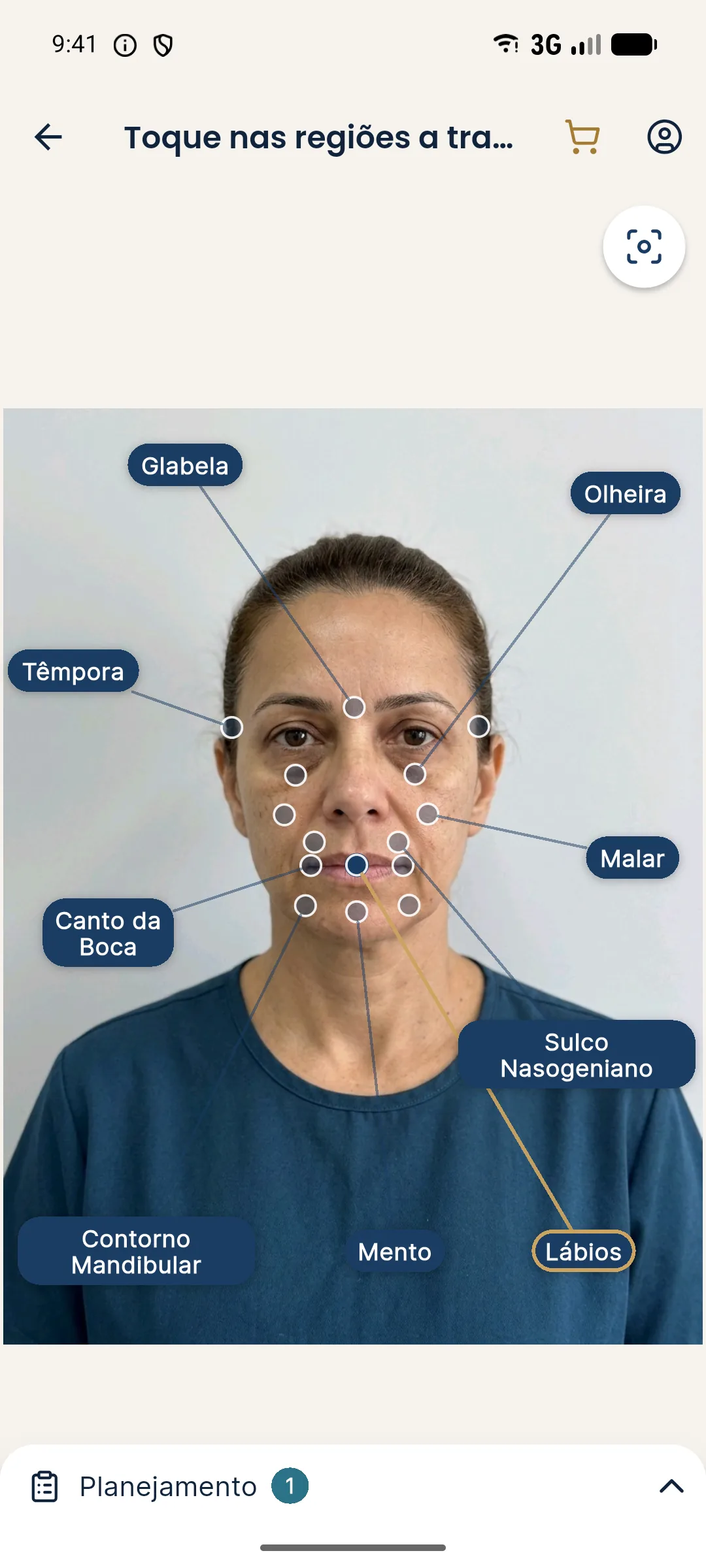
Harmy uses a frontal photo and shows the result over the marked areas. This is useful for showing the proportion difference between the sides, but the app does not correct a midline deviation and does not simulate tooth position. For this concern, the useful points are Lips, Mouth Corner and Chin. In a bilateral area, the ml is the total, split between the two sides.
The deviation that only shows up in photos
Many patients notice the mouth deviation only in selfies. The phone's front camera distorts the face, the angle of the arm changes the head position and mirroring flips the sides, which makes patients see themselves differently from how others see them. Before measuring anything, compare the selfie with the standardized photo taken in the office: it is common for the deviation to shrink or disappear.
This conversation prevents treating a concern created by the image. Ask the patient to bring two or three photos taken by other people, from the front and in motion, and compare them with the clinical assessment. If the deviation persists in all conditions, it is real and follows the cause roadmap. If it changes a lot between selfies and photos taken by others, the conversation goes through the difference between mirror, selfie and photo and through expectations.
Wrap-up
Record the measurements on the standardized photo, the likely origin and what was agreed with the patient. Also document that harmonization acts on soft tissue and does not correct dental or skeletal deviation. Volumes and technique are at the discretion of the licensed professional, in accordance with the rules of their professional council in Brazil.
Frequently asked questions
Can a mouth off the midline be corrected with filler?
In mild soft-tissue deviations, there may be partial improvement by balancing the lip contour. When the origin is dental, skeletal or muscular, filler alone has limits and the assessment defines the path.
How can I tell whether the deviation comes from the teeth or the lip?
Compare the dental midline with the philtrum and the facial midline in a frontal photo. If the teeth are off but the philtrum is centered, the origin is dental; if the philtrum is also off, there is a lip or facial component.
Can head posture mimic a crooked mouth?
Yes. Tilting or turning the head changes how the reference points read. That is why the photo must be taken with the head in the Frankfurt plane and the pupil line parallel to the floor.
Does toxin help a crooked mouth?
In cases of muscle imbalance, small doses may even out the strength between the sides, but the indication is delicate, because the same toxin can cause smile asymmetry. The decision belongs to the licensed professional.
Harmy images are illustrative simulations generated by AI from the patient's photo to support the conversation between practitioner and patient. They are not a promise of results. Indication, technique, product and volume are solely the decision of the licensed practitioner. This content is for information only and does not replace a clinical assessment.