
Small Mouth: Assessing Width and Volume

 BeforeSimulation
- Muscle
- Highlighted area
Quick facts
- Concern
- Mouth seen as small or narrow relative to the face
- Distinction
- Mouth width and lip volume are independent measures
- Limit
- Injectables do not widen the commissure, they only change perception through volume and proportion
- Pitfall
- Too much volume in a narrow mouth creates a "duck" lip
The small-mouth concern usually comes with a request for a bigger lip, but the two are independent: a narrow mouth (short distance between the corners) can have full lips, and a wide mouth can have thin lips. When the professional does not separate the two, the plan becomes "more volume," and the result can be a prominent lip on a short mouth, which looks out of proportion.
This page guides you in measuring the mouth, understanding the role of the commissure and planning without creating an artificial mouth. The opposite concern is in large mouth, and lip volume is in thin lip: assessment.
What defines the perceived size of the mouth?
Three elements add up:
| Element | What it is | How it affects the reading |
|---|---|---|
| Width | Distance between the two commissures | Defines whether the mouth is narrow, average or wide |
| Volume | Thickness of the vermilion | Defines whether the lips are thin or full |
| Corner position | Lifted, neutral or drooping corners | Changes the impression of size and of expression |
The modiolus, where several muscles of the mouth converge, anchors the corner. It plays a central role in corner position and smile movement. The lip proportion between the upper and lower lip completes the picture.
A common reference compares the mouth with the distance between the pupils and with the division of the face into fifths, as described by the rule of fifths. The same caveat given in large mouth applies: these are guides, and harmony matters more than the number.
How to assess
The assessment needs a standardized photo and observation in motion. A small mouth at rest can look bigger when smiling, and the opposite also happens.
In some patients there is a limitation from scarring or tissue tension, for example after a burn, lip surgery or radiotherapy. In these cases, filler carries greater risk and the conversation moves closer to a surgical assessment.
What harmonization can and cannot do
It cannot: widen the mouth in the anatomical sense by moving the corners apart. No injectable does that.
It can, within limits:
- Define the contour: lip filler in a small amount can improve the definition of the bow and the white line and give the impression of more present lips, without exaggerated enlargement.
- Work on the corners: mouth corner filler can visually lift the corner and reduce the side shadow, which changes the perception of width and expression.
- Balance the lower third: giving projection to the chin, when it is lacking, can improve the proportion between the mouth and the face. See small chin.
- Respect the anatomy: often the best plan is to accept the mouth as it is and treat only what is out of proportion.
When the mouth looks small for another reason
Some findings reduce the perception of size without the mouth being small:
- A long upper lip, which hides the vermilion. See long upper lip.
- A lip that rolls inward, common in smiles that "disappear." See inward-turned lip and lip that disappears when smiling.
- Drooping mouth corners, which visually shorten the line. See sad mouth.
- A wide face or large chin, which makes the mouth look smaller by comparison.
Identifying these cases avoids adding volume where the solution is something else.
Risks
The risks of lip filler include swelling, bruising, asymmetry, nodules and irregularities, plus less frequent but serious vascular complications. The lip is supplied by the labial arteries and hyaluronidase must be available. In a small mouth there is less room for corrections, which calls for even more caution. The management of an occlusion is in lip vascular occlusion.
How to simulate in Harmy
In Harmy, the Lips point and the Mouth Corner point let you show the patient how a small volume changes the way the mouth reads. The projection uses the frontal photo and changes only what was marked, with no retouching of skin or expression. It does not widen the mouth, and that is good for aligning expectations: the patient sees that the width stays.
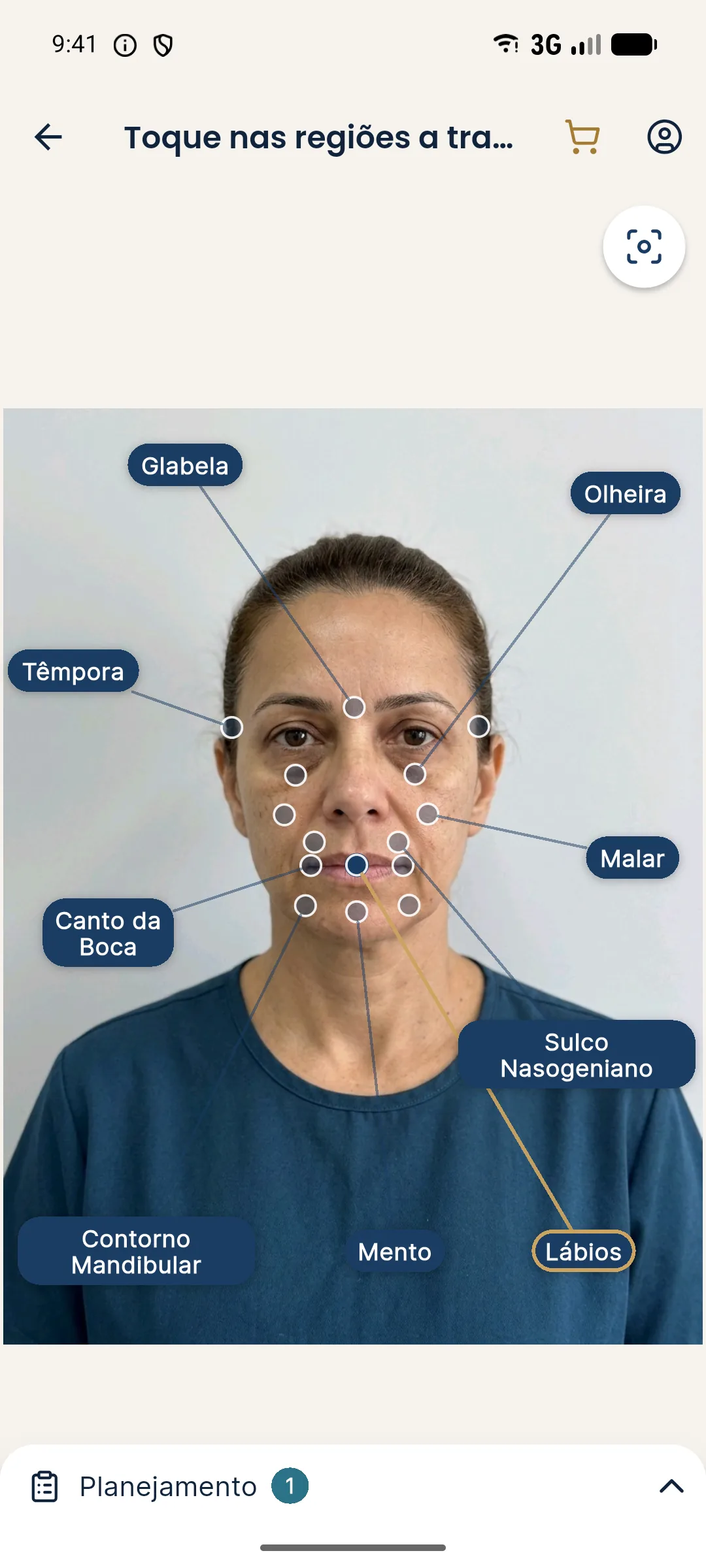
The First time shortcut marks lips 1 ml at Moderate intensity. For a small mouth, it is worth adjusting to a lower value and Subtle intensity, and comparing the two versions side by side in the slider.
Makeup, lipstick and the perception of size
A small mouth is, in part, a matter of perception, and makeup changes that perception a lot. Dark and matte lipsticks tend to shrink the mouth; light and glossy tones enlarge it. Lining the lip slightly beyond the natural edge is a common trick. Before planning volume, it is worth asking the patient how they do their makeup and whether the complaint exists with and without lipstick.
This also helps with the assessment photo: always photograph without lipstick to see the real edge of the vermilion. If the small-mouth complaint exists only when the patient is without makeup, the gain in contour definition may be more useful than a gain in volume. Record this conversation and show the patient the difference between photos with and without makeup, which often recalibrates expectations without any injection.
Wrap-up
Record the measurements, the photos and the plan in stages. In cases of a complaint out of proportion with the finding, consider body dysmorphic disorder in facial harmonization. Volumes and techniques are at the discretion of the licensed professional, in accordance with the rules of their professional council in Brazil.
Frequently asked questions
Can filler make the mouth wider?
Not in a real sense. Filler changes volume and contour, and it can give the impression of a slightly bigger mouth by shifting the shadow and defining the line, but the distance between the corners does not change.
Are a small mouth and a thin lip the same thing?
No. A person can have a narrow mouth with full lips or a wide mouth with thin lips. The assessment separates width, volume and the proportion between the upper and lower lip.
How much volume fits in a small mouth?
It depends on the anatomy, the proportion with the face and what the patient wants. In general, smaller volumes in stages adapt better, at the discretion of the licensed professional after assessment.
Do lifted mouth corners make the mouth look bigger?
They can change the perception of width and of expression, which is why corner position is part of the assessment. The structure itself stays the same.
Harmy images are illustrative simulations generated by AI from the patient's photo to support the conversation between practitioner and patient. They are not a promise of results. Indication, technique, product and volume are solely the decision of the licensed practitioner. This content is for information only and does not replace a clinical assessment.