
Tooth loss and the face: effects on facial harmony
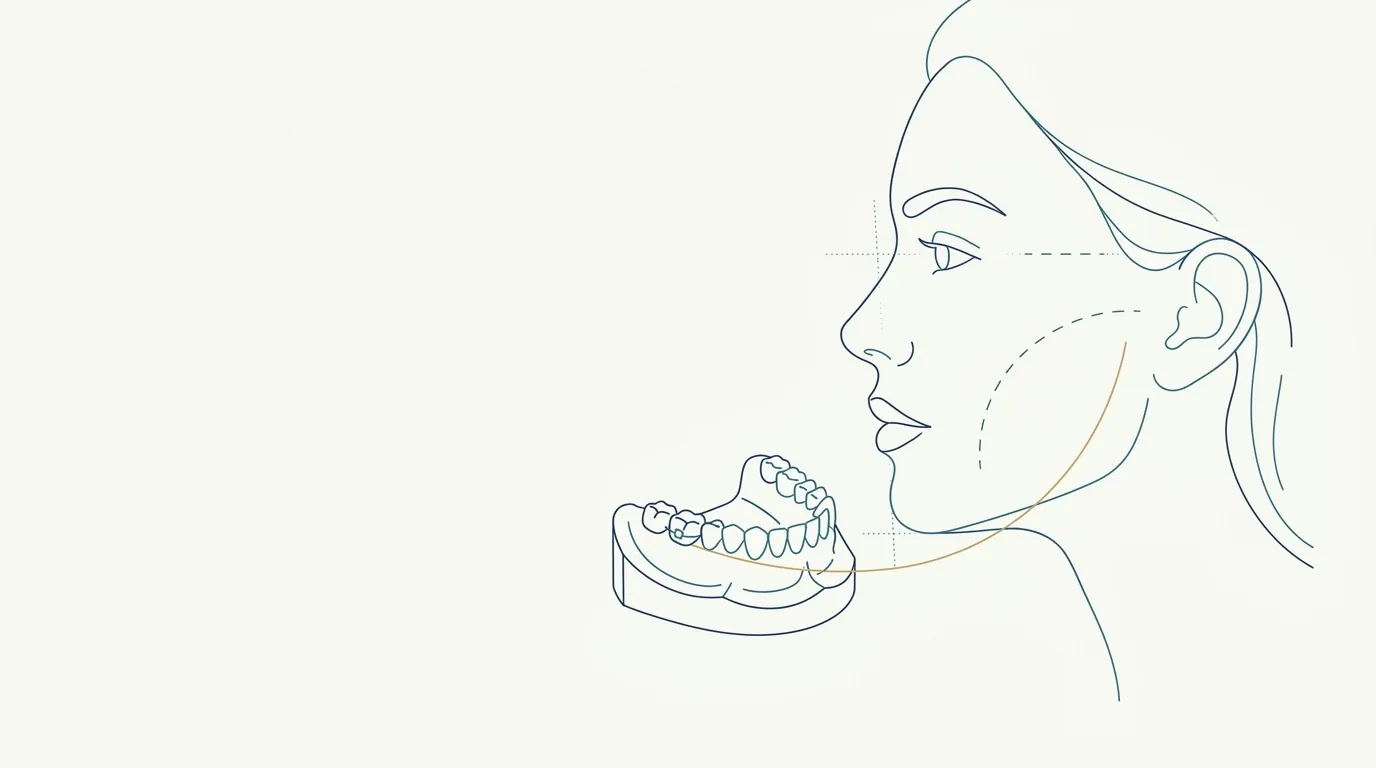
Quick facts
- Concern
- Sunken mouth, thin lips turned inward, chin closer to the nose and lines around the mouth
- Mechanism
- Loss of dental support and alveolar bone, with collapse of the lower third
- Suggested order
- Dental rehabilitation first, HOF afterward, when possible
- Pitfall
- Trying to compensate with filler for what a toothless mouth and lost vertical dimension cause
The face is not just skin, fat and muscle. The teeth and the alveolar bone that holds them are part of the structure that keeps the mouth in place. When they are lost, the harmony of the lower third changes in a way that no injectable product rebuilds on its own. The patient arrives with an aesthetic concern ("my mouth caved in", "I look older", "my chin is getting closer to my nose") and, in fact, the origin is dental.
This page is for the orofacial harmonization (HOF) professional who sees this patient: how to recognize the picture, what HOF can and cannot do, and how to work together with dentistry. For the lip support perspective, see dental prosthesis and lip support and teeth and facial harmonization: which comes first.
What happens to the face when teeth are lost?
The teeth support the lip from the inside. The alveolar bone, which surrounds the roots, is also maintained by the stimulus of chewing. When a tooth is lost and not replaced, the alveolar bone resorbs over time, and the maxilla and mandible lose height.
The visible effects on the lower third are usually:
- Sunken lip. Without the support of the teeth, the lip falls inward, looks thinner and loses its border.
- Lines around the mouth. The orbicularis muscle works without support and forms vertical lines, and the labiomental fold deepens.
- Loss of vertical dimension. The height between nose and chin decreases. The face looks "shortened" below.
- Chin closer to the nose. The mandible rotates up and forward, and the profile shows the nose and chin closer together.
- Downturned mouth corners. The loss of support contributes to drooping of the commissures.
These signs vary with the number of teeth lost, the time without rehabilitation and the type of prosthesis. In fully edentulous patients, the effects are greater. See also deep bite and recessed chin and open bite and appearance.
Vertical dimension and the lower third
Vertical dimension is the height of the lower third when the teeth are in contact. When it decreases, through wear, tooth loss or a poorly sized prosthesis, the face looks shorter and older. HOF does not change vertical dimension. At most, it can soften soft-tissue signs.
That is why oral rehabilitation has logical priority. Restoring the support, the occlusal plane and the vertical dimension can change the face more than any injectable product, and it also changes the base on which HOF will work. If the HOF professional acts first, there is a risk of planning on a base that is going to change.
| Situation | Effect on the face | General direction |
|---|---|---|
| Loss of a few posterior teeth | Little visible effect on the lip, more on function | Rehabilitate; HOF is rarely needed |
| Loss of anterior teeth | Unsupported lip, loss of border | Rehabilitate first; reassess the lip afterward |
| Total edentulism without prosthesis | Collapse of the lower third | Full rehabilitation; HOF as a complement |
| Poorly fitted or worn prosthesis | Reduced vertical dimension | Dental evaluation before any injectable |
| Tooth wear from bruxism | Shortened incisors, shorter face | Dental evaluation; see bruxism |
Where HOF comes in
Once the dental base is defined, HOF can contribute at soft-tissue points. At the discretion of the licensed professional, this may include lips (volume and contour), mouth corners (direction), chin (projection) and skin quality. Each decision should take into account that the support has changed and that the proportions need to be reassessed.
A few common-sense guidelines:
- Do not fill to "compensate" for missing teeth. Volume in an unsupported lip tends to look heavy and to move strangely.
- Reassess the lip after the prosthesis. The lip may look fuller with the new support and make the procedure unnecessary.
- Think about the chin and the profile. In some patients, projecting the chin balances the look of a shortened lower third. See short face and recessed chin and chin filler.
- Coordinate with the dentist. Exchanging information about the prosthesis plan avoids rework.
The conversation with the patient
A patient who has lost teeth often feels embarrassed and has a mistaken idea of what is "aesthetic" and what is "functional". They may think filler solves everything and postpone rehabilitation. Or they may think it is not worth treating the face before fixing the mouth. Both extremes are costly.
A clear conversation usually has three parts: acknowledge the discomfort, explain what the dental structure does for the face and agree on a working order with the dentist. Avoid criticizing the work of other professionals and focus on what will be done from here on.
Integrated planning: HOF and dentistry
The ideal plan is an integrated one, in which the dentist and the HOF professional share photos, measurements and goals. Dentistry defines the occlusal plane, the vertical dimension and the position of the teeth. HOF assesses the soft tissue, the lip support and the profile. Each side respects the scope of the other, according to the rules of their professional council.
For the smile aspect, see smile analysis in HOF, veneers and smile planning and HOF plan with lenses and veneers.
What Harmy helps show
The Harmy simulation shows a soft-tissue change from a frontal photo. It does not account for missing teeth, prostheses or vertical dimension. That makes it a support tool for the moment when the base is already defined, and it does not replace the dental plan.
When to postpone the HOF procedure
- Dental rehabilitation that is planned, ongoing or recent (wait for it to stabilize).
- Mucosal lesions, infection or inflammation in the mouth.
- A patient who expects the injectable to solve chewing function.
- Lack of definition about the prosthesis, which may change lip support.
In summary
Tooth loss remodels the lower third in a way that HOF cannot resolve alone. The safe path is to rehabilitate first, reassess the soft tissue and only then plan HOF, with vertical dimension and lip support as the reference. Results vary from person to person and depend on individual factors. The choice belongs to the licensed professional, according to the rules of their professional council.
Frequently asked questions
Does losing teeth change the face?
It can. The teeth and the bone that holds them support the lips and the lower third. With tooth loss, the lip may sink, the distance between nose and chin may shrink and the lines around the mouth may become more pronounced.
Does filler fix the face of someone who lost teeth?
It may soften part of the appearance, but it does not restore the function or the support of the teeth. Dental rehabilitation usually comes first and HOF complements it afterward, at the professionals' discretion.
Should I get filler before or after the prosthesis?
In general, afterward, or in a plan coordinated with the dentist. The prosthesis changes the support of the lip, and filling beforehand can lead to adjustments or to excess volume.
Does vertical dimension affect facial harmonization?
Yes. Vertical dimension is the height of the lower third with the teeth in occlusion. When it decreases, the face looks shorter below, with the chin closer to the nose. This influences the plan.
Harmy images are illustrative simulations generated by AI from the patient's photo to support the conversation between practitioner and patient. They are not a promise of results. Indication, technique, product and volume are solely the decision of the licensed practitioner. This content is for information only and does not replace a clinical assessment.