
Hollow Face After Buccal Fat Removal: Assessment and Plan

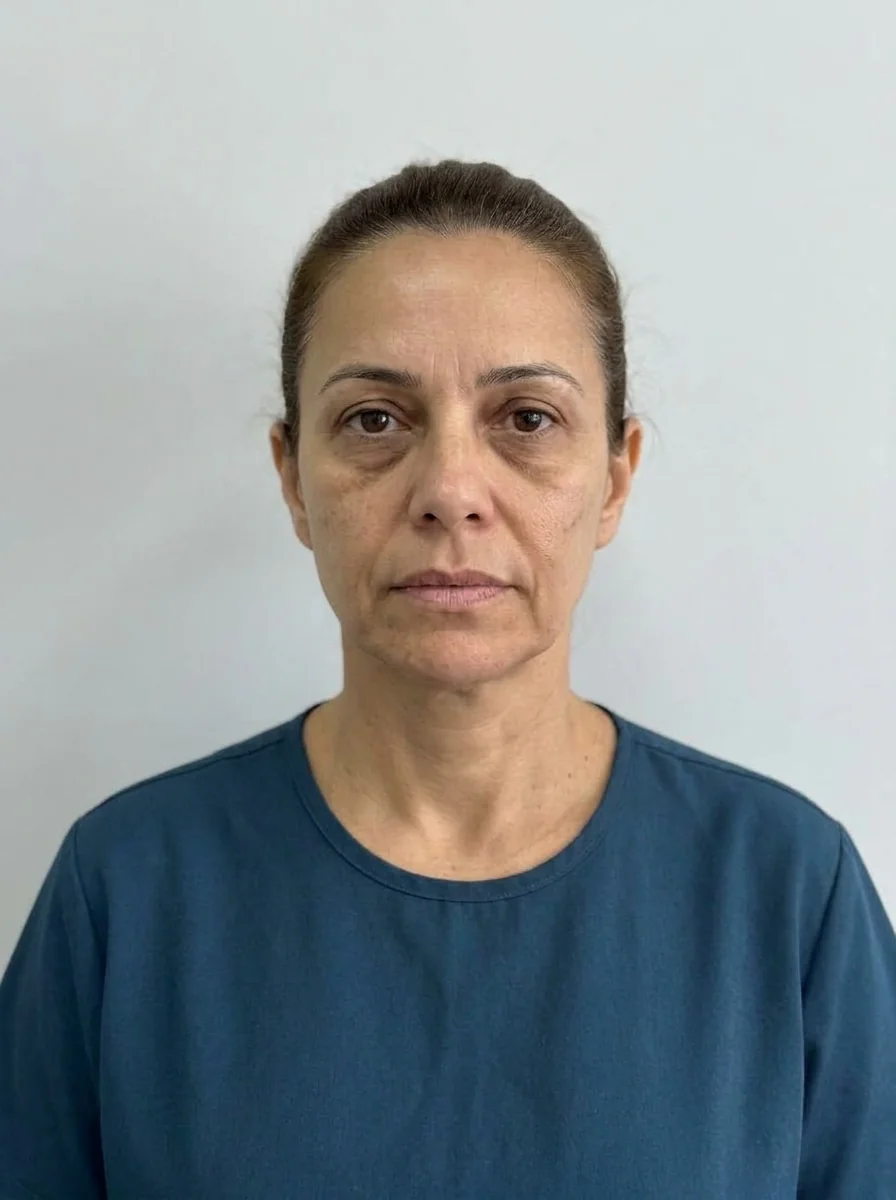 BeforeSimulation
- Highlighted area
Quick facts
- Concern
- Years after buccal fat removal the face looks hollow, thin and older
- Likely mechanism
- Less deep fat added to the natural aging of the midface
- What to assess
- Lateral volume loss, folds, tear troughs, contour and weight-loss history
- Approach
- Restore support in stages, without trying to bring back the original cheek
For years, buccal fat removal was a very popular procedure for slimming the face. Today, some patients come back to the clinic years later with a different concern: "my face looks hollow." The cheeks look empty, the cheekbone has lost its height, and the person looks more tired or older than their age.
This page is about assessing this picture honestly: what the fat removal actually changes, what is natural aging, what facial harmonization can restore and what it cannot bring back.
What buccal fat removal takes out
The buccal fat pad (bola de Bichat) is a pad of deep fat located in the cheek, between muscles and facial planes. The surgical procedure removes part of this fat through the oral mucosa, with the goal of reducing volume in the lower cheek. In young faces, often rounder ones, the immediate effect is usually pleasing.
The point of attention is that this fat quietly takes part in midface support. It sits alongside other compartments, such as the deep medial cheek fat, and contributes to the contour the skin needs to stay supported. Over time, the loss of other compartments adds to its absence. For context, see does buccal fat removal age the face and buccal fat removal in a thin face.
Why can the face look hollow years later?
There is no single mechanism. In general, the picture is the sum of factors that build up.
| Factor | What it does | What the patient sees |
|---|---|---|
| Less deep fat | Reduces the central support of the cheek | Empty cheek, thin-faced look |
| Midface aging | Loss of superficial volume and descent | Deeper nasolabial fold, marked tear trough |
| Bone resorption | Loss of skeletal support | Flatter face, less defined contour |
| Weight loss | Overall fat loss | Gaunt face, flattened apple of the cheek |
| Thinner skin | Less collagen | Folds and laxity |
When a face that was already narrow goes through buccal fat removal and later weight loss or aging, the result can be a face with little supporting structure. See the reasoning in midface aging and in gaunt face after weight loss.
How to assess
The assessment should separate absence of deep fat from superficial volume loss or laxity, because the approach differs in each case.
Ask the patient to smile and then relax. If, when smiling, the cheek forms a small "ball" high up and leaves a hollow below, the midface has lost continuity. If the hollow is also visible at rest, the loss of support is more global. This finding guides the starting point.
What facial harmonization can restore, and in what order
The general strategy is to restore support starting from the cheekbone and the midface, in stages, reassessing the whole. People with a hollow face are often tempted to "fill the cheek" at the spot where the fat was removed. This is a frequent mistake: filling the hollow exactly where the surgery acted rarely reproduces the natural contour and can produce an odd-looking face. See pillow face: how planning avoids it.
Cheekbone and midface. Cheekbone filler restores projection and height, and improves the interplay of light and shadow on the face. It is the foundation. See ideal cheekbone projection and midface fat compartments in the plan.
Collagen biostimulator. The collagen biostimulator can be considered for quality and gradual support, mainly in the lateral cheek. See biostimulator in the cheeks and biostimulator in the midface. It does not replace volume and carries its own risks, such as nodules.
Nasolabial fold. Nasolabial fold filler comes next, if needed, because the fold often improves with upper support. A high vascular risk area.
Tear trough and contour. When the tear trough or the contour is marked, they go into a second phase. See cheekbone and tear trough: combining in the plan.
Restoration timeline
Intervals vary, and the decision belongs to the qualified professional. The advantage of a staged plan is not losing the read of the face: each addition changes the other points.
Risks and limits
The midface and fold area has important vascular branches, such as the facial artery, and the serious complication, although uncommon, is vascular occlusion. Hyaluronidase must be at hand when hyaluronic acid is used. Other risks: swelling, bruising, asymmetry and irregularities. Excess volume in a thin face is easily perceived as artificial.
Honesty is also part of safety: a face with little fat and prominent bones has a limit to how much can be restored. In those cases, the gain is smoothing, not reconstruction. See deep facial fat loss and hollow cheeks.
How to show the plan in Harmy
Harmy generates a 2D projection from a front-facing photo. At the Cheekbone point, it shows the effect of the marked volume on the face, and at the Nasolabial Fold point the effect on the fold.
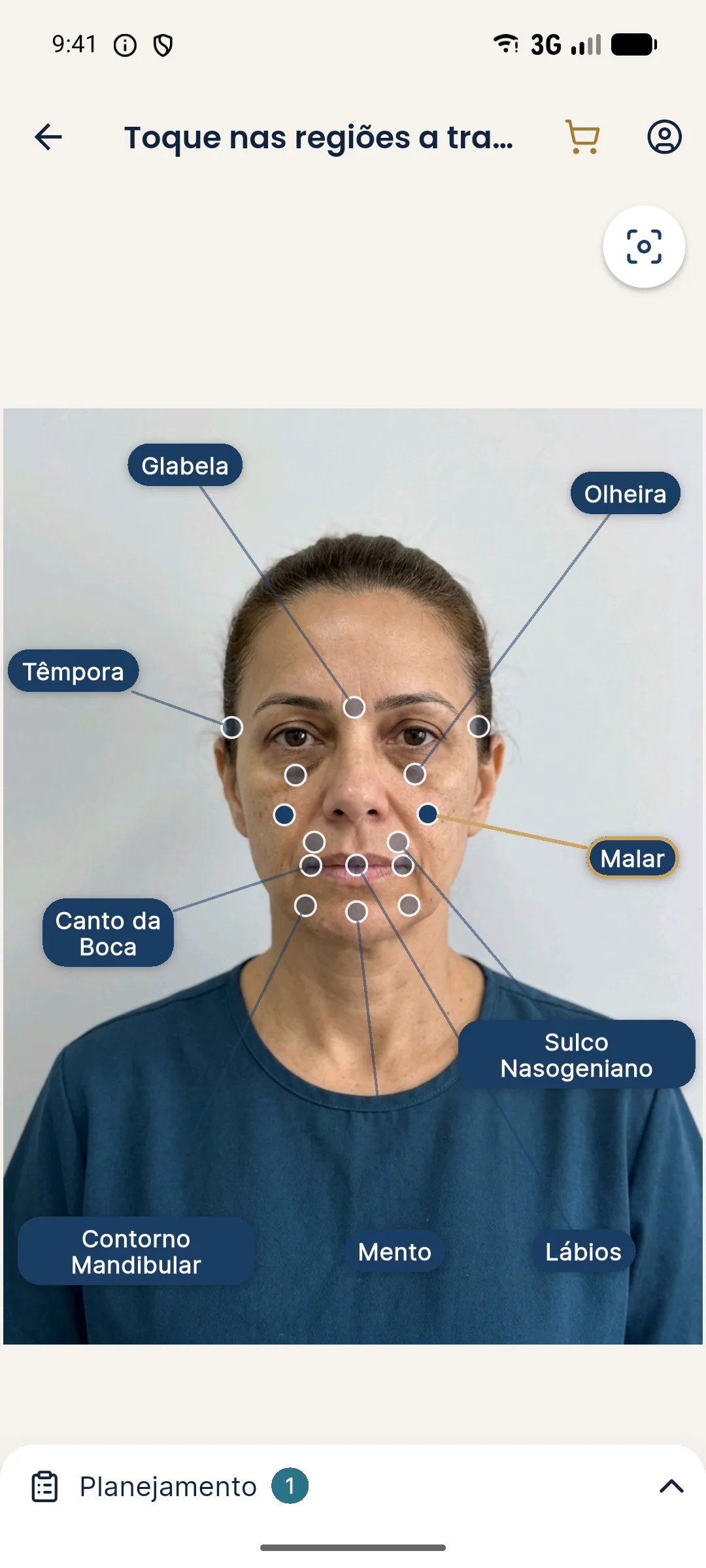
The projection helps show that the gain is modest and consistent with the patient's face, which is more honest than the mental image of "full cheeks" that some patients bring.
Record keeping
Record the previous surgery, the concern, the findings, the explanation of limits and the staged plan, along with the photos. The decision for a new intervention should be shared with the patient. Volumes and techniques are at the discretion of the qualified professional, after assessment and in line with the rules of their professional council in Brazil.
Frequently asked questions
Can buccal fat removal age the face?
In some patients, removing the buccal fat pad contributes to a thinner, more hollow look over the years, especially when there was little facial fat to begin with. It is not a rule and depends on the person.
Can buccal fat removal be reversed?
The fat that was removed does not come back. Facial harmonization can restore volume and support in the midface with hyaluronic acid or a biostimulator, at the professional's discretion.
What should be filled when the face looks hollow after buccal fat removal?
Planning usually looks at the cheekbone, the lateral cheek and the nasolabial fold, always in small steps and with reassessment.
Do people who had buccal fat removal have a higher risk of a tired-looking face?
Those who already have a slim face, prominent bones or associated weight loss tend to notice it more. The decision to have the procedure should take future facial aging into account.
Harmy images are illustrative simulations generated by AI from the patient's photo to support the conversation between practitioner and patient. They are not a promise of results. Indication, technique, product and volume are solely the decision of the licensed practitioner. This content is for information only and does not replace a clinical assessment.