
Long face: how harmonization balances the thirds

 BeforeSimulation
- Nerve
- Highlighted area
Quick facts
- Concern
- A long, narrow face, with a sense of length greater than width
- Key reading
- The strategy is to gain lateral width and reduce vertical emphasis, without adding more height
- Supporting measurement
- Proportion of the three thirds and face width by fifths
- Limit
- Bone height does not change, and vertical volume in the chin makes the length worse
Some patients feel their face is "too long." It shows up in photos as a narrow, vertical frame in which the forehead, nose and chin seem to stretch the face. The concern has a clear bony component: a long face is a growth trait, and facial harmonization does not change it. What it can do is shift perception, with caution.
Here is a guide to reading proportions, deciding what helps and what makes things worse, and explaining the limit. For the pattern associated with the chin, see long face and recessed chin. The opposite is in short face and recessed chin.
How do you read the proportion of a long face?
Start with the thirds. In a long face, it is common for one or more thirds to be proportionally large: a high forehead (upper third), a long nose (middle third) or a long chin (lower third). Identify which third weighs the most, because the plan changes in each case.
Next, assess the width. The rule of fifths divides the face into five widths equal to one eye. A narrow face has lateral widths (temples and zygomas) smaller than ideal, which reinforces the sense of length. See the reading in face width by fifths.
| Longest third | How it appears | What usually helps | What to avoid |
|---|---|---|---|
| Upper | High forehead, receding hairline | Hair, temple support | Forehead volume that lengthens |
| Middle | Long nose, tall midface | Lateral cheekbone projection | Adding height in the fold |
| Lower | Long chin and jaw | Soften height, project without lengthening | Vertical volume in the chin |
| Combined | Several thirds | Lateral width and frame | A package with no criteria |
What can harmonization do?
The logic is to gain width and lateral projection, and avoid adding height. The options discussed, at the discretion of the qualified professional, are:
- Lateral cheekbone projection, which visually widens the midface and breaks the vertical line. See cheekbone filler.
- Temples, to give lateral continuity to the forehead and zygoma. See temple filler.
- Chin with projection, not with height, when there is recession, taking care not to lengthen. See chin filler.
- Jaw, with caution, to give a frame but without accentuating the lateral vertical line.
- Hair and forehead line, which can be addressed with resources outside HOF.
For an organized look at the design, see planning a long face and lower third larger than the middle third.
At the temples and cheekbone there is a relevant vascular risk, and possible complications include swelling, bruising, asymmetry, nodules and, rarely, vascular occlusion. Hyaluronidase must be available when hyaluronic acid is used. See safety and complications.
What is the role of the bite and breathing?
A long face often comes from a vertical growth pattern. In some patients, this is associated with an open bite, mouth breathing in childhood and slightly parted lips at rest. HOF does not correct this, and the primary management belongs to dentistry, orthodontics and, if needed, speech therapy and otolaryngology.
Recognizing this picture avoids frustration. A patient who wants to "shorten" the face with volume may in fact have a functional issue. See open bite and appearance and orthodontics and profile change.
How do you talk to the patient?
Avoid suggesting there is a "right face." Describe the goal as balance, and use the word "perception." The patient should understand that HOF can soften the sense of length but cannot shorten the face.
The conversation about naturalness and limits is also in aligning expectations of naturalness and in facial identity: how to preserve it.
What does Harmy help show?
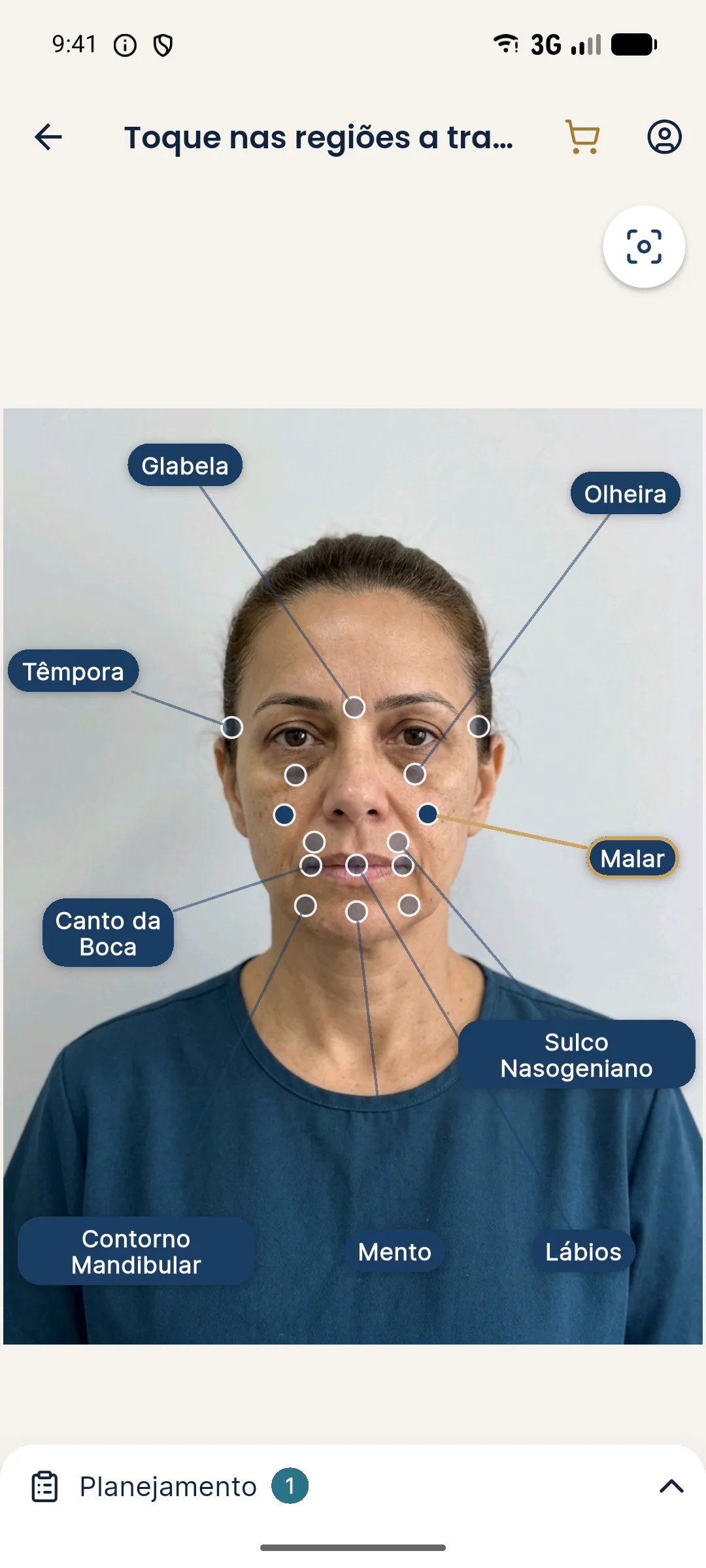
Harmy simulates the gain in lateral projection well at the Cheekbone and Temple, and the patient sees from the front how the face "opens up." It is a good way to show that the change is one of perception, not length. The app does not simulate the profile and does not change the height of the face.
What planning mistakes show up most often?
Three missteps repeat in long faces. The first is treating the chin in isolation, without looking at width, which lengthens the face even more. The second is adding volume to the cheeks only forward, leaving the face looking like a ball on a vertical structure. The third is ignoring the upper third: a high forehead can be part of the concern, and HOF is not always the answer, because hairstyle, bangs and haircut balance the upper third with no procedure at all.
It is also worth asking the patient how they see themselves from the side. Many long faces have a retruded profile, and the concern about length hides a wish for projection. Separating the two avoids a plan that increases height when the patient wanted more lateral and frontal volume. Record the conversation and the profile photos before proposing any volume, and reassess at each stage whether the proportion improved or the face became even more vertical.
When to refer?
Refer to an orthodontist, an oral and maxillofacial surgeon or another specialist when there is an open bite, mouth breathing, apnea or significant skeletal disproportion. HOF comes in as a complement. See patient referral in HOF.
Record keeping
Record the measurements, the longest third, the bite assessment, the planned range and what was explained about limits. Compare at follow-up in front, profile and three-quarter views. Standardized clinical photography and the history per patient help keep things organized.
Frequently asked questions
What defines a long face?
Facial height greater than width, with long vertical thirds or a long lower third. The pattern can be bony, and it often comes with an open bite and a recessed chin.
Does filler help a long face?
It can soften the sense of length by adding width and lateral projection, as at the cheekbone and temples. The design should avoid adding height, and the result is partial, at the discretion of the qualified professional.
Can I fill the chin on a long face?
With great care. Volume that lengthens the chin can reinforce the length of the face. Often forward projection, without height, is the choice, after assessing the profile.
Is a long face related to the bite?
It can be. Vertical growth patterns often coexist with an open bite and mouth breathing. In these cases, assessment by a dentist and other specialists is part of the plan.
Harmy images are illustrative simulations generated by AI from the patient's photo to support the conversation between practitioner and patient. They are not a promise of results. Indication, technique, product and volume are solely the decision of the licensed practitioner. This content is for information only and does not replace a clinical assessment.