
Overly full face: assessing cheek volume

- Highlighted area
Quick facts
- Concern
- "My face is round and too full" or "I have big cheeks"
- Key insight
- Full can be fat, muscle, bone, swelling or old filler, and each has its own path
- Supporting measure
- Frontal and oblique photos and palpation of the cheek at rest and when biting
- Limit
- Removing volume is not the same as losing weight, and the decision belongs to someone with surgical competence
When the patient says they have a "very full face," the conversation tends to head toward adding volume elsewhere to balance it, or removing what is in excess. The second option is more complex than it seems, because HOF works mostly by adding, and a full face first calls for a diagnosis of what exactly is full.
This page helps separate the causes, assess what can be done within the scope of facial harmonization and recognize when the approach involves other fields. For related topics, see cheeks that are too big, wide face and swollen face.
What is full, really?
"Full" is a visual impression with five possible explanations, which often overlap.
- Bulky buccal fat, the buccal fat pad, which occupies the region between the masseter and the buccinator and gives volume to the lower third of the cheek.
- Superficial fat, more tied to body weight and constitution.
- Enlarged masseter, which widens the angle of the jaw. See masseter muscle.
- Wide bone structure, in the zygoma or mandible, which does not respond to any soft tissue treatment.
- Swelling or old filler, which are reversible or correctable.
At the first consultation, do not assume the cause. Ask how long the face has looked this way, whether it changed with weight and whether there is bruxism. A face that has always been full suggests structure. A face that became full in the last few months suggests weight, retention or accumulated material.
How to tell them apart in the photo?
The photo does not decide on its own, but it gives clues. The shape of the contour, the point of greatest width and the relationship between the parts help raise hypotheses.
| Sign in the photo | Main hypothesis | Exam complement |
|---|---|---|
| Greatest width at the jaw angle | Masseter or bone | Palpation while clenching the teeth |
| Fullness below the cheekbone, between fold and jaw | Buccal fat | Internal palpation and profile assessment |
| Round face with a short neck | Overall fat and constitution | Weight, measurements, history |
| Blurred contour, puffy texture | Swelling or retention | Variation through the day |
| Symmetric, firm volume in the cheek | Previous filler | History and palpation |
Always compare with an old photo. The difference between the photo from ten years ago and the current one says a lot about what changed. Remember also that camera angle and lens widen the face: see distance and lens in the assessment photo.
Why can removing be better than adding?
In a full face, adding volume to the cheek amplifies the impression of width. Even a well-planned cheekbone filler can increase roundness. The right approach is usually different: define what outlines the face. That means working with structure at the jaw and chin, which give the volume a frame, or reducing the muscular component when there is one. See the logic in jaw and masseter combined in the plan and in square face: assessment.
There are, however, patients for whom buccal fat reduction is discussed. It is a surgery with a restricted indication, with risks such as asymmetry, injury to neighboring structures and, in the long term, loss of support in faces that naturally lose volume with age. The page buccal fat removal: when it is indicated gives the context, and buccal fat removal ages the face details the point of caution.
What does HOF offer for a full face?
The harmonization options are more indirect than the patient expects. Instead of "slimming," you redistribute how the face reads.
- Toxin in the masseter, when the muscle is enlarged, with reassessment in weeks and attention to chewing. See botulinum toxin in the masseter.
- Chin and jaw structure, to create a frame. See chin filler and jawline filler.
- Reducing previous filler, with hyaluronidase, when the excess is hyaluronic acid.
- Skin and habit care, which helps with texture and retention.
Each step has risks. Toxin in the masseter can cause smile asymmetry and changes in chewing with poorly calibrated doses, and jawline filler requires knowledge of the facial artery. Explain everything beforehand and record consent.
How to organize the plan?
When the component is muscular, the sequence is to treat the muscle and wait for the effect before adding anything. When it is structural, the plan focuses on definition. When there is excess material, the priority is revision. The decision map is simple, but it depends on the patient and the professional.
And the simulation?
In Harmy, the projection adds volume, it does not remove it. So for a full face, the most honest use of the app is to show the definition effect at the jaw or chin, and not to promise that the face will look slimmer. Explain this to the patient before showing the image.
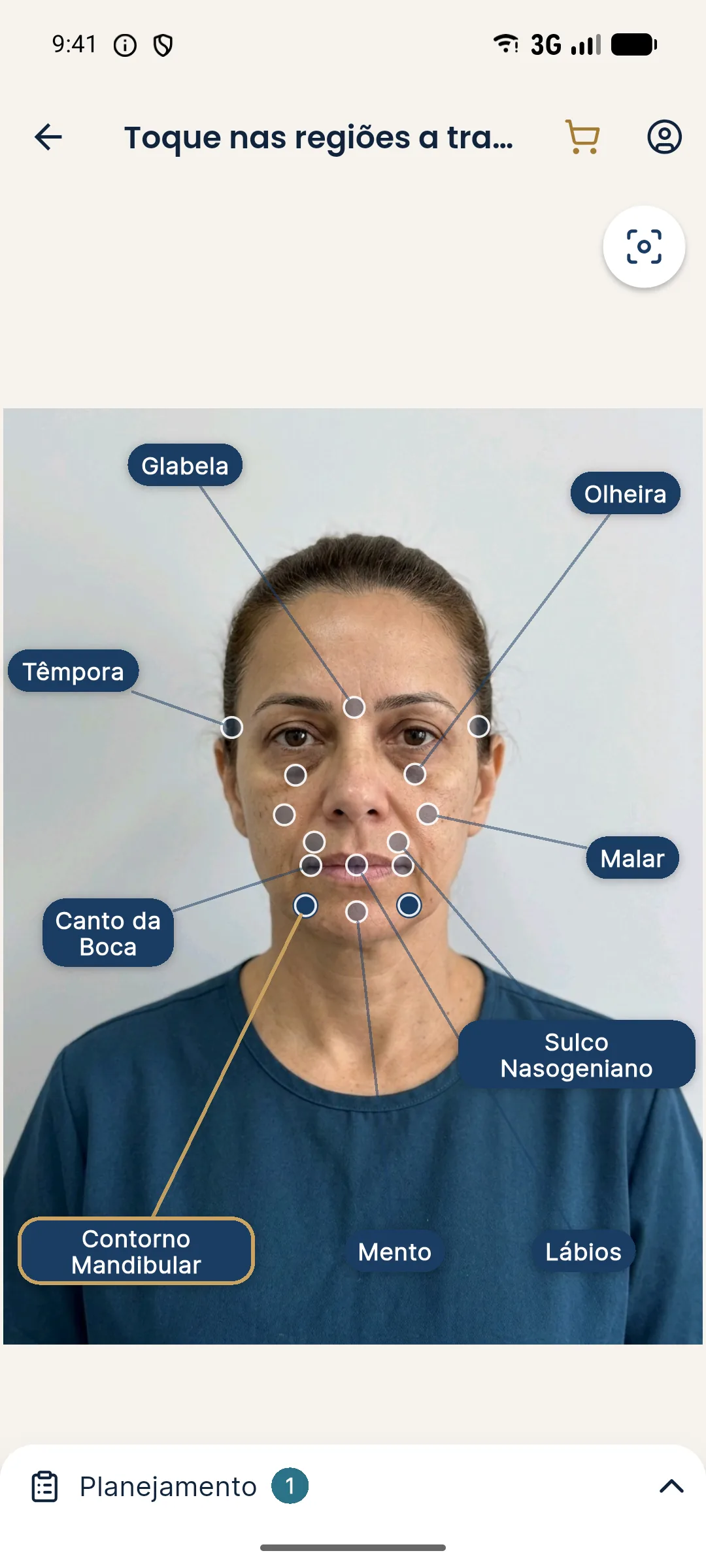
To learn more about jaw structure, read weak jaw. If the face is full with a small chin, the reasoning is in full cheek and weak chin.
Frequently asked questions
Why is my face full even though I am thin?
There may be bulky buccal fat, an enlarged masseter or a wide bone structure, regardless of body weight. The assessment separates these causes.
Does filler help a full face?
Generally not for reducing it. It can help create definition at the jaw or chin and shift the reading away from the full cheek, but it must be planned so as not to increase overall volume.
Does toxin in the masseter slim the face?
When the width comes from the muscle, toxin can reduce masseter volume over weeks, at the discretion of the qualified professional. It does not act on fat or bone.
Is buccal fat removal indicated for a full face?
It is a surgical procedure with a restricted indication, which removes part of the buccal fat. The decision belongs to a professional with surgical competence, and the patient must be informed of the risks and of how the face ages in the long term.
Harmy images are illustrative simulations generated by AI from the patient's photo to support the conversation between practitioner and patient. They are not a promise of results. Indication, technique, product and volume are solely the decision of the licensed practitioner. This content is for information only and does not replace a clinical assessment.