
Pillow face: what it is and how to avoid it

 BeforeSimulation
- Highlighted area
Quick facts
- Concern
- Full, rounded cheeks and a "puffy" face after fillers
- Key insight
- The effect comes from too much volume in the lateral and middle area, with no contour structure
- Supporting measure
- Frontal, oblique and profile photos, and assessment of projection versus width
- Limit
- Correcting requires reducing or repositioning how the volume reads, not adding more product
"Pillow face" has become a common expression in the clinic: a face whose cheeks look like pillows, wide and rounded, with a puffy appearance. The concern may come from the patient ("my face is too round") or from the professional who receives a case for review. In every case, the care is the same: understand how the volume ended up there before deciding what to do.
This page describes the pattern, lists the most frequent causes and proposes a path for correction and prevention. For cases with a history of multiple sessions, see face overdone by fillers, and for the general look of lacking naturalness, artificial-looking face.
How to recognize the pattern?
Pillow face has a visual signature. The cheek is wide instead of projected, the nasolabial fold looks deeper by contrast with the full cheek, the transition to the jaw is diffuse and the eyes look small amid the volume. When smiling, the cheek rises like a ball instead of gliding. In a profile photo, the most prominent volume sits lateral and low, not at the height of the cheekbone.
Two signs help tell it apart from a naturally round face. The first is history: the face changed after procedures. The second is where the volume sits: in a naturally round person, the fullness follows the bone, whereas in pillow face it accumulates above the fold and in the lateral region, where there was no structure.
Why does the effect happen?
Four causes appear most often, almost always combined.
- Too much volume in successive sessions, each one small, which added together exceed what was needed.
- A plan that ignores projection, with product placed in the lateral and low area, where it widens the face.
- Material poorly suited to the area, with less lift capacity or more hydrophilic, which expands over time. See g prime for the concept of firmness.
- Unrecognized tissue descent, where the patient had midface ptosis and received volume instead of support. The page midface ptosis describes this mechanism.
There is also the role of time: material that accumulates and changes shape as the patient ages, or that migrates through pressure and movement. The topic of residual material appears in real duration of hyaluronic acid in the face.
| Cause | How it presents | Direction of management |
|---|---|---|
| Accumulated excess | Wide face from every view | Reduce and replan |
| Lateral plane | Width without projection | Reduce lateral, project anteriorly |
| Inadequate material | Volume changes over time | Consider dissolving |
| Unrecognized descent | Weight over the fold | Base support, not more volume |
How to assess what to remove and what to keep?
The ideal assessment divides the face into parts: what gives projection, what gives width and what supports. The volume that gives projection at the high point of the bone is usually useful. What accumulates lateral and low is generally excess. What sits above the fold may be masking a descent. An oblique photo with side light is the best tool for this reading, and the page oblique facial analysis shows how to get it.
When there is doubt about what was injected, ask for the records. Without knowing the material, area and date, dissolving is a shot in the dark. Hyaluronidase acts on hyaluronic acid, not on other materials, and the patient needs to understand that the result of dissolving is gradual and that there may be temporary swelling. See the criteria in dissolving filler: criteria for indication and the reasoning in plan to correct previous excess.
What is the correction plan?
Correction is usually done in stages and has two simultaneous directions: reducing the excess and restoring the logic of projection. When the material is hyaluronic acid, partial dissolving is one tool, always at the discretion of the qualified professional and with hyaluronidase handled knowledgeably. After dissolving, the face needs time to stabilize before any restoration.
In patients with tissue descent, the later plan may involve targeted support rather than general volume. The logic of nasolabial fold and cheekbone combined and of complete midface in the plan helps in thinking about the whole.
How to avoid the effect in planning?
Prevention starts with the opening question of the consultation: what is the face missing, not "how much do you want to put in." Planning by proportion, with small volumes and reassessments, avoids silent accumulation. A simple criterion is to decide before the session the point at which the plan stops, and record it. Another practice is to always compare with the initial photo, not with the previous session's, to notice the sum of the changes.
The percentage distribution of volume between areas and structure before detail are good guides. For the patient who keeps asking for more and more volume, review how to say no to the patient in HOF.
How does Harmy help prevent it?
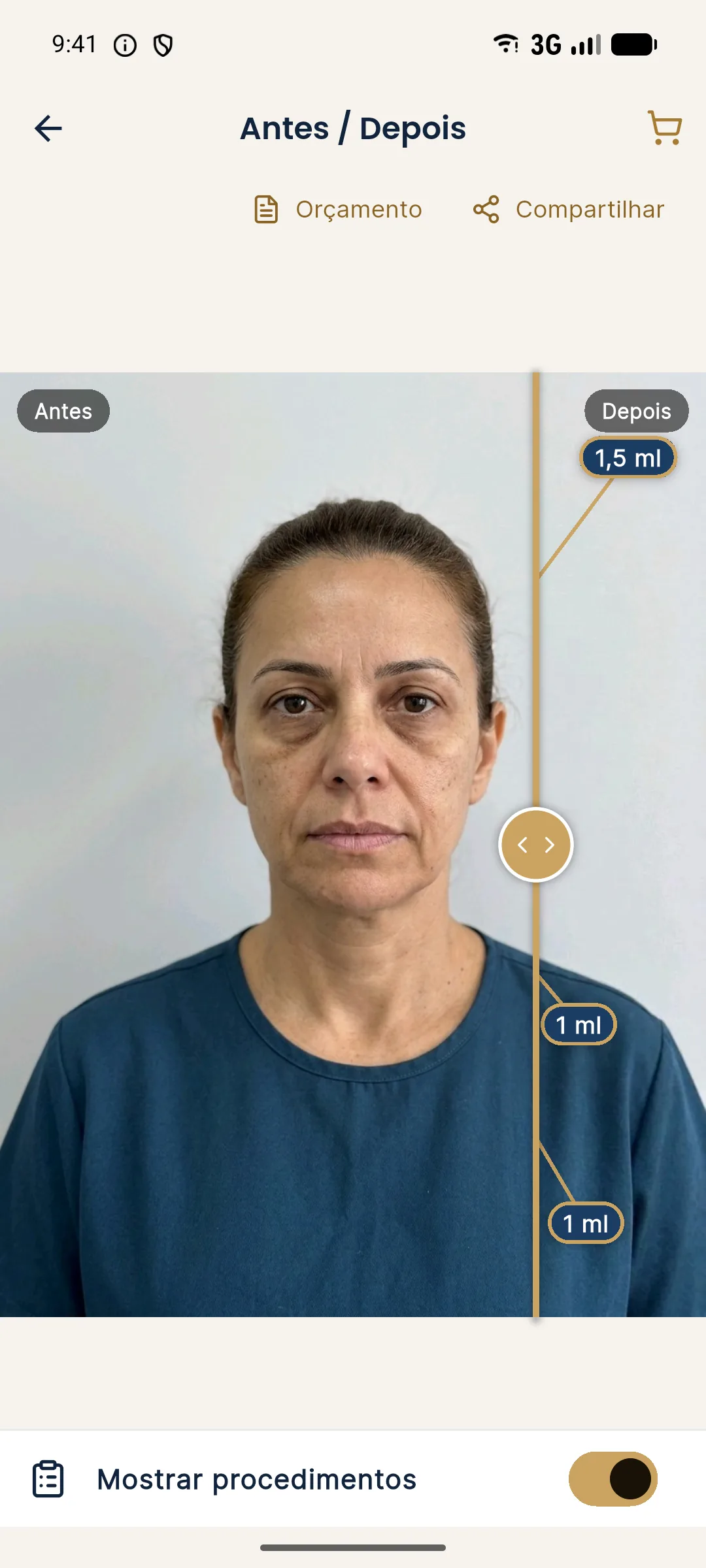
The app shows a discreet projection, which contrasts with excess. Marking Cheekbone with few ml and comparing the Subtle, Moderate and Pronounced intensities lets the patient see the difference between support and puffiness. For someone who already has pillow face, Harmy does not remove volume in the projection, so it only serves to plan a future restoration.
Frequently asked questions
What is pillow face?
It is the puffy look of a face with wide, rounded cheeks, resulting from excess volume in the cheekbone and midface. The term describes the appearance, not a diagnosis.
How does pillow face form?
Usually from volume accumulating over several sessions, use of a material poorly suited to the area, or a plan that ignored projection and width. In some cases, tissue descent adds to the effect.
Can it be reversed?
Hyaluronic acid can be dissolved with hyaluronidase, at the discretion of the qualified professional, after assessment. The new plan should consider what stays and what goes.
How to avoid it?
By planning by proportion, in conservative volumes with reassessment between sessions, prioritizing projection over width and avoiding filling where there is tissue descent.
Harmy images are illustrative simulations generated by AI from the patient's photo to support the conversation between practitioner and patient. They are not a promise of results. Indication, technique, product and volume are solely the decision of the licensed practitioner. This content is for information only and does not replace a clinical assessment.