
Weak jaw angle: how to assess it

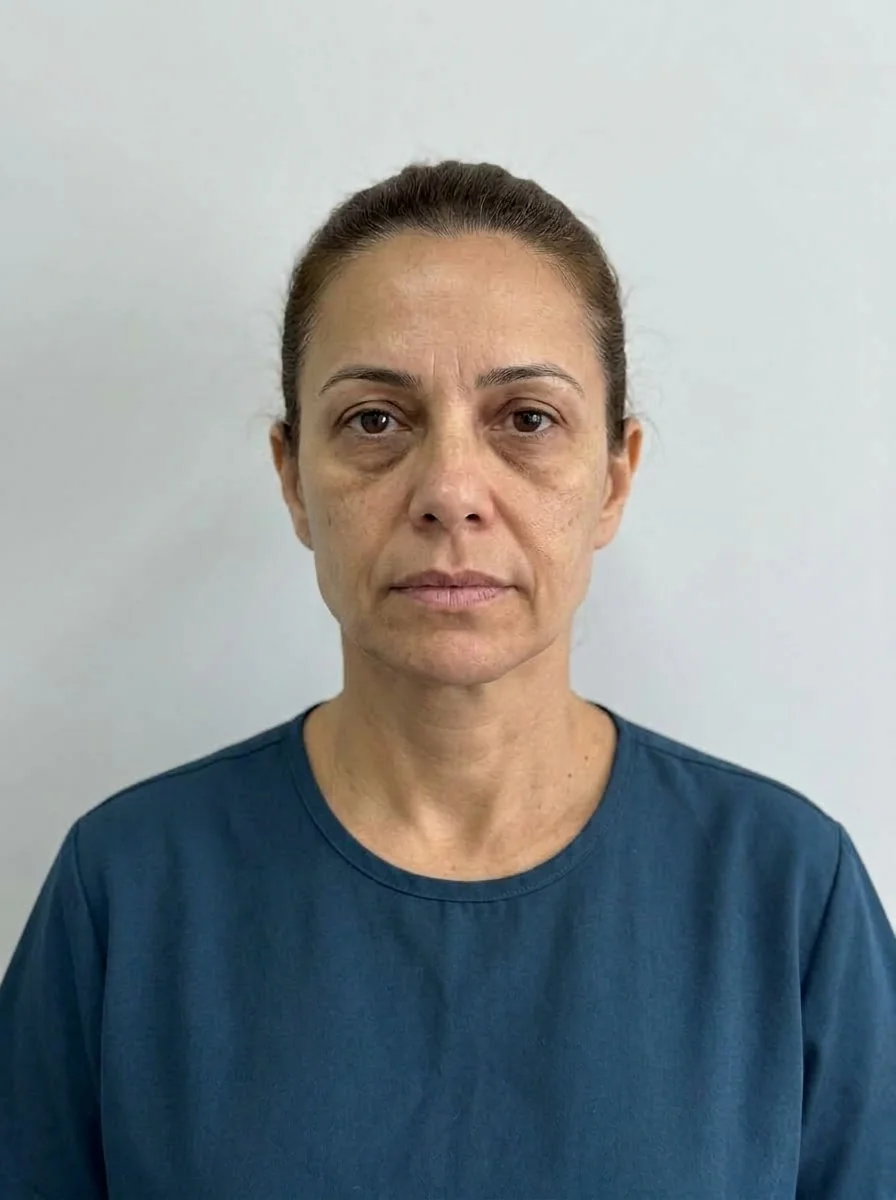 BeforeSimulation
- Nerve
- Highlighted area
Quick facts
- Concern
- Weakly defined jaw angle, straight or rounded contour
- First question
- What is hiding the angle: bone, muscle, fat or skin
- Key photo
- True profile and resting frontal view, with the head in the Frankfurt plane
- Risk of overdoing it
- A wide, heavy, masculinized face in women
When a patient says they "have no jaw" or that their face "has no angle," the first task is not choosing the product: it is finding out what is hiding the angle. A weak jaw angle can be a bony trait, a layer of fat on top, a low-volume masseter, loose skin, or the effect of a recessed chin that shortens the whole line. Each of these causes calls for a different conversation.
This page offers an assessment routine using photos and clinical examination, a way to measure the angle without being misled, and the limits of what orofacial harmonization can do in this area. The underlying anatomy is covered in jawline, and the broader patient conversation is in defined jawline.
What is the gonial angle and how do you measure it?
The gonial angle is where the ramus of the mandible (the vertical part, near the ear) meets the body (the horizontal part running to the chin). In office practice it is read in two ways: the angular measurement on the profile and the visual impression of a "corner" in the frontal and oblique views.
To measure with any confidence, the photo has to be standardized. The minimum routine:
- Patient seated, with the head in the Frankfurt plane (the line from the lower border of the orbit to the top of the tragus, parallel to the floor).
- True 90-degree profile, with no neck rotation and no chin raised or lowered.
- Hair tucked behind the ear and no collar, large earring or bulky beard covering the contour.
- Neutral expression, teeth in light contact, tongue on the palate.
- Camera at the patient's eye level, at a distance that reduces lens distortion.
Draw one line along the lower border of the body of the mandible and another along the posterior border of the ramus. The angle between them is the measurement. It is useful for following the same patient over time and for organizing your reasoning, not for comparing with a chart value. The photo technique is covered in standardized clinical photography.
Why does the angle look weak?
Before talking about volume, separate the causes. They often overlap, but one usually dominates.
| Cause | What you observe | Direction of management |
|---|---|---|
| Open bony angle | Smooth transition between ramus and body, even in a thin face | Structural filler, at the professional's discretion |
| Fat over the angle | Rounded contour that improves when you pinch the area | Assess the cause of the fat before adding volume |
| Jowls and fat descent | Bulge between the cheek and the chin | Midface support and assessment of laxity |
| Recessed chin (retrogenia) | Short line, visible double chin in profile | Chin projection may solve more than the angle does |
| Low-volume masseter | Flat posterior face | Bone or soft tissue volume should be discussed with care |
| Loose or thin skin | Contour without tension | Biostimulation or other approaches; limit of injectables |
A simple test in the office: ask the patient to clench their teeth and feel the masseter, then relax. If the angle "appears" when the muscle contracts, the bony structure has more to show than it does at rest. If nothing changes, lack of support is more likely.
How do you discuss definition without overdoing it?
The request usually comes from a reference: an actor, an influencer, a photo with light from above. The angle in that image depends on shadow, camera angle and editing. The professional needs to bring the conversation back to the patient's own face, to what their anatomy allows.
The classic risk is too much lateral volume. In women, excess pushes the angle outward and masculinizes the lower third; in men, it widens a face that was already wide. The difference between the sexes is covered in ideal jaw angle by sex and on the page about male orofacial harmonization.
What can HOF do and what can it not do?
Jawline filler using firmer hyaluronic acid is the most common resource for giving structure to the angle and body of the jaw. In some plans, chin projection (chin filler) makes the line look longer and more defined without touching the angle. A collagen biostimulator can play a role in skin that has lost quality, but it does not sculpt bone.
What harmonization does not do: it does not change the shape of the bone, it does not correct a major skeletal asymmetry, and it does not replace surgical evaluation when the concern is malocclusion or a deformity. When there is an obvious skeletal discrepancy, referral to the surgery or orthodontics team is part of good practice. See also weak jaw and small chin.
The general risks of dermal fillers apply: swelling, bruising, pain when chewing in the first days, nodules, asymmetry and irregularities. The area has relevant vessels and nerves, such as the facial artery as it crosses the border of the mandible and the marginal mandibular branch of the facial nerve. Hyaluronidase must be available whenever hyaluronic acid is used.
How does Harmy help with this conversation?
In Harmy, the Jawline point simulates the definition of the jaw line, and the Chin point simulates chin projection. The projection uses only the frontal photo, so it shows width and visual transition, not the angle measured on the profile. For bilateral areas, the ml entered is the total, split between the two sides, and the app changes only what was marked, with no skin retouching.
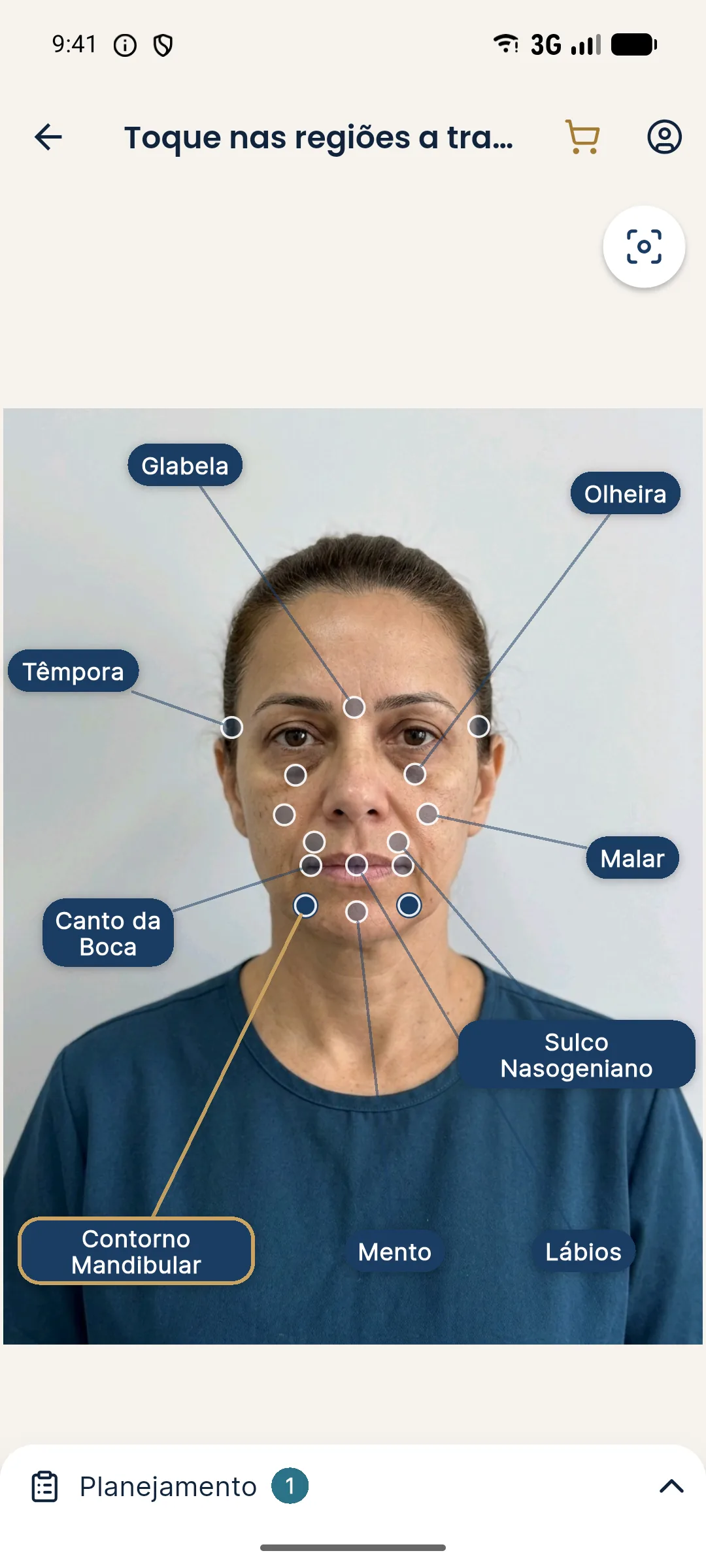
One practical use is to generate two versions of the same face: one with only the Jawline and another with only the Chin. Comparing the two illustrative simulations shows the patient how much of the "jaw" they want actually depends on the chin, which helps decide where to start.
How to organize the plan
A reasonable sequence is: standardized photo, examination with the patient at rest and in contraction, definition of the predominant cause, simulation, staged plan and reassessment. The lower third should be read together with the midface, because cheek descent affects the contour (cheek sagging over the jaw). Volumes and technique are left to the discretion of the licensed professional, in line with the rules of their professional council in Brazil, after an individual assessment.
Frequently asked questions
How do you measure the jaw angle in a photo?
On a true profile photo, with the head in the Frankfurt plane, draw one line along the lower border of the body of the mandible and another along the posterior border of the ramus. The angle between them is the gonial angle. On a frontal photo you can only assess width and visual transition.
Is a weak jaw angle always a lack of bone?
No. It can be a bone with an open angle, but also fat over the angle, loose skin, jowls, a double chin or an underprojected chin. The cause changes the approach, at the discretion of the licensed professional after assessment.
Can filler alone define the jaw angle?
In many cases filler helps draw the transition between the ramus and the body of the jaw, but it does not change the bone. When the problem is fat or laxity, filler alone has a limit.
Is there an ideal jaw angle?
There is no single number. Assessment references usually vary with sex, body type and the face as a whole. The ideal is whatever balances that patient's lower third, not a chart value.
Harmy images are illustrative simulations generated by AI from the patient's photo to support the conversation between practitioner and patient. They are not a promise of results. Indication, technique, product and volume are solely the decision of the licensed practitioner. This content is for information only and does not replace a clinical assessment.