
Reassessment at 3, 6 and 12 Months in Facial Harmonization
Quick facts
- Milestones
- Three reassessments over the first year: at 3, 6 and 12 months, or depending on the product and the plan
- At each milestone
- Standardized photos, current concern, comparison with the projection, decision to maintain, touch up or space out
- Logic
- Each product and area has its own pace; the milestones are for organization, not protocol deadlines
- Caution
- Do not add product out of calendar routine; add it on an assessed indication
A harmonization plan does not end at the last injection. The result evolves: swelling subsides, the product settles, the tissue responds, the patient gets used to it. Without planned follow-ups, the plan becomes a frozen photograph of a face that keeps changing. Reassessment at fixed milestones gives structure to follow that evolution and to decide, with data, what to do next.
Here is a reassessment roadmap in three milestones, 3, 6 and 12 months, with what to look at in each. These are organizational milestones, not protocol deadlines.
Why use milestones instead of ad hoc follow-ups?
An ad hoc follow-up depends on the patient remembering. Agreed milestones create a routine, allow photos to be compared at consistent intervals, and keep the clinic from reacting only when the patient complains. Milestones also help separate expected evolution from a problem.
There is no universal timeline, because products and areas have different paces. The numbers 3, 6 and 12 months are a practical structure, and the professional adjusts them to the plan. What to do at each follow-up, in general terms, is in what to reassess at the plan follow-up, and the schedule across the year is in annual maintenance plan in facial harmonization.
What to look at at 3 months?
The first milestone is usually the stabilization one. Swelling has long gone, the product has integrated into the tissue, and the result closest to final for the first stage is visible. It is the best time to compare with the projection and decide whether the next stage is needed.
With biostimulators, the effect is progressive and the 3-month assessment is partial. With toxin, the initial effect has already peaked and may be declining. Each product has its own logic, and the professional should take it into account.
What to look at at 6 months?
The second milestone is the first possible maintenance. Some products are starting to metabolize, and the patient notices the area has changed. This is the time to separate expected metabolization from unexpected loss of result.
It is also the time to reassess volume distribution. If volume was added in stages, check whether the whole is still coherent before any reinforcement. Watch out for excess that creeps in through small additions, described in when total volume becomes excess.
| Aspect | Question at 6 months |
|---|---|
| Duration | Is the result within what is expected for the product and area? |
| Distribution | Does the whole still look coherent after uneven metabolization? |
| Concern | Was the original concern addressed, or has it changed in nature? |
| Habits and health | Any change in weight, medication or routine that affects the plan? |
| Maintenance | Does it make sense to reinforce now, wait or space out? |
If the patient's condition has changed, a formal review is needed, as in when the plan needs to change. Handling maintenance by treatment type is in maintenance: toxin, filler and biostimulator.
What to look at at 12 months?
The third milestone is the plan review. A year is enough time for many products to have gone through their cycle, for the patient to have lived through different seasons and routines, and for the natural evolution of the face to show. It is the milestone to assess the whole plan and decide on the next year.
This is where decisions such as reducing volume or spacing out maintenance come in, covered in gradually reducing volume in the plan and 12-month facial harmonization plan. The long-term view continues in a three-year facial harmonization plan.
How do you standardize photos across the three milestones?
Comparison only works if the photos are comparable. Use the same light, distance, lens, expression and framing as the initial photo, and shoot under the same conditions (makeup, beard, hair). The details are in photo documentation by plan stage, lighting for the planning photo and alignment errors when comparing photos.
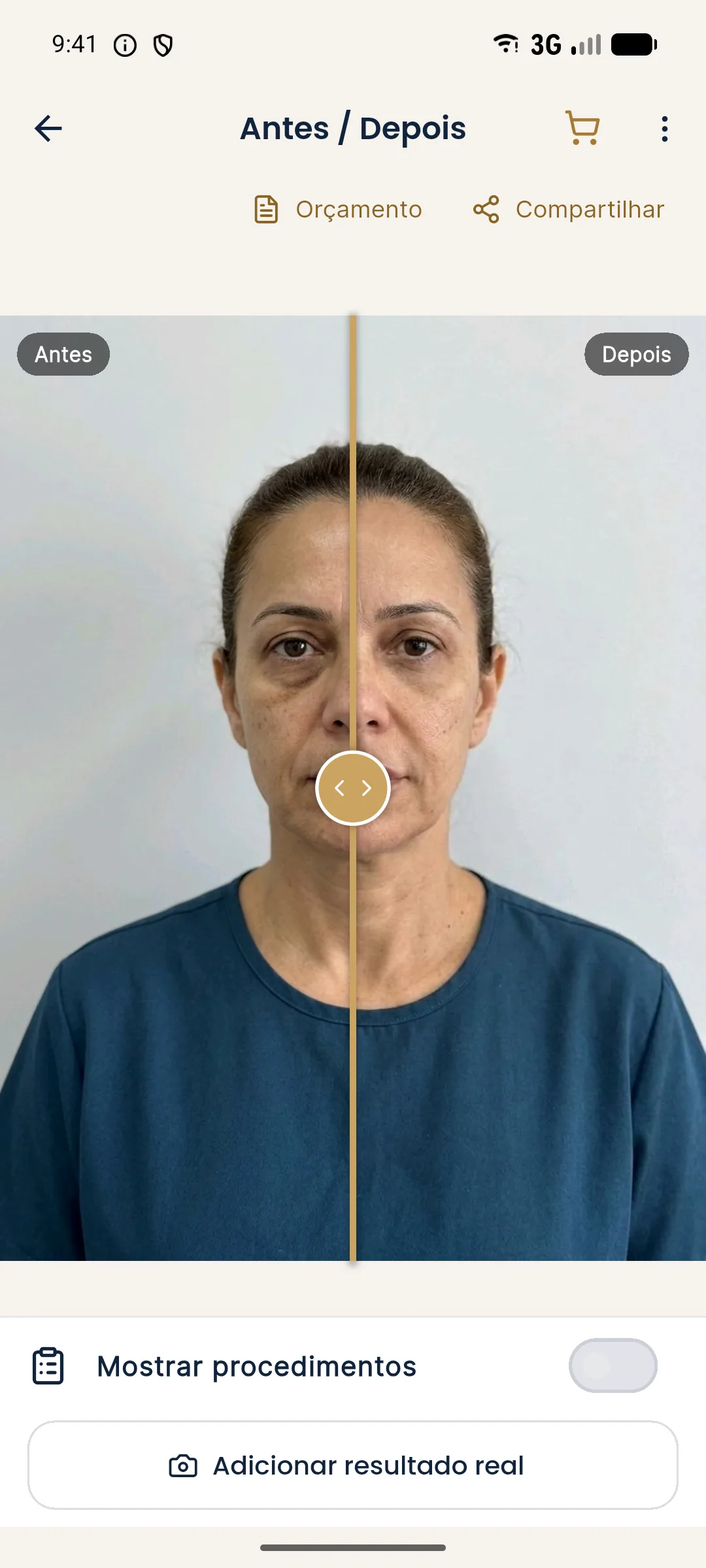
In Harmy, Actual result stores the after photo aligned by the eyes, with a guided capture that shows the "before" photo as a transparent overlay on the camera. The app compares Projection, Actual result and Projection vs Actual, which helps you look at each milestone with the original projection alongside.
How do you talk with the patient at each milestone?
Start with their perception, not yours. Ask "how are you seeing the result?" and listen. Then show the photos side by side and the evolution. The follow-up conversation is in follow-up consultation: what to say and the conversation about a result below expectations is in communicating a result below expectations.
How do you record and track adherence to the milestones?
At each milestone, record the date, photos, concern, decision and next milestone. Measuring how many patients attend each milestone gives you an indicator of the quality of your follow-up, as in plan execution rate. For the link with follow-up and retention, see follow-up and retention.
Frequently asked questions
Why reassess at 3, 6 and 12 months?
They are practical milestones for following how the result evolves, adjusting the plan and deciding on maintenance. Actual timing depends on the product, the area and the patient's response, and the professional decides.
Does every patient need all three milestones?
Not necessarily. Patients on a biostimulator or a staged plan tend to benefit more from the milestones; someone who had a simple touch-up may need fewer follow-ups.
What should be photographed at reassessment?
The same series as the initial photo, with the same light, distance, expression and framing, to compare with the starting point and with the projection.
Does reassessment always end in a new procedure?
No. Many reassessments end in 'maintain and observe.' Adding product out of calendar obligation is a planning mistake.
Harmy images are illustrative simulations generated by AI from the patient's photo to support the conversation between practitioner and patient. They are not a promise of results. Indication, technique, product and volume are solely the decision of the licensed practitioner. This content is for information only and does not replace a clinical assessment.