
Three-Year Facial Harmonization Plan: A Long-Term View

Quick facts
- Idea
- Plan over a three-year horizon to prioritize, spread cost, and avoid piling up
- Notice
- The face changes; a long-term plan is a revisable map, not a contract
- Structure
- Year 1 foundation, year 2 consolidation, year 3 maintenance and review
- Risk
- Selling the entire future now and losing the chance to adjust
Planning three years sounds big, but the idea is simple: give the patient and yourself a medium-term map. Instead of deciding session by session, you both see the trajectory: what is a priority now, what can wait, and what will be maintenance. The risk is turning the map into a contract, or the future into a promise.
Why think in three years?
Facial aging is gradual and the result of facial harmonization is not static. A longer horizon helps in three ways:
- Priority. Not everything has to be done right away; putting things in order avoids piling up.
- Budget. Spreading the cost over time is more realistic for many patients.
- Consistency. A single plan prevents each session from correcting the previous one.
This view complements the 12-month facial harmonization plan and the facial harmonization patient timeline. The discussion of how a result behaves over time is in how facial harmonization results age.
How do you structure the three years?
A simple structure, as a hypothetical example:
| Period | Focus | What usually goes in |
|---|---|---|
| Year 1 | Foundation and main concern | Structural areas, reassessments, small adjustments |
| Year 2 | Consolidation | Refinements, toxin maintenance, biostimulation assessment |
| Year 3 | Maintenance and review | Touch-ups, review, and a new plan for the coming years |
The table is illustrative; every patient has a different design. For the logic of maintaining without overdoing it, see maintenance: toxin, filler, and biostimulator and maintenance after five years of facial harmonization.
How do you picture the face three years from now?
This is where the most care is needed. Nobody can predict the future face, and an image "of the future" would be a promise in disguise. What you can do is talk about trends and about habits that influence the outcome:
- the tendency to lose volume in the midface and temples with age;
- the influence of sun, smoking, and sleep, covered in habits that change the plan;
- weight and hormonal changes;
- duration and reabsorption of the products applied.
How do you split the investment?
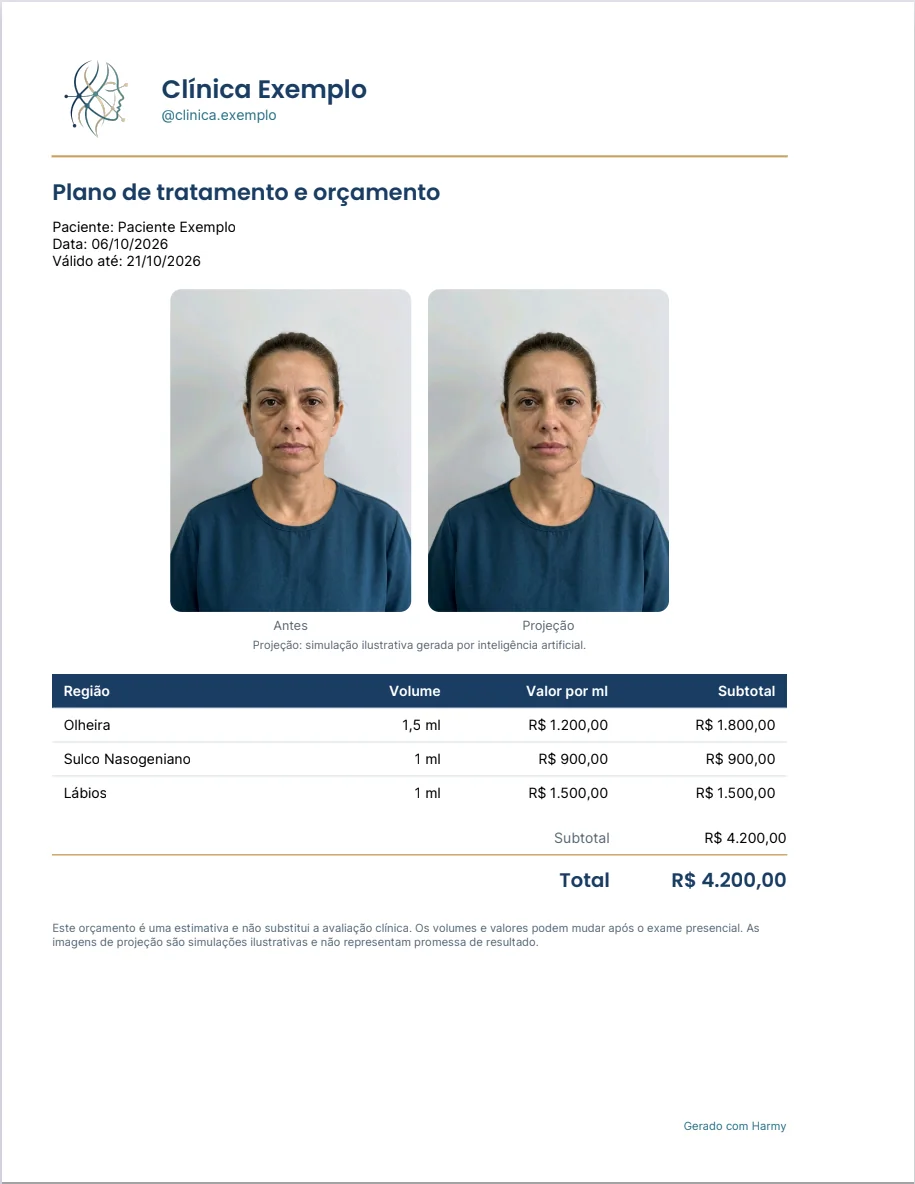
Investment is one of the most common reasons for a long plan. The responsible practice is to quote by stage, with a validity period, instead of charging everything up front. This preserves the patient's freedom to change their mind and yours to adjust the plan. See linking the plan and the quote in facial harmonization and pricing per ml.
How does the simulation fit into a long plan?
Use the simulation for each stage, not for the future. Generate a projection when the stage is coming up, and a new one at each follow-up, with a current photo. This builds a record of decisions and actual results, instead of a long-term promise. It is an illustrative simulation, not a promise of results.
When there is an actual result, add the aligned after photo and compare. This trains your eye and helps calibrate future conversations. See comparing projection and actual result and limits of 2D simulation.
Which ethical precautions matter?
Three in particular. First, do not push the patient into a long plan just to build loyalty. Second, keep the option to stop at any time, without awkwardness. Third, use the plan to reduce procedures, not to increase them: a good long-term map often shows what does not need to be done. See ethics of result simulation and follow-up and retention.
What signs show the map needs to be redone?
Three signs call for a revision: a major weight change, a life change (pregnancy, illness, shifting priorities), and a different response than expected to the procedures. When any of them appears, stop, redo the assessment, and redesign the plan, without clinging to the old map.
What if the patient wants to pay for everything at once to get a discount?
Be cautious. An early-payment discount creates a financial tie and pressures the indication. If you offer it, make clear that the patient can adjust the plan and that unused amounts have a destination defined in writing, according to your business rules and applicable law. When in doubt, charge by stage.
How do you use photos to tell the story of the plan?
Keep a folder per patient with standardized photos at each review. At the end of each year, put together a side-by-side comparison. It helps the patient see continuity, helps you assess what worked, and helps the clinic keep an honest record. Avoid using these images in marketing without specific authorization; see consent and LGPD (Brazil's data protection law) for photos.
Practical summary
Use the three-year horizon as a revisable map: foundation in the first year, consolidation in the second, maintenance and review in the third. Guide the patient stage by stage, never promise the future face, do not charge everything up front, and use the simulation only for the current stage.
Revise the map at the agreed points and whenever the patient changes weight, health, or priorities.
How to record a three-year plan
Keep, year by year, the standardized photos, what was done, what changed in the patient's life (weight, health, priorities), and the decisions to revise the map. Treat each record as a milestone of the plan, not as a promise about the future face. Put in writing that the simulation illustrates only the stage in progress, that results vary, and that the course of action rests with the qualified professional, after an in-person assessment and according to the rules of their professional council in Brazil.
Frequently asked questions
Does it make sense to plan facial harmonization over three years?
For some patients, yes: it helps prioritize and spread out the investment. It should be a revisable map, because the face, weight, and priorities change.
Do I need to charge for the three-year plan all at once?
That is generally not recommended. Quotes by stage, with a validity period, preserve the patient's freedom and yours to adjust the plan.
How can I predict the face three years from now?
It cannot be predicted precisely. You can discuss aging trends and habits, and make clear that the plan will be reassessed.
Can I show a simulation of the face in three years?
That is not appropriate. Harmy's simulation illustrates the effect of planned volumes on the current photo and does not predict aging or future results.
Harmy images are illustrative simulations generated by AI from the patient's photo to support the conversation between practitioner and patient. They are not a promise of results. Indication, technique, product and volume are solely the decision of the licensed practitioner. This content is for information only and does not replace a clinical assessment.