
Asymmetric face in selfies: camera distortion
Quick facts
- Concern
- In selfies the face looks crooked, with one side larger or the nose shifted
- Frequent cause
- A wide-angle lens, short distance and camera angle distort proportions
- Decisive step
- Re-photograph in a standardized way, from farther away and at eye level
- Approach
- Only treat asymmetry confirmed in a standardized photo and on physical exam
"My face is crooked in selfies." This sentence comes up in almost every practice that sees young patients. They arrive with a screenshot of three photos, and in each one the nose seems to veer to a different side, one eye looks bigger and the mouth looks higher on one side. The question is: is this asymmetry or is it the camera?
This page deals with a concern that comes from an image, not from the face. The professional's role is to take the image apart before building a plan. Often, the wisest course is to treat nothing.
What the selfie does to the face
Three factors add up to distort a selfie.
Wide-angle lens. Phone front cameras use lenses that capture a wide field. That kind of lens exaggerates perspective: whatever is closer to the camera looks bigger and wider than what is far away.
Short distance. With the phone an arm's length away, the nose and forehead are closer to the lens than the ears. The nose looks bigger and the face narrower at the sides. See distance and lens in the assessment photo.
Angle. A camera slightly above eye level makes the chin recede and the face look shorter. A camera below lengthens the face and highlights the nostrils. A face turned a few degrees alters the read of the midline.
The result is an image in which real proportions are not preserved. The "left" half of the face may look larger simply because it is a little closer to the lens, and the patient interprets it as asymmetry.
Mirror, selfie and the face others see
The mirror shows a flipped image, which the person has gotten used to. The default selfie in many apps also flips the image, but when shared, the result returns to its true orientation, and the face "changes". That swap feels strange. Every face has small differences between the sides, and seeing the less familiar side draws attention to them.
There is also the difference between static and dynamic. Others see the face in motion, talking, smiling. A selfie freezes a fraction of a second, which may catch a blink, a half-finished smile or a contraction. See mirror, selfie and photo: self-image difference and natural facial asymmetry.
Real asymmetry or camera asymmetry?
The decision requires a photo protocol and a physical exam.
| Data | If the asymmetry is from the camera | If the asymmetry is real |
|---|---|---|
| Standardized photo | Disappears or switches sides | Persists consistently |
| Several selfies | Changes from one photo to another | Repeats across photos |
| Physical exam | Symmetric measurements and palpation | Measurable difference |
| Old photos | Face similar to today's | Asymmetry present over time |
| When turning the face | The perceived side swaps | The difference stays |
If the asymmetry disappears in the standardized photo, the conversation should be about perception, and the professional must take care not to validate a concern the exam does not confirm. If the asymmetry persists, it becomes a clinical matter. See asymmetric face and natural facial asymmetry.
How to re-photograph for assessment
Standardized clinical photography is the tool for separating camera from face.
The full set of rules is in standardized clinical photography, planning photo lighting and reference lines on the frontal photo. On top of those photos, the midline, the interpupillary plane and the proportions can be checked reliably. See tilted interpupillary plane and deviated midline.
When the asymmetry is real
If the standardized photo confirms asymmetry, the workflow changes. You need to identify which structure is different: bone, muscle, fat, skin or tooth. Each calls for a different approach. Harmonization can help compensate for volume differences, but it does not correct significant bone asymmetries. See plan for an asymmetric face and simulation in a patient with asymmetry.
An essential caveat: some degree of asymmetry is normal and part of the face's identity. The goal is not perfect symmetry, and promising it is making a promise of results the face cannot support.
Timeline of a selfie consultation
Many patients leave the consultation relieved by the explanation, with no procedure. That is a good outcome and strengthens trust.
Risks of treating what does not exist
Treating an asymmetry that is not real exposes the patient to all the risks of the procedure with no benefit: swelling, bruising, nodules, iatrogenic asymmetry and, in some areas, serious vascular complications. Hyaluronidase must be available when using hyaluronic acid. There is also psychological risk: a patient with intense, disproportionate concern about their own image may need support and referral, not another procedure.
What Harmy shows and what it does not
Harmy works with one frontal photo per projection. If the patient sends a distorted selfie, the point marking and the projection start from a warped image. That is why the app should be used with a standardized photo, taken at eye level and from an adequate distance.
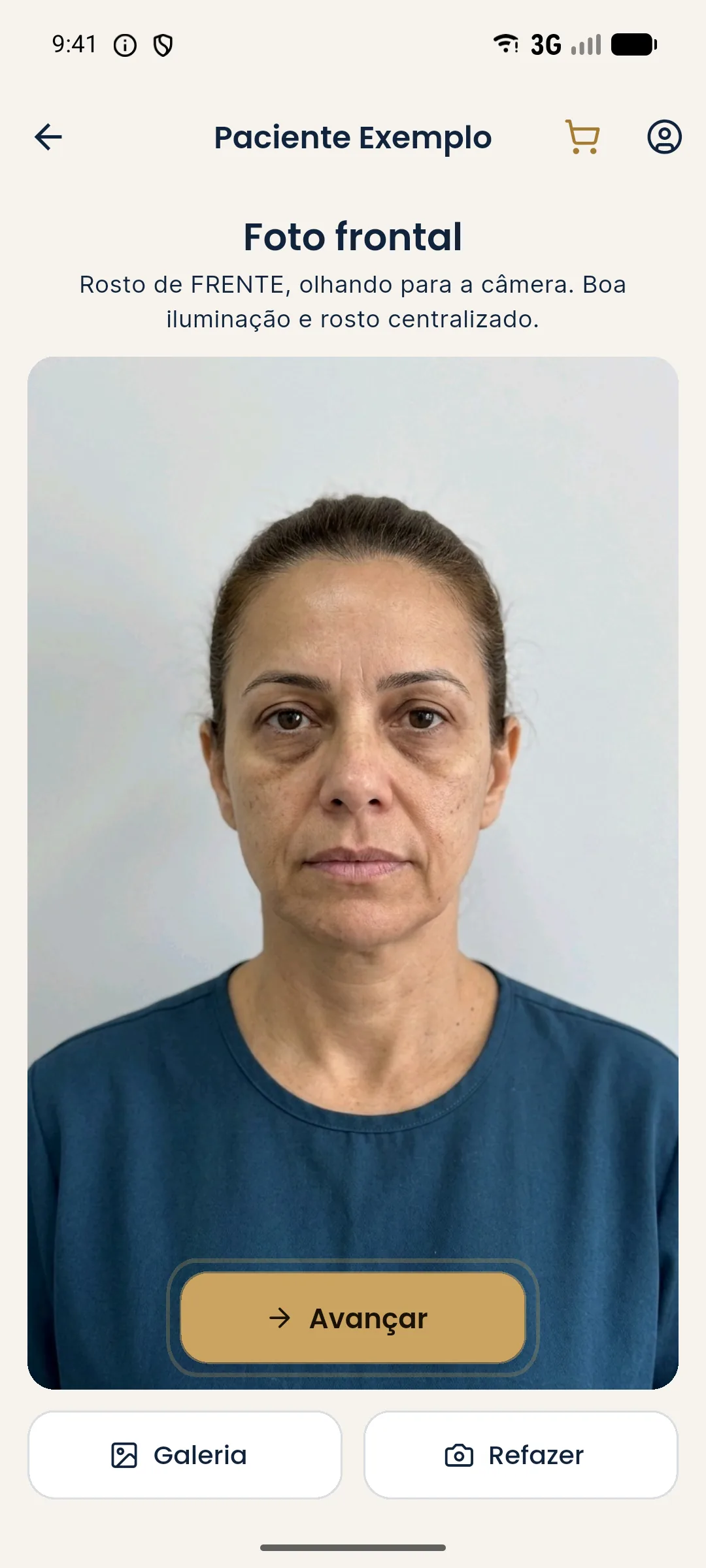
See the capture step by step in standardized frontal photo.
Record
Record the standardized photos, the comparison with the selfies, the exam and the decision made, including when the decision is not to treat. The patient's images follow the LGPD (Brazil's data protection law) and consent. See consent and LGPD in photos. Volumes and techniques are at the discretion of the qualified professional, after assessment and in line with the rules of their professional council in Brazil.
Frequently asked questions
Why does my face look more crooked in selfies?
The phone's front camera uses a wide-angle lens and sits close to the face, which enlarges whatever is nearest the lens and distorts proportions. The mirror shows another version, the one the person is used to seeing.
Does a selfie show how others see me?
Not exactly. People see your face from a greater distance, in motion and in three dimensions. A selfie is a distorted image, and flipped relative to the mirror.
Can I treat the asymmetry I see in a selfie?
Before any treatment, you need to confirm that the asymmetry exists in a standardized photo and on exam. Treating camera distortion can create a real asymmetry.
How do I avoid distortion in assessment photos?
Photograph from an adequate distance, with the camera at eye level, head straight and a neutral expression, preferably with another person's help or a fixed stand.
Harmy images are illustrative simulations generated by AI from the patient's photo to support the conversation between practitioner and patient. They are not a promise of results. Indication, technique, product and volume are solely the decision of the licensed practitioner. This content is for information only and does not replace a clinical assessment.