
Tilted bipupillary line: what it changes in the plan
- Nerve
- Highlighted area
Quick facts
- Situation
- The line joining the two pupils is not horizontal when the head is aligned
- Clinical use
- Reference for assessing symmetry of eyes, brows, cheekbone, mouth and chin
- Caution
- Confirm the tilt is not from the photo or posture before treating
- Pitfall
- Correcting an "asymmetry" that is really just head tilt in the photo
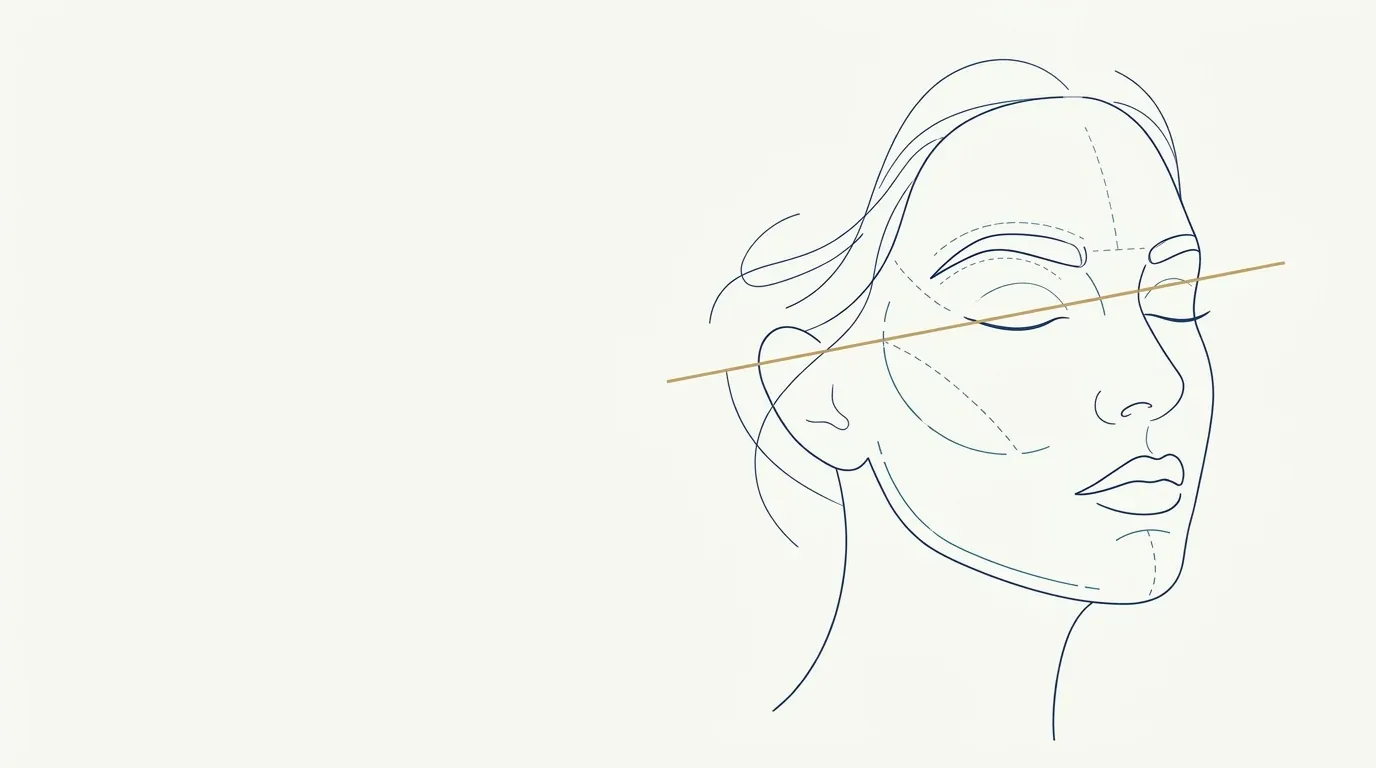
The line joining the two pupils, the bipupillary line, is one of the most widely used references for assessing facial symmetry. On an aligned face with the head in a natural position, it is horizontal. The other lines of the face, such as the brow line, the line of the mouth corners and, to a degree, the line of the chin, tend to follow it. When the bipupillary line is tilted, the rest of the face looks "crooked", and the professional has an important clue for the plan.
The clue has a catch, though: not every tilt belongs to the patient. This page shows how to use the line as a reference and how to avoid the most common reading errors. It connects with eyes at different heights, asymmetric eyes, asymmetric face and how to measure facial symmetry.
What is the bipupillary line and what is it for?
The bipupillary line passes through the center of both pupils and is, by convention, the horizontal reference of the face. It is perpendicular to the facial midline. From it, the professional compares:
- the height of the brows and of the outer corners of the eyes;
- the position of the cheekbone and the apple of the cheek;
- the line of the mouth corners (intercommissural line);
- the tilt of the occlusal plane and of the base of the chin.
The use is comparative. On natural faces, the lines are not perfectly parallel, and the small divergence is part of the person's look. What matters is whether the difference is evident, whether it bothers the patient and whether it is structural or apparent. See reference lines on the front photo and natural facial asymmetry.
Why might the line be tilted?
There are causes of different natures, and the approach changes with each.
| Cause | How to recognize it | General direction |
|---|---|---|
| Head tilt in the photo | Changes when the photo is retaken with the head aligned | Standardize the photo; no treatment |
| Mild difference in eye socket height | Persists in the standardized photo; small difference | Explain natural asymmetry; generally do not treat |
| Skeletal asymmetry | Evident difference associated with other deviations | Assess with other specialties |
| Soft tissue difference | Cheek, brow or eyelid at different heights | Assess targeted approaches, with caution |
| Effect of a previous procedure | Asymmetric toxin or filler | Review history and approach |
| Shoulder and neck posture | Changes when the shoulders are leveled | Postural guidance |
The most frequent cause is the first one. That is why the golden rule is to photograph again, with standardized positioning, before drawing any conclusion. See photo with a tilted face and symmetry and framing the front photo.
What this changes in the plan
When the tilt is real and stable, the plan should take it into account. The main consequence is conceptual: the patient's face is not symmetrical, and the goal is not to even out the sides but to balance the whole. Trying to correct a structural asymmetry with volume tends to create a face that is "crooked in a different way". See plan for an asymmetric face and aligning expectations about asymmetry.
Some decisions the tilt influences:
- Marking bilateral areas. The ml per area is a total split between both sides. On a tilted face, there may be a clinical reason to treat one side with more volume, and that requires individual assessment.
- Symmetry reference. Use the midline and the bipupillary line together, without treating either as an absolute rule.
- Brows and mouth corners. If the tilt shows up in them, the conversation covers what can be harmonized and what is structural.
- Before and after comparison. Make sure head position is the same in the photos, so a change in position is not mistaken for a change in the face.
Bipupillary line, brow and cheekbone
The relationship of the bipupillary line with the brow and the cheekbone is the most used in planning. Brows at different heights may reflect the position of the eye sockets, expression habits or asymmetric toxin use. Cheeks at different heights may reflect the skeleton, fat or a previous procedure.
Before treating, tell them apart. An asymmetry the patient never noticed and that only shows up in the analysis may not be their concern. An asymmetry that appeared after a procedure deserves review. See asymmetric brows, asymmetric cheeks, asymmetry after toxin and ideal brow position in planning.
How to measure without being misled
Visual measurement is enough for clinical practice, as long as the photo is standardized. Some digital tools draw the lines automatically, but they depend on image quality and positioning. They are support, not a substitute for the clinical eye. See AI facial analysis: what it measures and reference lines on the front photo.
Talking with the patient
A patient who discovers that their face is asymmetric may panic, so be careful with the language. Instead of "your left eye is lower", prefer "both sides of the face have small differences, like everyone". Showing photos with the line drawn can help, but it can also frighten. Do it calmly and offer perspective: almost every face has this pattern. See how to point out asymmetry without offending and explaining natural asymmetry to the patient.
What Harmy helps show
The Harmy simulation starts from the front photo that was sent, and the quality of the photo alignment affects the reading. The app does not correct head tilt or show the bipupillary line. It can help start a conversation about targeted changes, but it does not replace a symmetry analysis.
In short
The bipupillary line is a good symmetry reference, as long as the photo is standardized. Confirming whether the tilt is real, separating what is structural from what is apparent and aligning expectations avoid treating what does not need it and promising what cannot be delivered. Results vary from person to person and depend on individual factors. The choice belongs to the licensed professional, according to the rules of their professional board in Brazil.
Frequently asked questions
What is the bipupillary line?
It is the imaginary line joining the centers of the two pupils. On an aligned face it is horizontal when the head is in a natural position, and it serves as a reference for assessing the symmetry of other structures.
Is a tilted bipupillary line a problem?
Not always. It can reflect a small difference in eye height, which is common, or simply head tilt in the photo. The assessment should confirm the cause before any decision.
Does HOF correct eyes at different heights?
In general it does not correct the position of the eye sockets. It can adjust the perception of symmetry in neighboring areas, subtly and at the professional's discretion. Marked structural differences deserve other assessments.
How do I avoid misreading the bipupillary line in a photo?
By standardizing head position, distance and camera alignment. A slightly tilted head or a crooked camera already alters the bipupillary line and misleads the assessment.
Harmy images are illustrative simulations generated by AI from the patient's photo to support the conversation between practitioner and patient. They are not a promise of results. Indication, technique, product and volume are solely the decision of the licensed practitioner. This content is for information only and does not replace a clinical assessment.