
Heavy Face: Excess Volume or Lack of Support

 BeforeSimulation
- Nerve
- Highlighted area
Quick facts
- Concern
- The face feels heavy and pulled downward, even though it is not large
- Two origins
- Excess volume in the lower areas, or lack of support that lets tissue descend
- Decisive test
- Lift the tissue with your fingers and see whether the face improves or just shifts
- Caution
- Treating an already full face with volume makes the complaint worse
"My face feels heavy." The phrase is common and misleading, because it covers two opposite pictures. In one, there is too much volume, and the face looks full, rounded, with little shadow. In the other, support is lacking, and the volume that was there has descended, gathering in the fold, the jowl and the contour. Both patients use the same word, but only one of them benefits from restoring structure.
This page teaches how to tell them apart in the clinic and how to avoid the costliest mistake: treating a heavy face with more product.
What does "heavy" mean in the patient's words?
Before the exam, it is worth asking the patient to describe what they feel. "Heavy" usually hides one of these readings:
- It feels like the face has slid downward, mainly along the jawline.
- The face looks wide and full across the whole lower half.
- The feeling is of permanent tiredness in the expression, with no obvious wrinkle.
- The smile "pulls" the cheek down instead of lifting it.
The first and fourth readings suggest descent. The second suggests excess. The third can be either one, or the sum of both with a low brow. So the description has to be checked against the exam.
Full face or unsupported face: how to tell them apart
The most useful difference is not the amount of fat, but where it is and how the tissue behaves when lifted.
| Sign | Full face | Unsupported face |
|---|---|---|
| Distribution | Even, rounded | Gathers below, sparse above |
| Cheekbone | Full, little shadow | Flat or flattened |
| Contour | No line defined by volume | Interrupted by jowls |
| Folds | Shallow | Deep, with an evident nasolabial compartment |
| Lift test | Changes little | Clearly improves |
| History | Stable weight or gain | Volume loss and age |
In younger faces the cause tends to be excess; in more mature faces it tends to be descent. But there are exceptions on both sides, which makes the physical exam indispensable.
The anatomical basis of descent
The face stays in place thanks to a network of supporting structures: bones, layers of fat and retaining ligaments. Over time, those ligaments lengthen, the fat compartments lose their support and the volume shifts to the lower face. That is why a 50-year-old can have less total fat than at 30 and still feel the face is heavier.
This shift forms folds, deepens the nasolabial fold, creates the jowl and gives the contour an interrupted look. Understanding this logic is the basis for proposing support instead of local volume. See also retaining ligaments and laxity and facial aging by layers.
When the problem is excess
If the face is full, planning changes completely. Adding volume to an already full face tends to increase the feeling of heaviness. Some approaches to consider, always at the discretion of the qualified professional:
- Assess whether there is chronic swelling from old product or clinical causes, with a referral when needed. See swollen face.
- Check for accumulated old filler that could be reduced with hyaluronidase. See heavy face from old filler.
- Consider the role of the masseter when the lower width comes from muscle. See masseter larger on one side and square face from bruxism.
- Refer when the cause is weight-related or clinical, such as fluid retention, hormonal changes or medication.
The work here is subtraction and definition, not addition. The conversation includes making it clear to the patient that harmonization does not replace health care.
When the problem is lack of support
If the lift test improves the face and the distribution is displaced, the approach is to restore support, with reassessment at each stage.
Midface first. Cheekbone filler restores projection and support to the tissue that is descending. It is the most logical starting point, because it acts where support was lost. See sagging cheeks and midface ptosis.
Contour next. Jawline filler can redefine the lower line, but only after the midface is supported. Otherwise, the product goes into a face that keeps descending. See cheekbone and jawline: combining in the plan.
Quality and gradual support. The collagen biostimulator and thread lifts can be considered in selected cases, with their own indications, risks and limits. See biostimulator or PDO threads.
Decision timeline
Mixed cases are frequent, and the order changes case by case. The criterion is always the same: the next stage only goes in after looking at the result of the previous one.
Risks
The midface and contour area has relevant vascular and nerve structures. Risks include swelling, bruising, asymmetry, nodules, irregularities and serious vascular complications, although uncommon. Hyaluronidase must be available when hyaluronic acid is used. In a full face, excess volume can make the complaint worse. For the overview, see safety and complications: overview.
Showing the patient the difference with Harmy
Many patients do not distinguish "more volume" from "more support." Harmy helps test the hypothesis: mark the Cheekbone and the Jawline at Subtle intensity and compare the before and after photo.
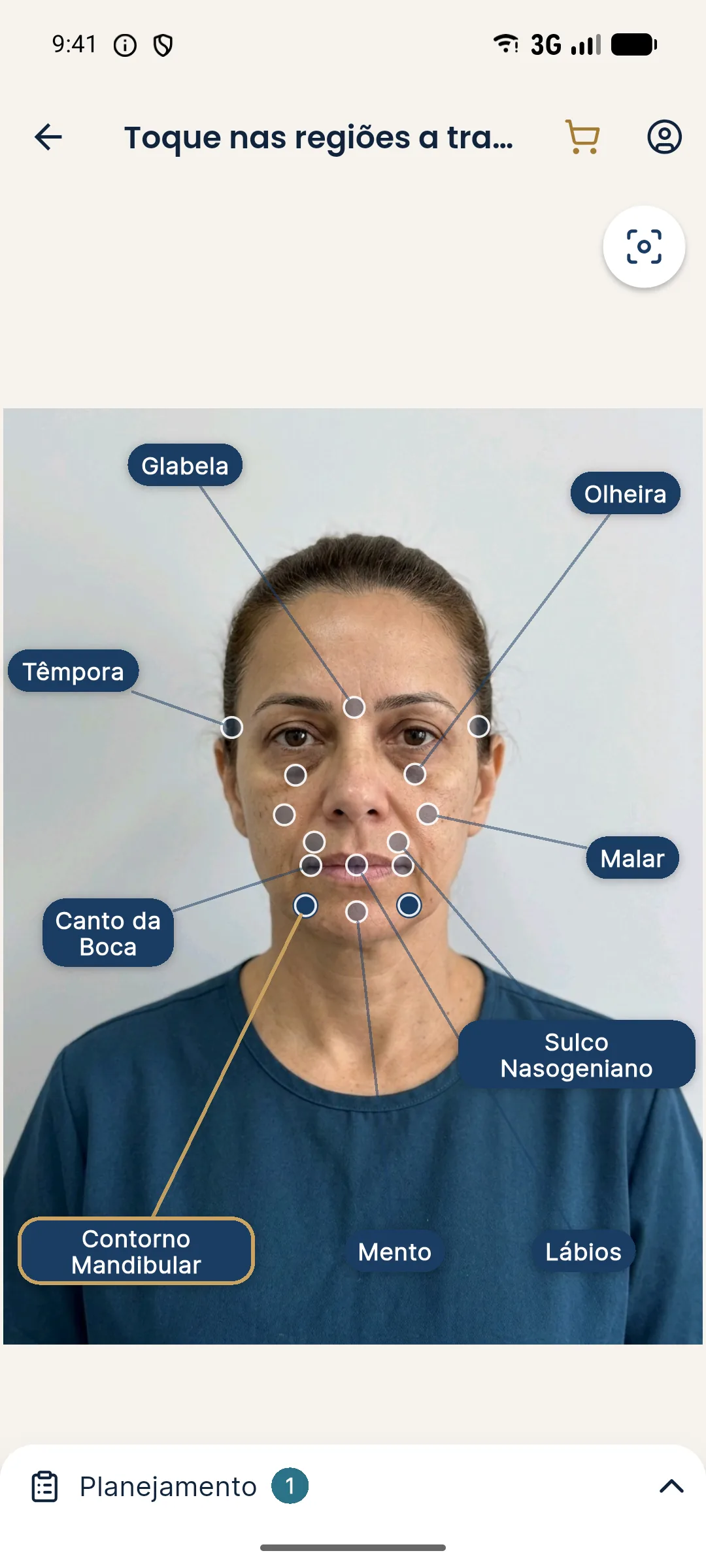
If the projection shows a face that gets wider below, the message is clear that the complaint is one of excess, and the plan should change. It is a cheap and honest way to keep the next stage from repeating the earlier mistake. For more ideas on talking with the feature, see showing the complaint in the visual projection.
Record keeping
Note the patient's description, the lift test result, the classification and the staged plan, along with the photos. In cases where the cause is clinical or weight-related, record the referral. Volumes and techniques are at the discretion of the qualified professional, after assessment and in line with the rules of their professional council in Brazil.
Frequently asked questions
Is a heavy face too little volume or too much?
It can be either. A full face has more volume than needed, with a rounded contour. A heavy face from lack of support has volume displaced downward. The assessment tells the cases apart.
Does filling the cheekbone relieve the feeling of a heavy face?
When the cause is tissue descent, supporting the midface can reduce the feeling of heaviness. If the face is full, filler can make the complaint worse.
Is there a difference between a heavy face and a swollen face?
Yes. Swelling has a temporary cause, such as retention or a reaction, and varies through the day. A heavy face has a stable shape tied to structure, fat and laxity.
Which procedures can help?
It depends on the cause: support and volume replacement at strategic points, a biostimulator or threads in selected cases, and clinical management for what is not structural. The decision is up to the qualified professional.
Harmy images are illustrative simulations generated by AI from the patient's photo to support the conversation between practitioner and patient. They are not a promise of results. Indication, technique, product and volume are solely the decision of the licensed practitioner. This content is for information only and does not replace a clinical assessment.