
Wide forehead and narrow chin: what to balance

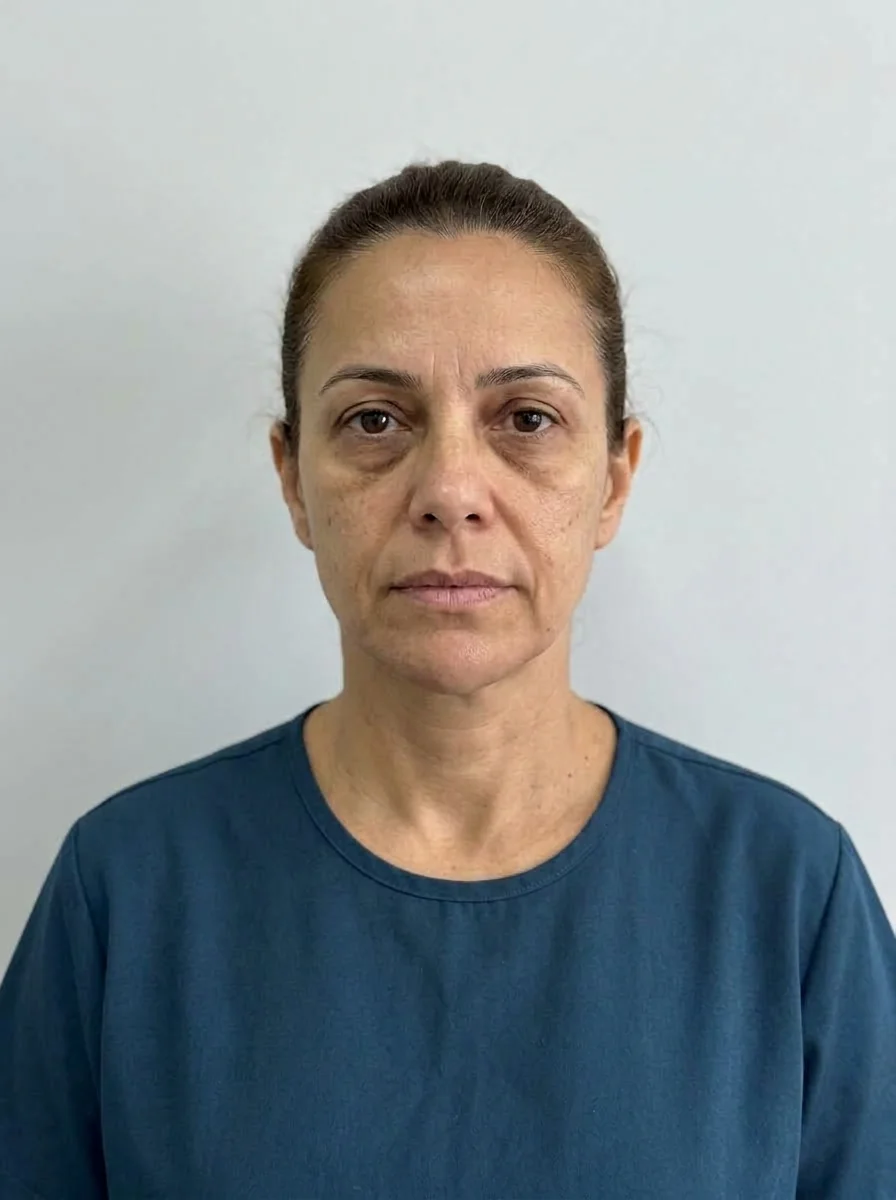 BeforeSimulation
- Nerve
- Highlighted area
Quick facts
- Concern
- A face wider at the top and narrow at the bottom, with a broad forehead and a thin or pointed chin
- Key question
- Does the width come from the forehead and temples, from the cheekbone, or from a lack of width in the jaw and chin?
- Assessment stance
- Treat it as a balance of widths and not as a flaw: the heart shape is a common variation
- Plan risk
- Adding volume below without changing how the whole is perceived and creating a heavy lower third
A heart-shaped face, or inverted triangle, is described by patients in many ways: "very wide forehead", "very thin chin", "pointy face", "I look like a beak at the bottom". The concern is about the balance of widths between the thirds, and HOF (facial harmonization, in Brazil an orofacial harmonization specialty in dentistry) has a real, though modest, role in that balance. Being candid about this is part of the care.
This page shows how to measure the relationship between forehead, cheekbone, and jaw and how to think through a plan that respects the shape of the face. For the chin alone, see small chin and pointed chin. For the whole lower third, complete lower third in the plan.
Why a face becomes "heart-shaped"
The heart shape is characterized by a relatively wide forehead and zygomatic region, and a narrower jaw and chin. It differs from the triangular shape, which is wider below, and from the diamond shape, with a cheekbone wider than the forehead and the jaw. These shapes describe proportions, not diseases, and the classification helps more with conversation than with decisions.
What usually prompts the consultation is the perception of imbalance: the forehead draws attention, the chin looks small, and the patient feels the face "ends" early. It is worth asking what bothers them most, because sometimes the concern is the forehead and sometimes the chin, and the two call for different reasoning.
Where the width difference lies
| Area | How it contributes to the heart shape | What HOF can do |
|---|---|---|
| Forehead and temples | Wide forehead, concave temples that accentuate the contrast | Little in the forehead; temporal replacement softens the transition |
| Cheekbone and zygomatic | Wide zygomatic, projected cheekbone | Avoid adding width where it already exists |
| Jaw | Poorly defined mandibular angle, narrow line | Definition and width with volume, in selected cases |
| Chin | Thin, pointed, or under-projected chin | Adjusting projection and design with volume |
The table shows that, to balance a heart-shaped face, the most common strategy is to give more presence to the lower part and soften the contrast above. It is not a rule, and each patient may prefer to keep the shape and treat only one detail.
How HOF fits into the balance
A frequent line of reasoning is to give more width and presence to the lower third, to reduce the contrast with the upper part. In selected cases this can be done with volume in the chin and the jawline. The goal is not to "fill a thin chin" but to restore a smoother relationship between the widths. The procedure is described at review level in chin filler and jaw filler.
The second front is the upper part. Concave temples increase the contrast, and replacing temporal volume can soften the transition between the forehead and the face. It is an approach that needs to be assessed with caution, because of the vascular anatomy of the area, and it is covered in hollow temples.
Care with the chin
A thin chin can be thin because of narrow bone, little projection, or a lack of soft tissue. The same volume changes the appearance in different ways in each case. In a narrow, pointed chin, adding projection without widening can increase the pointed look. The design needs to combine width, projection, and height, and a professional who assesses from the front and in profile avoids surprises.
The relationship with the lower lip and the labiomental fold also matters. If the lip is small and the chin thin, the whole may call for balancing both. See explaining the chin to the patient and hyaluronic acid in the labiomental fold.
The jaw as part of the equation
The jawline gives width and definition to the lower third. In heart-shaped faces, the jaw line tends to be narrow, and moderate definition can change how the whole reads. The decision depends on the structure and on expectations. In people with little soft tissue, the volume can become too visible if the amount is excessive. For the contour itself, see how to explain the jawline to the patient.
How to organize the plan
- Measure the widths and proportions in standardized photos.
- Ask the patient what bothers them most: the forehead, the chin, or the whole.
- Assess the temples, chin, and jaw as possible targets.
- Avoid adding width where it is already large.
- Plan in steps, starting with the smallest intervention that addresses the concern.
- Reassess from the front, in profile, and in three-quarter view.
Safety
The chin and the jaw involve the facial artery, the submental artery, the marginal branch of the facial nerve, and the mental nerve. The temples have branches of the temporal artery and the temporal branch of the facial nerve. Possible complications include swelling, bruising, asymmetry, nodules, paresthesia, and, rarely, vascular occlusion. Keep hyaluronidase on hand and know the risk structures.
How to use Harmy in this conversation
Harmy simulates the Chin and Jawline points on a frontal photo. For face-shape concerns this is useful because the patient sees how the lower third gains presence. The projection does not show the profile, does not alter the bone, and does not represent a change of shape, and that needs to be said. It is an illustrative simulation, not a promise of results.
Questions to test your reasoning
What to record in the patient record
Record the measurements, the frontal, profile, and three-quarter photos, the concern in the patient's own words, the plan in steps, and the specific consent for each area. Note what was explained about limits. For photos, see standardized clinical photography.
Frequent mistakes
The first mistake is treating the face shape as a flaw. The second is adding volume to the cheekbone of someone who already has zygomatic width. The third is projecting the chin without considering width and height.
Summary for the decision
A wide forehead and narrow chin make up a common shape, and HOF can balance the perception by giving the lower third presence and softening the contrast above. Measure the widths, avoid adding width where it already exists, design the chin with projection, width, and height, and plan in steps. Keep hyaluronidase on hand, document, and act at the discretion of the licensed professional, in line with the rules of your professional council in Brazil, without promising results.
Frequently asked questions
Is a heart-shaped face a problem to correct?
Not necessarily. It is a common variation. Treatment is only discussed if the patient has a concern, and the conversation should separate what is a trait from what bothers them.
Does filling the jaw and chin balance the width?
It can help increase the perceived width below, but the result is subtle and depends on the structure. The goal is to balance, not to equalize the widths.
Do hollow temples influence this concern?
They do. Temporal concavity accentuates the width of the forehead by contrast. Assessing the temples is part of the reasoning, and replacement can soften the transition.
Can a pointed, thin chin be treated?
There are options that change the design of the chin with volume, at the professional's discretion. The patient needs to know that the bone does not change and that the adjustment is one of perception.
Harmy images are illustrative simulations generated by AI from the patient's photo to support the conversation between practitioner and patient. They are not a promise of results. Indication, technique, product and volume are solely the decision of the licensed practitioner. This content is for information only and does not replace a clinical assessment.