
Facial harmonization plan for people on camera or video
Quick facts
- Topic
- Facial harmonization plan for people on camera or video
- Central point
- The camera reads motion, light and angle, not just a still image
- Main care
- Preserve mobility and natural expression
- Typical risk
- A "frozen" face or obvious asymmetry in motion
- Guidance
- Test before recording, with days of margin
People who make a living on camera, whether presenters, content creators, teachers, telehealth physicians or speakers, have a different relationship with their own face. The camera exaggerates some things, hides others and, above all, records motion. A beautiful result in a still photo can look odd on video. This page guides the harmonization plan for this audience, with emphasis on reading in motion, lighting, angles and a natural look.
What does the camera do to the face?
Five things. The lens distorts with distance: up close, the nose and center of the face look bigger. Strong, frontal light flattens volumes, while side light brings out shadows and relief. Motion reveals asymmetries and stiffness that a photo hides. High resolution shows texture and irregularities. And exposure time, from minutes to hours, makes the viewer notice anything that looks off. See distance and lens in the assessment photo, video to assess facial dynamics and face at rest vs in motion.
How do you assess facial dynamics in the consultation?
Ask the patient to read a passage of text, smile, furrow the forehead, raise the brows and close the eyes tightly while you observe. If the patient agrees and signs the image release, a short phone video helps with documentation. Note which muscles dominate, whether there is functional asymmetry and how the lines form in motion. See dynamic facial analysis in expression, consent for clinical video and patient clinical video.
Which areas call for the most care?
| Area | What the camera shows | Planning caution |
|---|---|---|
| Forehead and glabella | Stiffness, lack of expression | Toxin at a conservative dose, without freezing |
| Lips | Volume and movement while speaking | Discreet volume; watch the lip while talking |
| Under-eye area | Shadow and shine under studio light | Delicate area; avoid treating close to recordings |
| Cheekbone and midface | Shadows in the smile and the wide smile | Support, without overdoing width |
| Mouth corners and chin | A tired expression at rest | Assess the muscular and support causes |
With toxin, balance is central: the forehead needs to keep enough movement for a natural expression, and brow position can change with treatment. See toxin in the glabella, glabella and forehead: combining in the plan and heavy look after toxin. For lips, see lip filler and speech video to assess the lips.
How is the recording schedule organized?
Ideally, plan facial harmonization between recording cycles, not in the middle of them. Swelling, bruising and small asymmetries are expected and vary, and the camera records everything. New procedures should have weeks of margin, and even familiar procedures call for a few days. See the general reasoning in facial harmonization plan for an event with a set date.
How do light and angle change the conversation?
The patient needs to know that recording light can change how the result looks. Overhead light accentuates under-eye shadows, side light accentuates relief, diffuse frontal light softens. Ask them to bring a clip recorded under their typical conditions, if possible, and review it together. Fit the plan to what the camera shows, not to what the mirror shows. See lighting for the planning photo and camera and lighting for clinical facial harmonization photos.
How do you use the simulation, with its limits?
In Harmy, the projection uses a static frontal photo and shows the subtle effect of volume in the marked areas. For someone who appears on camera, it helps in talking about proportion, but it does not show motion, speech or camera angles. Say so, and use clinical video, when there is consent, for the dynamic part.
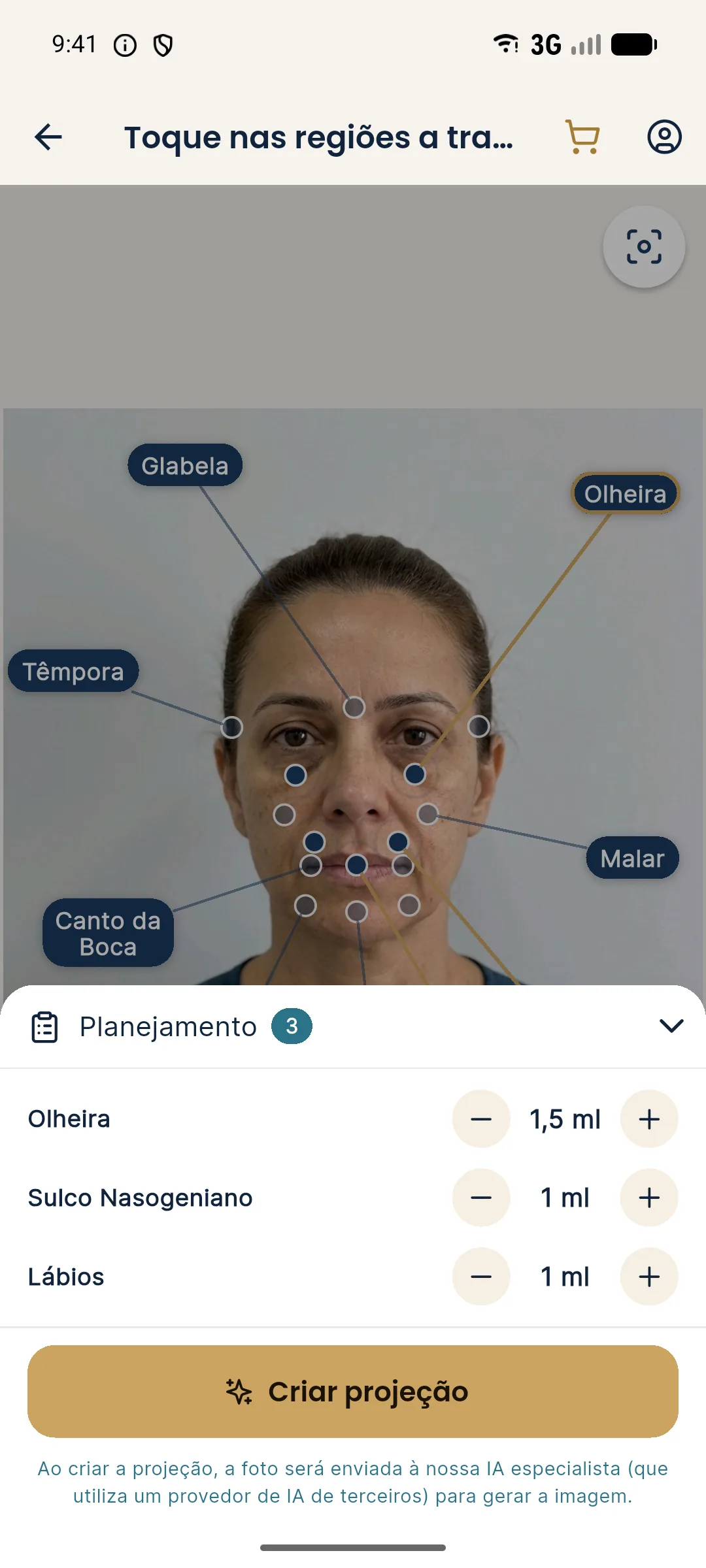
A good practice is to record the starting photo in neutral light and compare it with the follow-up photo, in the same framing. Harmy's per-patient history keeps the sessions, and "Add actual result" stores the photo aligned by the eyes. See limits of 2D simulation and the simulation does not show motion.
How do you talk about a natural look and filters?
People who work on camera often use filters and editing, and may bring references of a "filtered" face. Make clear that facial harmonization does not deliver the edited face, and that the camera does not forgive excess. Explain that the best result on video is the one that goes unnoticed. Record what was agreed. See filter face: handling unrealistic references and filter dysmorphia.
How do you handle the makeup and editing the patient uses?
People who work on camera often wear video makeup, which hides dark circles, evens out the skin and changes how contours read. This can hide the concern on the recording and show it in real life, or the other way around. Ask whether the patient prefers to fix what shows with makeup or without it, because the answer changes the plan. For dark circles, for example, a makeup artist can handle the color component, leaving facial harmonization only the relief.
Later editing matters too: someone who retouches their own videos may have a more "polished" image of themselves than the real one, which feeds unrealistic expectations. Talk about it gently, without judging, and show the starting photo without a filter. The gap between the edited image and the real face is one of the main triggers of dissatisfaction after a procedure.
Reasoning quiz
Summary
For people on camera, assess the face in motion, treat little and naturally, schedule between recording cycles, consider light and angle, and use the simulation as static support. The best result is the one the camera does not give away.
Frequently asked questions
Can someone who works on video have toxin?
Yes, but the dose and distribution must preserve expression. On camera, excess stillness gives it away quickly. The decision and the dose are the professional's, after assessment.
Does filler show more on camera?
It can. Strong light, a close lens and movement reveal disproportionate volume and asymmetries. That is why conservative volume and reassessment in motion matter.
When should you have facial harmonization before recording?
With room to spare. Swelling, bruising and small asymmetries can last for days. In general, treatment close to important recordings is avoided.
Does Harmy's simulation show the face in motion?
No. The projection is static, based on a frontal photo. It does not account for expression, speech or camera angles.
Harmy images are illustrative simulations generated by AI from the patient's photo to support the conversation between practitioner and patient. They are not a promise of results. Indication, technique, product and volume are solely the decision of the licensed practitioner. This content is for information only and does not replace a clinical assessment.