
Nose and upper lip: the nasolabial angle in the HOF plan

- Nerve
- Highlighted area
Quick facts
- Topic
- Relationship between the base of the nose, the tip and the upper lip
- Central question
- What do the nasal tip and the philtrum do together in the nasolabial angle
- Deciding view
- Profile with the head level
- Risk
- The nose is a high vascular risk area, hyaluronidase available
Someone looking at a profile rarely sees the nose and the upper lip as separate things. The nasal tip, the philtrum and the lip form a set, and what one does changes the reading of the other. A drooping tip seems to shorten the lip. A retracted upper lip seems to lengthen the nose. The nasolabial angle is the way to talk about this in numbers, but in the consultation what matters is a careful eye for the whole.
This page shows how to assess the nose and upper lip together, what the angle tells you, how the philtrum and Cupid's bow come in, what the risks of the area are and what Harmy shows and does not show. For profile balance, also read aesthetic profile: how lips, nose and chin relate.
What is the nasolabial angle and what does it tell you?
The nasolabial angle is formed by the line of the columella and that of the upper lip, in profile view. Its value reflects the rotation of the nasal tip and the position of the upper lip. Numeric references exist in the literature and vary with sex, age and population, so they should be used as a question and not as a goal.
| Profile reading | What may be happening | Question for the plan |
|---|---|---|
| More closed angle | Tip rotated downward or lip very projected | Does the tip weigh more, or the lip? |
| More open angle | Tip rotated upward or lip retracted | Did the lip lose support? |
| Long philtrum | Upper lip looks far from the nose | Can the plan consider the lip, and is the cause anatomical? |
| Short philtrum | Upper lip projected, nose close | Be careful not to overdo the volume |
| Faded Cupid's bow | Loss of lip definition | Reassess the vermilion border |
Isolated measurements mislead. What the patient sees is the whole, in the photo and in the mirror, with expression and light. Standardize the profile with the head level, as in profile facial analysis: checklist and standardized frontal photo.
How do you assess the nose and upper lip together?
An ordered assessment reduces the risk of treating the wrong concern. One possible sequence, at the professional's discretion:
- Level profile: tip rotation, nasal projection and position of the upper lip.
- Frontal: width of the nasal base, symmetry and philtrum.
- Mouth: proportion between upper and lower lip and Cupid's bow.
- Dynamics: what changes with the smile and speech.
- Concern: what the patient wants to change and what they do not perceive.
The skeleton counts too: the position of the premaxilla influences the support of the upper lip, and injecting to compensate for bone has a limit. See facial skeleton before injecting. For lip proportions and smile analysis, see smile analysis in HOF.
What risks does the area carry?
The nose is a high vascular risk area. The vessels of the area communicate with the circulation of the face and, in severe cases, with that of the retina. Complications such as vascular occlusion, necrosis and visual changes are possible, and the area requires mastery of anatomy, preparation for a complication and hyaluronidase available when hyaluronic acid is used. The lips also have labial arteries and a risk of bruising, swelling and nodules.
For the upper lip, excess volume is usually the visible problem: the lip becomes projected, the philtrum shortens and the nasolabial angle closes, which can look artificial. Moderation is the rule. See ml per area: ranges used in visual planning.
What does Harmy show here?
Harmy marks the Lips, with ml (0.5 ml steps) and intensity (Subtle, Moderate or Pronounced). The nose is not a point in the app, so the tip and the nasolabial angle are not simulated. In addition, the projection uses only the frontal photo, and the nasolabial angle is a profile measurement.
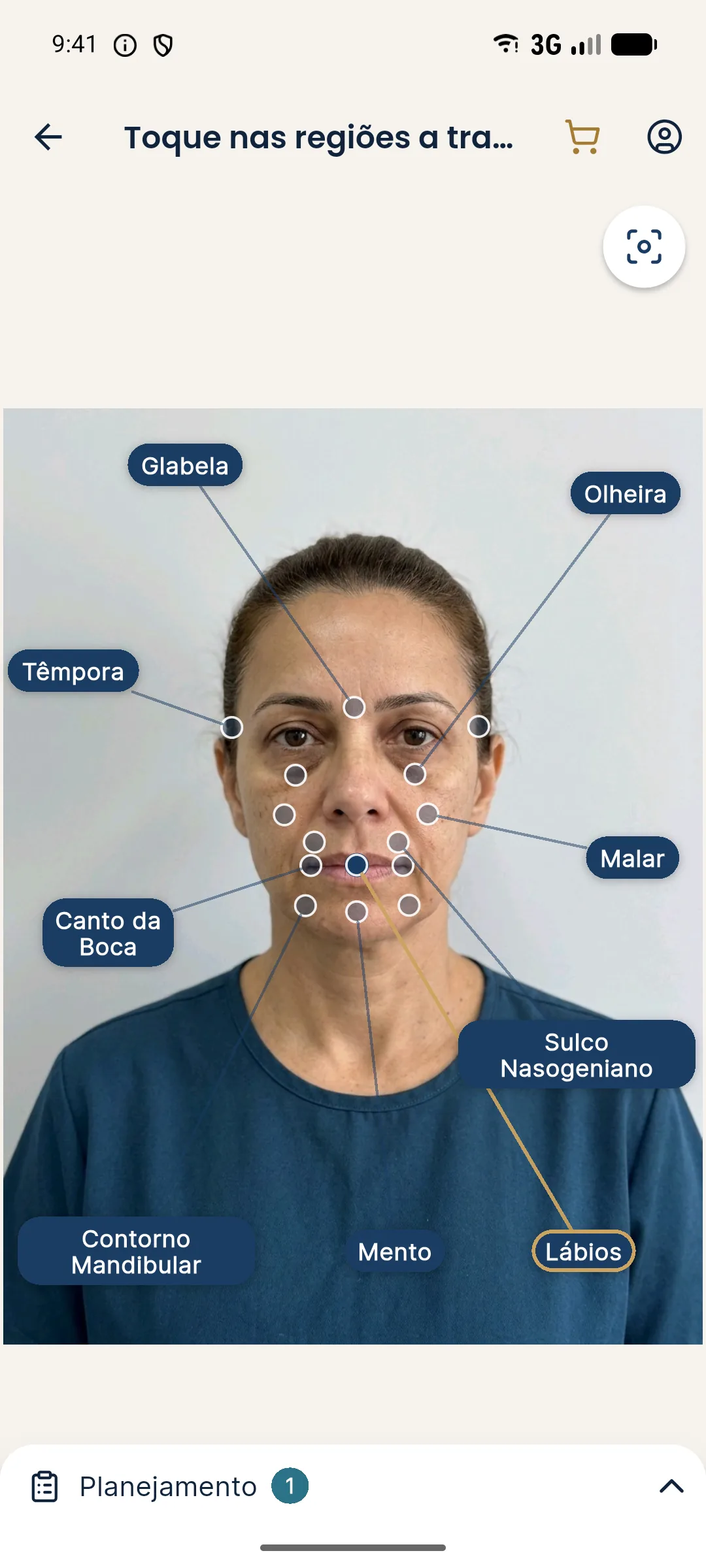
This has a clear consequence for the conversation. If the patient sees the lip simulation and believes their profile will look a certain way, the expectation goes beyond what the image shows. Say that the simulation shows the lip from the front, and that the reading of the profile is clinical. For that conversation, see explaining that a simulation is not a guarantee.

When is the upper lip not the answer?
Not every concern in this area calls for lip volume. A few scenarios:
- Drooping nasal tip: the lip looks short because of the tip, and lip volume does not correct that.
- Retracted premaxilla: lack of bony support can limit the result of any volume.
- Vertical lines of the upper lip: another approach may be more appropriate than volume.
- Smile dynamics: the lip rises too much or too little, and the cause may be muscular.
For other aspects of the smile and the lip, see smile arc and lower lip curve and buccal corridor and smile. For the relationship with the chin, see nose and chin: profile balance in planning.
Every decision on area, product, volume and technique belongs to the qualified professional, after assessment. The simulation is illustrative.
Frequently asked questions
What is the nasolabial angle?
It is the angle between the columella, at the base of the nose, and the upper lip, seen in profile. It reflects the rotation of the nasal tip and the position of the upper lip.
Does filling the upper lip change the nasolabial angle?
It can change the perception, because the lip projects differently. The effect depends on anatomy, and the profile assessment is what guides it.
Does Harmy simulate the nose?
No. The app marks Glabella, Temple, Tear Trough, Cheekbone, Nasolabial Fold, Mouth Corner, Lips, Chin and Jawline. The nose is not one of the points.
Should the nose and upper lip be treated together?
They should be assessed together, because one changes the reading of the other. Whether to treat both is the professional's decision, after assessment.
Harmy images are illustrative simulations generated by AI from the patient's photo to support the conversation between practitioner and patient. They are not a promise of results. Indication, technique, product and volume are solely the decision of the licensed practitioner. This content is for information only and does not replace a clinical assessment.