
Replanning After the First Session: When and How

Quick facts
- Topic
- Adjusting the plan after session 1
- When to reassess
- Once initial swelling has passed, on the agreed timeline
- Key questions
- What changed, what the patient notices and what is missing
- Possible decisions
- Add more, wait, change area or close
- Pitfall
- Reacting to swelling or to the patient's impatience
The first facial harmonization session is a hypothesis put to the test. You planned, you injected, and now the tissue responds. The follow-up is the moment to look at that response honestly and decide what comes next: add more, wait, change area or stop. Replanning is not admitting a mistake, it is exactly what splitting treatment into stages allows. This page gathers criteria for that moment.
Why replan instead of following the original plan?
The initial plan was made without knowing how that particular face would respond. Volume, durability, residual asymmetry and patient satisfaction only appear afterward. Following the original plan out of inertia ignores what the first session taught. On the other hand, replanning without criteria leads to changing course with every comment from the patient. What balances the two is a reassessment roadmap, with fixed questions and a defined timeline.
This view is part of when the plan needs to change and rests on the idea of conservative volume in the first session: starting low is what creates room to adjust later.
When should you do the reassessment?
Agree on the date on the day of the first session. A follow-up booked before the patient leaves is far more likely to happen. The exact timing is the professional's decision, but the principle is to wait until swelling and initial settling are over. Reassessing in the first week is usually reassessing swelling.
See also interval between sessions in the facial harmonization plan and reassessment at 3, 6 and 12 months.
What should you reassess at the follow-up?
A set of questions helps keep the conversation objective and avoid getting lost in impressions. Ideally, answer each one with the standardized photo in hand.
Always compare with the photo under the same conditions, not with the memory of the mirror. To avoid pitfalls, see alignment errors when comparing photos and swelling gets in the way of comparing results.
What decisions can the follow-up produce?
| Decision | When it makes sense | Caution |
|---|---|---|
| Add to the area | Response below expectations, no warning signs and tissue settled | Small volume; reassess again |
| Maintain and observe | Satisfied patient or result still settling | Set a new date so it is not forgotten |
| Change area | Patient's goal shifted or another area became the priority | Record the change in the plan |
| Adjust an asymmetry | A difference between sides that bothers the patient and is treatable | Remember that perfect symmetry is not a goal |
| Close the plan | Goal reached or limit of what facial harmonization delivers | Agree on maintenance, if any |
| Refer | Concern outside the scope or the competence of another professional | Communicate clearly |
Adding more is the most tempting decision and the one that calls for the most caution. Before adding volume, consider when total volume becomes excess and when to split volume across sessions. For asymmetry cases, see new asymmetry during the plan.
How do you handle the patient's impatience?
Many patients want to "finish it now." The rush usually comes from comparison with outside expectations or insecurity about the initial result. The professional's role is to translate time into safety: the tissue needs time to show the real result, and treating again too soon can create excess.
How does Harmy fit into replanning?
If you showed a projection at the first consultation, it is a point of comparison, but not a goal. At the follow-up, the relevant comparison is the real tissue against the plan and the baseline photo. Harmy lets you add the actual result photo aligned by the eyes and compare Projection, Actual result and Projection vs Actual. If the plan changes, you can create a new projection with the current photo and the ml for the next stage, using the Subtle, Moderate or Pronounced intensities to discuss alternatives.
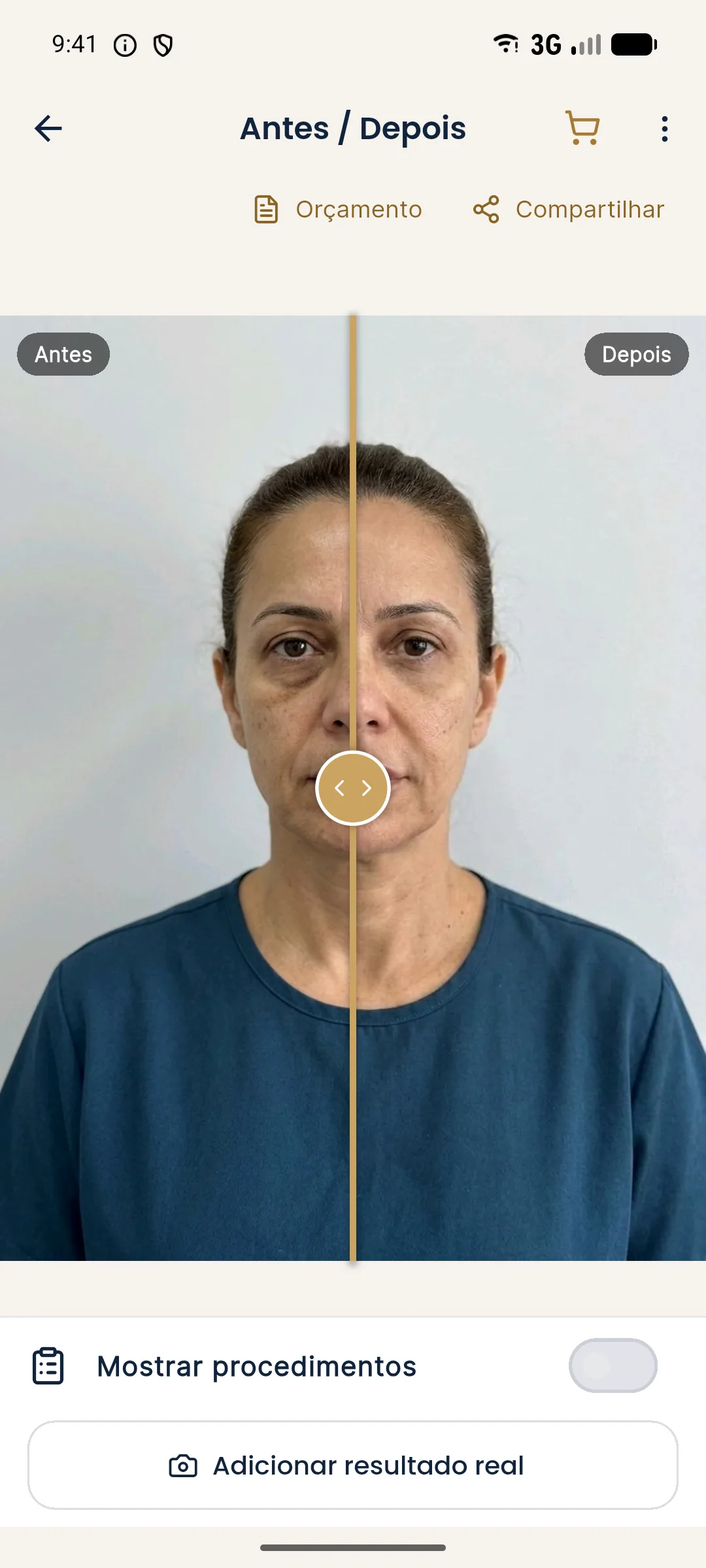
To understand why the real result and the image differ, read why the actual result differs from the simulation and comparing projection and actual result.
What records should you leave after replanning?
Update the plan sheet with the date, the follow-up photos, what was observed, the decision made and the reason. If the plan changed, keep the earlier version archived instead of overwriting it. This shows the evolution of the reasoning and protects the relationship with the patient. See treatment plan versions and adjusting the plan based on patient feedback.
One additional point of attention: confirm whether the original quote is still valid. If the plan changed, the amount and validity may change too, and the patient should know before accepting the next stage. See linking plan and quote in facial harmonization.
Frequently asked questions
How long should I wait to replan after the first session?
Generally, long enough for the initial swelling to pass and the tissue to settle. The timing varies with the area and the procedure, and is set by the professional. Reassessing too early leads to adjustments on a face that is still swollen.
Does every patient need a second session?
No. In some cases the first stage meets the goal. A second session is a possibility assessed at the follow-up, never an obligation of the plan.
The patient asked for more volume in the first week. What should I do?
Explain that the result is still settling and arrange the reassessment on the planned timeline. Deciding on a top-up over swollen tissue raises the risk of excess.
Should Harmy's projection be redone at the follow-up?
It can be useful. A new projection with the current photo and the ml you now consider helps discuss the next stage, always as an illustration and not as a promise.
Harmy images are illustrative simulations generated by AI from the patient's photo to support the conversation between practitioner and patient. They are not a promise of results. Indication, technique, product and volume are solely the decision of the licensed practitioner. This content is for information only and does not replace a clinical assessment.