
Large Chin: What Facial Harmonization Can Soften

 BeforeSimulation
- Nerve
- Highlighted area
Quick facts
- Concern
- Chin that looks big, long, wide or very projected relative to the rest of the face
- Key reading
- HOF only adds or relaxes, so it balances the surroundings and does not reduce bone
- Supporting measure
- Lower third height, profile projection and chin width compared with the jaw
- Limit
- True bony excess calls for a surgical assessment, and HOF acts as camouflage
"My chin is too big" is a concern the HOF professional should hear with care. Unlike the small chin, there is not much to add here, and the instinct to solve it with volume can make things worse. The first step is to check whether the chin is truly large or only looks large because the rest of the face has little volume.
This text helps to measure, to talk to the patient and to decide what HOF does, without promising reduction. For the opposite situation, read small chin, and for the narrow chin, pointed chin.
Is the chin large, or does it only look large?
Many "large chin" concerns are not confirmed by measurement. The chin looks large when the cheeks are hollow, when the jaw is poorly defined or when the midface is short. In those cases the chin is normal but stands out by contrast. The reading needs numbers and comparisons, not only the impression.
A few parameters help:
- Lower third height relative to the other thirds (facial assessment by thirds).
- Proportion within the lower third (in classic models, from subnasale to stomion is about one third of the height, and from stomion to chin, which adds lower lip and chin, about two thirds; this is only an approximate reference).
- Chin width compared with jaw width and with the rule of fifths.
- Pogonion projection in profile relative to the lower lip and the nose.
With these comparisons, you separate the truly large chin from the normal chin in an unbalanced face. The difference determines whether the plan is one of addition elsewhere or one of limits.
What are the types of large chin?
| Type | How it looks | Likely origin | Approach discussed |
|---|---|---|---|
| Vertical (long) | Elongated lower third | Vertical bone growth | Camouflage with midface volume; assess surgery |
| Projected (prominent) | Pogonion ahead of the ideal line | Bone or mandibular prognathism | Orthodontic and surgical assessment |
| Wide | Chin wider than the jaw | Bone or muscle | Balance the width of the jaw |
| Apparent | Normal chin, face lacking volume | Lack of volume around it | Volume in the midface and jaw |
| Muscular | Chin prominent on contraction | Mentalis hyperactivity | Toxin, at the professional's discretion |
The table shows why there is not one single approach. In some cases, treatment does not even involve the chin. In others, HOF has no role beyond guidance.
What can HOF do?
The general strategy is to balance the chin through its context. That means adding volume to neighboring areas so the chin loses relative prominence and, when there is a muscular component, relaxing the muscle. The approaches discussed, always decided by the licensed professional after an assessment, include:
- Midface support, so the face gains volume and the chin stops being the dominant point. See cheekbone filler.
- Jawline definition, when a wide chin contrasts with poorly defined angles. See jawline filler.
- Mentalis toxin, if contraction accentuates the look. See mentalis toxin.
- Lip adjustment, which affects the proportion of the lower third. See lips and chin: combining in the plan.
In the jaw and cheekbone areas, the risks include swelling, bruising, asymmetry, nodules and vascular complications, among others. When hyaluronic acid is used, hyaluronidase must be available. See safety and complications.
And when the excess is bony?
If the chin is large because of bone, HOF works as camouflage and has a clear limit. Chin surgery (genioplasty), indicated by a qualified surgeon, can reduce, reposition or shorten the bone. In cases of prognathism, treatment involves orthodontics and orthognathic surgery. The decision belongs to the patient with the specialist, and HOF may come before, after or never.
Explain to the patient the difference between changing proportion by addition and changing structure by reduction. Many accept camouflage once they understand what it does. Others prefer surgery, and your role is to point to the right assessment. See referring patients in HOF and when bone is the problem, not volume.
How to talk to the patient
A patient with a large chin often has a very fixed image of the problem. The conversation should respect what they feel while giving a realistic picture. Show the proportions on the photo, explain what can and cannot be done, and avoid pejorative terms.
On image and self-image, see perfectionist patient and patient with suspected dysmorphia. To talk about proportion without causing embarrassment, how to point out asymmetry without offending offers useful phrases.
What does Harmy help to show?
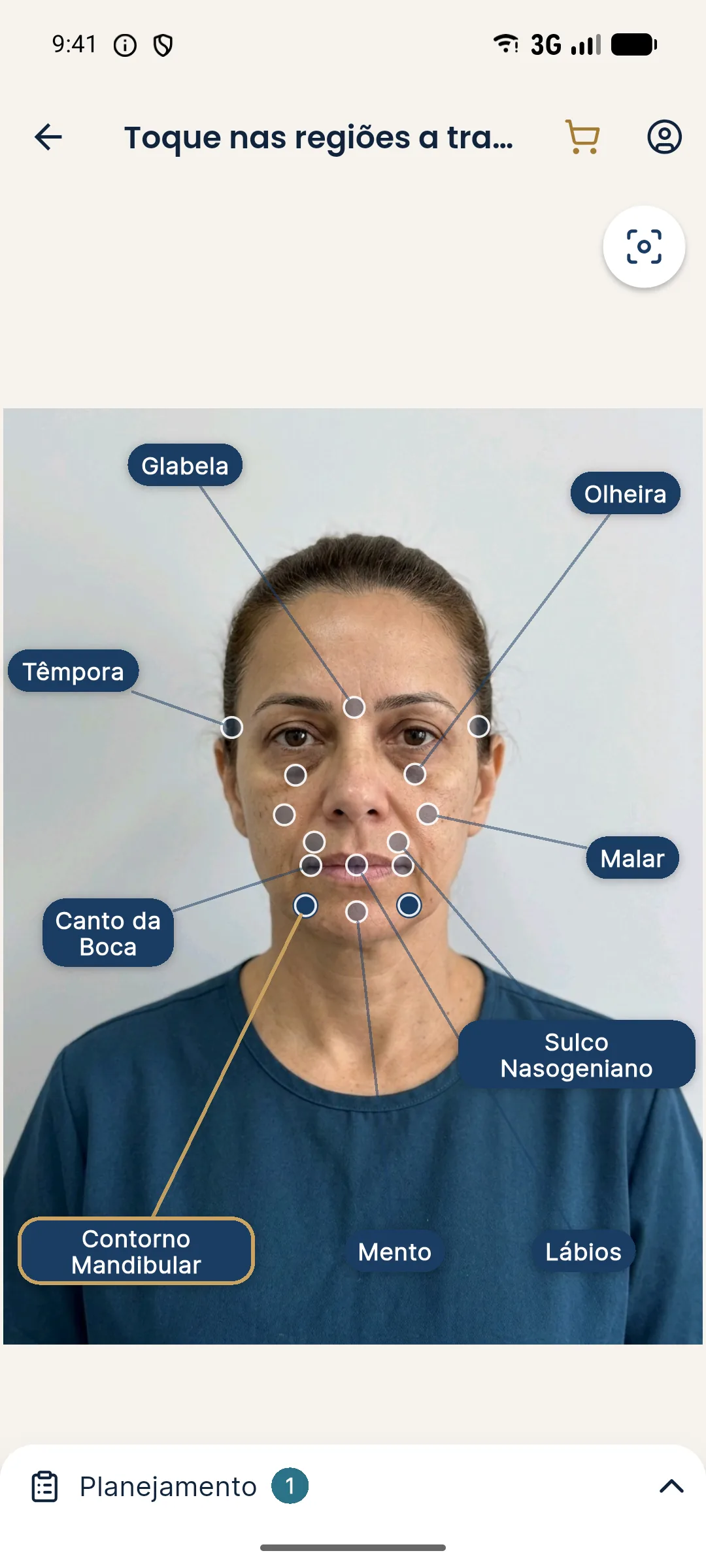
Harmy can simulate volume in the Cheekbone and the Jawline, which are the balancing areas in this case. The projection shows from the front how the face looks with more lateral support, and the patient sees the chin "settle" into the whole. The app does not shrink the chin or simulate profile, and that needs to be said.
Record keeping
Record the measurements and photos, the classification (large, apparent, muscular), the plan as a range and what was explained about limits. If there was a referral, note the specialty. At follow-up, repeat the photos under the same conditions. Standardized clinical photography and chin and jaw: combining in the plan help organize the method.
Frequently asked questions
Can harmonization make the chin smaller?
It does not reduce bone. It can balance facial proportion by enhancing neighboring areas, and, when there is a muscular component, toxin can tone down the chin's prominence. It is camouflage, at the professional's discretion.
How do you know whether the chin is truly large?
By comparing proportions: lower third height, profile projection and width relative to the jaw. Often the chin looks large because of a lack of volume around it, not because of an excess of its own.
Does toxin in the chin help make it smaller?
Only when mentalis hyperactivity makes the chin more prominent or puckered. It does not reduce bone or fat, and the effect is temporary.
What is the alternative for a large chin caused by bone?
Chin surgery, performed by a qualified surgeon, can reduce or reposition the bone. HOF can complement with volume in other areas to improve proportion.
Harmy images are illustrative simulations generated by AI from the patient's photo to support the conversation between practitioner and patient. They are not a promise of results. Indication, technique, product and volume are solely the decision of the licensed practitioner. This content is for information only and does not replace a clinical assessment.