
Man with a tired-looking face: assessment and subtle plan
- Highlighted area
Quick facts
- Concern
- Man who people say looks tired, sad or "worn out" even when rested
- Where to look
- Eye area, temples, midface, glabella and folds
- Male principle
- Correct what tires the face without rounding or softening its design
- Strategy
- Subtle plan, by area and in stages, with reassessment
"Everyone asks me if I'm sick or sleeping badly." It is one of the most common phrases among men who seek orofacial harmonization (HOF) without knowing exactly what they want to treat. The patient is not asking for a procedure; he is asking that his face stop conveying tiredness. The professional's job is to translate that into anatomical findings, and then into a proportionate plan.
The general picture of tiredness in the face is in tired-looking face, with the eye area in tired eyes: assessment and the plan in HOF plan for a tired-looking face. This page adds what changes in the male patient.
What does "tired" mean in the face?
A tired appearance is a reading of expression, and several signs produce it. It rarely has a single cause. The youth triangle (base high on the midface) tends to invert with volume loss, and the face seems to drop.
| Sign | How the patient describes it | Structure involved |
|---|---|---|
| Shadow under the eyes | "Hollow dark circles" | Tear trough and infraorbital compartment |
| Concave temples | "Shriveled face" | Loss of the temporal fat pad |
| Unsupported midface | "Sagging cheek" | Malar compartments and ligaments |
| Lines between the eyebrows | "Angry look" | Glabellar complex, corrugator muscle |
| Marked folds | "Mustache lines" | Nasolabial fold and skin |
| Dull skin | "Washed-out face" | Skin quality, sun, sleep, tobacco |
Dynamic wrinkles between the eyebrows, for example, are not related to tiredness anatomically, but they change the expression at rest and are part of the concern. See man with marked forehead and glabella.
Why the male plan avoids rounding
The male face has a more angular reading: temples and cheeks with less curvature, eyes with natural shadow, a defined jaw. A plan that fills every hollow with the same criterion as a female plan tends to round, soften the eyes and make the face lose its identity. That is what produces the phrase "it looks different, but I can't say what."
The alternative is a subtle plan that corrects only what weighs on the tired appearance and preserves the features that give the face character. This requires a conversation about limits at the start. See also differences between female and male faces and natural-effect plan.
In what order to think about the areas
The order varies, but a few criteria help decide the priority.
- What weighs most in the tired reading. In many men, the under-eye and the temple. In others, the glabella with a closed expression.
- What gives support to other areas. The midface often influences the under-eye and the fold. Treating the cause may reduce the need to treat the effect. See treating the fold or the cause of the fold.
- What carries the lowest risk to the result. High vascular risk areas, such as the temples and under-eyes, call for extra care.
- What the patient accepts. An excellent plan that the patient does not accept is not a plan.
Procedures that usually come up in the conversation, always at the discretion of the qualified professional, after assessment: under-eye filler, temple filler, cheekbone filler and glabella toxin. For the context of toxin in the male face, see botulinum toxin in the male face.
Simulating the subtle plan
A simulation helps the patient see that a subtle improvement is enough and understand the effect of each area. In Harmy, you mark the areas of the plan and see the illustrative projection of the after on the slider.
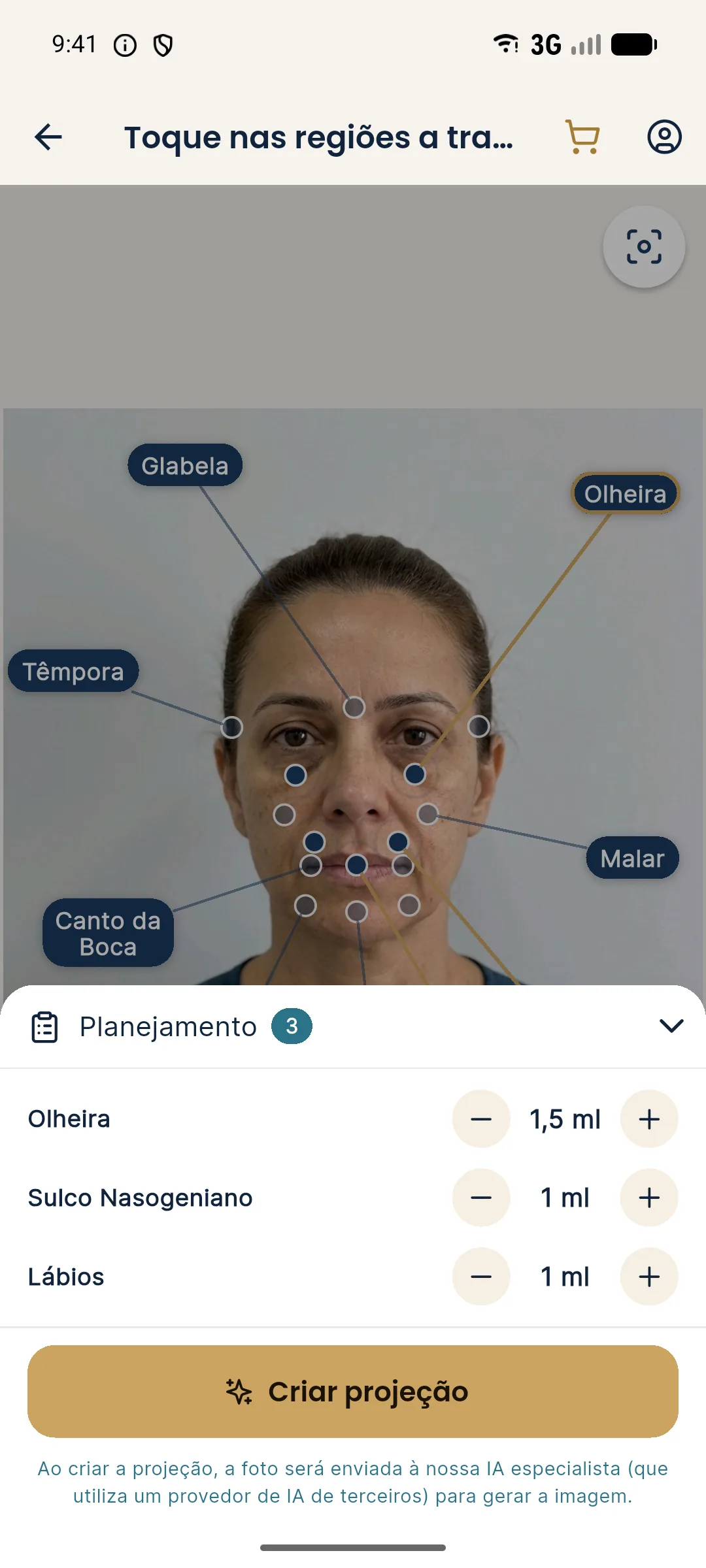
Show the patient that each added area changes the reading, and that more is not necessarily better. The conversation about intensities is in explaining Subtle, Moderate and Pronounced intensity. The projection is an illustrative simulation made with AI, not a promise of results, and the actual result may be different.
Risks and precautions
A tired-looking face involves high vascular risk areas, such as the tear trough, the temples and the glabella. Hyaluronidase must be available in the office when hyaluronic acid is used, and the professional must master the vascular anatomy of each area and the emergency pathway. Possible complications: swelling, bruising, asymmetry, nodules, the Tyndall effect and, rarely, vascular occlusion.
See the specific pages on glabellar vascular occlusion and vascular occlusion in the temples. With toxin, precautions include ptosis and asymmetry, described in ptosis after botulinum toxin. Plan the higher-risk areas with caution and with specific consent for each procedure.
When the cause is something else
Not every tired appearance is a matter for HOF. Worth considering:
- Sleep, apnea, alcohol, stress and allergies that worsen dark circles and swelling. Refer when indicated.
- Recent weight loss or use of weight-loss medications, with the face still in transition. See gaunt face after weight loss.
- Photodamaged skin or smoking, where skin quality weighs more than volume. See smoker's face.
- A closed expression out of habit, where toxin is relevant, but the patient needs to know the face stays expressive.
Records and follow-up
Note what the patient wants to communicate in his own words and what you agreed to do and not to do. Standardized photos in the same light and position allow the result to be compared without relying on memory. The use of the images follows informed consent and the LGPD (Brazil's data protection law).
In a man's tired-looking face, less is usually more. A small, clear and well-explained plan delivers the naturalness the patient is after and preserves the character of the face. Results vary from person to person and cannot be guaranteed.
Frequently asked questions
Why are men more concerned about looking tired?
Many report that a tired appearance hurts their professional and personal image. The reason for seeking treatment is individual and should be understood in the consultation, without assuming.
What makes a face look tired?
Usually a combination: shadow under the eyes, loss of volume in the temples and midface, more marked folds and lines between the eyebrows. Together they change the expression at rest.
Is the plan for a tired-looking face different in men than in women?
It usually is. The male plan avoids rounding volumes and over-softening the design of the eyes, and prioritizes subtle corrections in stages, at the professional's discretion.
Do I have to treat all areas at once?
No. It is generally more prudent to treat what weighs most on the appearance, in stages, reassessing how natural it looks at each follow-up.
Harmy images are illustrative simulations generated by AI from the patient's photo to support the conversation between practitioner and patient. They are not a promise of results. Indication, technique, product and volume are solely the decision of the licensed practitioner. This content is for information only and does not replace a clinical assessment.