
Masculinized face: assessment and softening of features

 BeforeSimulation
- Nerve
- Highlighted area
Quick facts
- Concern
- The face reads as masculine and the person would like softer features
- Most cited features
- Prominent forehead, low and straight brow, wide jaw, square chin
- What facial harmonization does
- Softens with toxin and volume in chosen points, without altering bone
- Limit
- Pronounced bony structure has a limited response to injectables
The patient says their face "has become hard", "heavy" or "too masculine". It might be a woman who has always been bothered by a wide jaw, someone who went through a hormonal change, a trans person seeking softer features, or simply a man who wants to soften a closed-off look. In every case, the starting question is the same: what exactly do you see as masculine in your face?
This page organizes that conversation by area and shows where orofacial harmonization can help, where it only works around the issue and where it cannot reach.
What makes a face look masculine?
The gender read of a face comes from a set of cues, none decisive on its own. The human eye compares proportions, relief and lines, and that comparison is what the patient feels as a "hard feature". The most common cues:
| Area | Feature read as masculine | Feature read as softer |
|---|---|---|
| Forehead | Prominent, with a marked brow ridge | More vertical and rounded |
| Brow | Low, straight, close to the orbit | Higher, with a lateral arch |
| Cheekbone | Under-projected, flatter face | Anterior and lateral projection |
| Jaw | Wide, evident mandibular angle | Continuous and narrower line |
| Chin | Square and wide | Smaller and more tapered |
| Lower third | Long and heavy | Proportional to the midface |
These differences are statistical tendencies in shape, not rules. There are feminine faces with strong jaws and masculine faces that are delicate. The professional's role is to translate the patient's perception into concrete findings.
How to assess: frontal, profile and in motion
The assessment should cover three angles, because each reveals a different cue. Starting with a standardized frontal photo, hair tied back and a neutral expression, keeps hairstyle and beard from masking the jaw. See standardized clinical photography.
From the front, observe the relative width of forehead, cheekbone and jaw, and the brow position. A face where the lower width exceeds the upper suggests working on the lower third. See the logic in triangular face and square face from bruxism.
In profile, assess the forehead and the projection of the nose, lip and chin. A very projected pogonion or a forehead that juts forward changes perception, and not every adjustment comes from an injectable. The facial profile tells a part of the story that the frontal photo does not.
In motion, ask for a smile, speech and a frown. Masseter contraction, corrugator strength and brow mobility show how much of the hard look comes from muscle and how much from bone.
What facial harmonization can soften, area by area
The principle is to work on soft tissue and be honest about what is bone. Below are the most used fronts, always at the discretion of the qualified professional and within the rules of their professional board in Brazil.
Brow and upper third
A closed-off look often comes from a low, straight brow combined with a strong corrugator. Botulinum toxin can reduce the downward pull and let the brow sit higher and more arched. See ideal brow position in planning and toxin in the brow. The risk is the opposite of what is wanted: if the dose goes too far, the brow can drop.
Cheekbone
Cheekbone projection softens the plane of the face and shifts the read of hardness toward the midface. Cheekbone filler is the most used resource, in conservative volumes. It does not replace bone, but improves the transition between forehead, cheek and jaw. See ideal cheekbone projection.
Jaw
When the masseter is bulky, toxin can reduce the width gradually and subtly. When the width is bony, the injection does not change the result. There is also the option of softening the angle through the transition between the cheekbone and the jawline, instead of touching the jaw itself. See toxin in the masseter and jaw and masseter: combining in the plan.
Chin
A square, wide chin is a delicate topic: filling adds volume, which can reinforce the square shape. In some cases, the conversation is about lengthening and tapering the chin, with targeted volume, and about treating the chin skin with mentalis toxin when a contraction hardens the contour. See square face: assessment and chin and jaw: combining in the plan.
When the goal is facial feminization or masculinization
The concern may come from a person who wants, precisely, a more feminine face, including trans patients. The assessment reasoning is similar, but the goal and the scale change. See facial feminization with injectables and respectful care for trans patients in facial harmonization. For the opposite direction, there is facial masculinization with injectables and plan for masculinizing the face. In all of them, respect for the patient's name, pronoun and wishes is part of the care.
Timeline of a staged plan
The order may vary. What matters is reassessing at each step, because the features influence each other: lifting the brow changes how the forehead reads, and projecting the cheekbone changes how the jaw reads.
Risks and limits
Each area brings its own risks: brow ptosis with forehead toxin, asymmetric smile or difficulty chewing with masseter toxin, irregularities and asymmetries with filler, and vascular complications in the glabella and fold. Hyaluronidase must always be available when hyaluronic acid is used. Tell the patient in writing that the goal is softening and not a change in structure. To map the risks, see safety and complications: overview.
How to use Harmy in this conversation
Harmy shows the effect of volume in the marked areas, from a frontal photo. It works well for the conversation about the cheekbone and chin, but it does not simulate toxin in the masseter or masseter reduction, and it does not show bone. That is why the simulation is an alignment tool, not a promise.
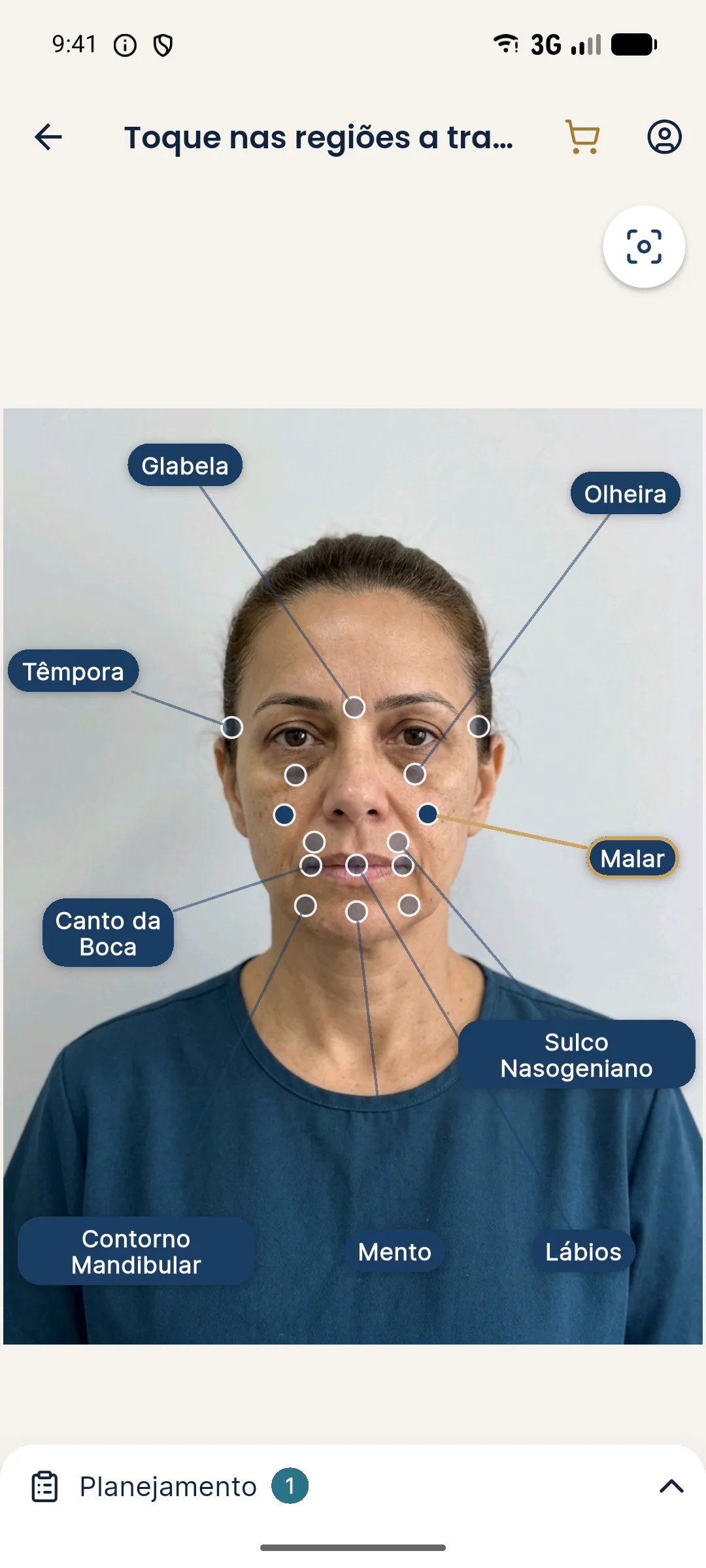
Showing the projection to the patient helps test a hypothesis: "if I soften the transition through the cheekbone, does the face change the way you imagine?". If the answer is "it changed little", that is an early sign that the expectation needs adjusting.
Record keeping and expectations
Record the concern in the patient's words, the findings, the limitations explained and the staged plan. Communication should avoid any term that stigmatizes: the goal is a face the person feels comfortable with, not an external standard. If the wish involves changes beyond what facial harmonization offers, refer calmly. Volumes and techniques always remain at the discretion of the qualified professional, after an assessment and in line with the rules of their professional board.
Frequently asked questions
Can facial harmonization feminize the face?
It can soften some features, such as the jaw angle, cheekbone projection and brow position. Pronounced bony structure has a limit, and other approaches can be discussed with the patient.
Which features make a face look masculine?
In general a prominent forehead, marked brow ridge, low brow, wide jaw with an evident angle, square chin and under-projected cheekbone. No single one defines the read.
Does toxin in the masseter soften the jaw?
In cases where muscle volume contributes to lower-face width, reducing the masseter can narrow it. It does not change bone, and the decision belongs to the qualified professional.
Does this concern also apply to trans people?
Yes, and the approach is the same: listen to the goal, assess and explain limits. Care should be respectful and centered on what the patient wants for their own face.
Harmy images are illustrative simulations generated by AI from the patient's photo to support the conversation between practitioner and patient. They are not a promise of results. Indication, technique, product and volume are solely the decision of the licensed practitioner. This content is for information only and does not replace a clinical assessment.