
Triangular face: balancing a narrow forehead and a wide jaw

 BeforeSimulation
- Nerve
- Highlighted area
Quick facts
- Concern
- The forehead looks narrow and the jaw wide, forming a triangle with the base at the bottom
- Compare
- Width of the forehead, cheekbone and jaw, from the front
- Levers
- Increase the read of the upper face (temple and cheekbone) and reduce the lower (masseter)
- Limit
- A wide jawbone and a bony narrow forehead do not change with injectables
The word "triangular" is confusing because it can describe two opposite faces. One has its base at the bottom: narrow forehead, medium cheekbone, wide jaw, like a triangle resting on its base. The other has its base at the top, with a wide forehead and a narrow chin, the so-called heart-shaped face. This page covers the first, the triangle with a lower base, in which the patient feels that "the lower part of my face is heavy".
The question that organizes the consultation is simple: where does the contrast between the upper and lower face come from? From bone, muscle, fat, or volume loss above? The answer decides whether facial harmonization has a role or whether the conversation is about accepting a constitution.
How to measure the triangle
The assessment starts with a standardized frontal photo and three width measurements, compared with each other: the width of the forehead at the level of the temples, the width of the cheekbone at its most prominent point, and the width of the jaw at the angle. The rule of fifths helps place the face in relation to the eyes.
| Relative width | Read |
|---|---|
| Forehead narrower than jaw, intermediate cheekbone | Triangle with a lower base |
| Forehead wider than jaw | Heart-shaped face, the opposite |
| Forehead, cheekbone and jaw similar | Square or rectangular face |
| Cheekbone wider than both extremes | Diamond-shaped face |
These shapes are reading tools, not closed categories. No real face fits perfectly, and the goal is to understand where the strongest contrast is. See also face width by fifths and planning a triangular face.
Where the contrast comes from
Four origins alternate, and the plan changes according to the dominant one.
Bone. A wide bony jaw and a narrow forehead by constitution do not change with injectables. The honest approach is to explain the limit. See asymmetric jaw and wide face.
Muscle. A bulky masseter, especially from bruxism, widens the base. Here toxin may have a role. See square face from bruxism.
Fat. Lower-face accumulation, jowls or double chin reinforce the triangular shape. See heavy face.
Volume loss above. Over time, the temples hollow and the cheekbone loses projection, and the upper face becomes relatively narrower. This is the case in which harmonization has the most to offer. See hollow temples and aging of the temples.
The levers of HOF
The strategy is to widen the read of the upper face and, when appropriate, reduce the read of the lower face. Neither alters the bone base.
Temples
When the temples are hollow, temple filler can restore width and smoothness to the upper face, reducing the contrast with the jaw. It is an area with significant vascular risk, with the superficial temporal artery and its branches, plus the temporal fossa with delicate planes. It requires anatomical knowledge and hyaluronidase on hand. See temple filler: risks.
Cheekbone
Lateral and anterior projection of the cheekbone softens the transition between the forehead and the jaw. It is a common starting point, in conservative volumes. See temples and cheekbone: combining in the plan.
Masseter
If the muscle is large, toxin can gradually reduce the lower width. See botulinum toxin in the masseter and jaw and masseter: combining in the plan.
Avoid the opposite
Filling the jaw in a triangular face reinforces the base and increases the contrast. In general, it is not the right tool for this concern. Watch the chin too: a very wide chin reinforces the shape. See chin and jaw: combining in the plan.
Assessment checklist
Timeline of a balance plan
Reassessing after the first step often shows that the upper face has already resolved part of the contrast, and the next step becomes smaller or unnecessary.
Risks
The temples and cheekbone are areas with vascular and asymmetry risk. Complications include swelling, bruising, irregularities, nodules and serious vascular occlusion, although rare. Hyaluronidase must be available when using hyaluronic acid. Toxin in the masseter can cause smile asymmetry and difficulty chewing. See safety and complications: overview.
Showing the proportion with Harmy
Harmy projects the volume effect on Temple and Cheekbone in the frontal photo, which is exactly the view in which the contrast between widths shows up.
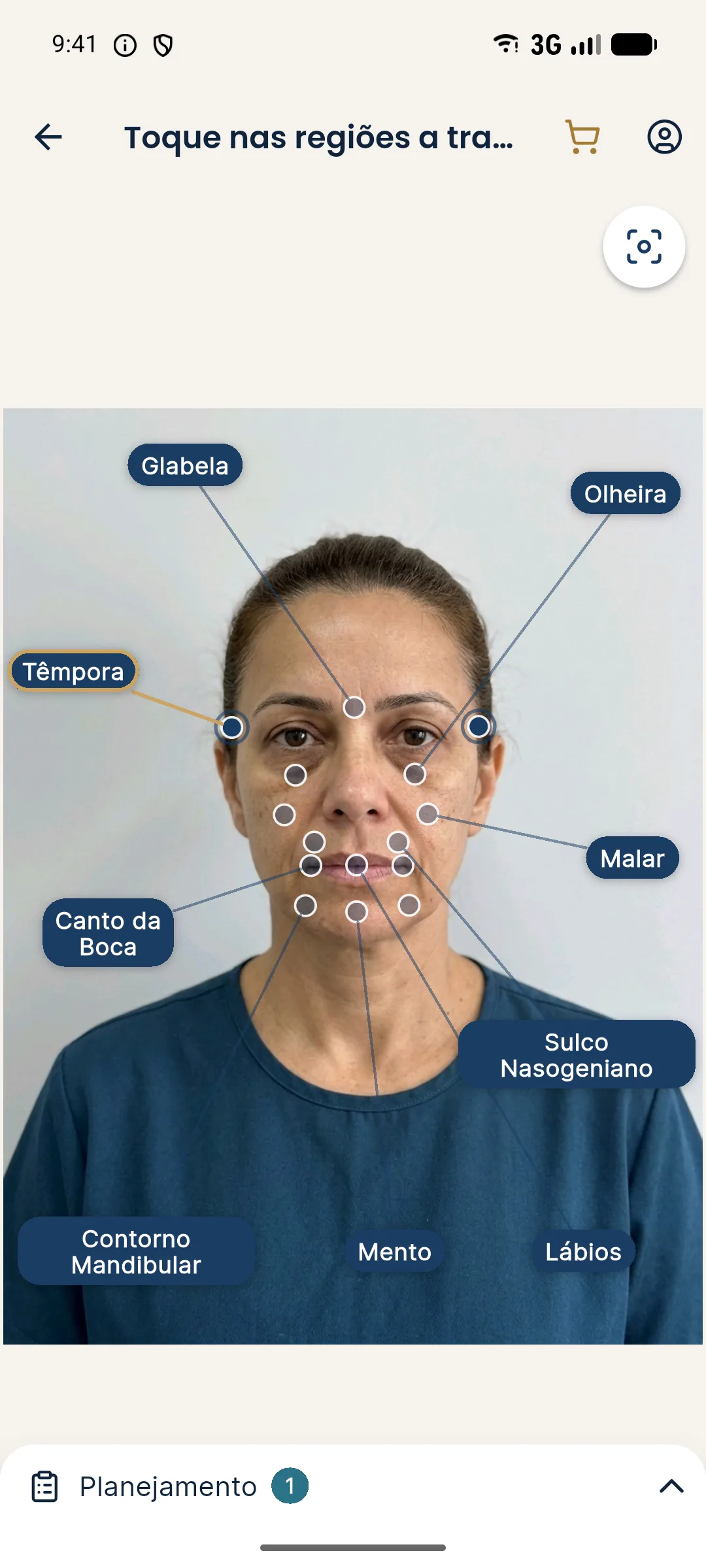
A presentation trick: generate one projection with Temple only and another with Cheekbone only. The patient sees which of the two areas changes the proportion more and decides with more confidence. See temples and eyebrow: combining in the plan for the reasoning on sequence.
Record
Record the measurements, the photos, the dominant component identified and the steps agreed, plus the explanations of limits. Volumes and techniques are at the discretion of the qualified professional, after assessment and in line with the rules of their professional council in Brazil.
Frequently asked questions
What defines a triangular face?
A forehead narrower than the jaw, which becomes the widest part of the face. It can be constitutional or the result of volume loss in the temples and cheekbones over time.
Does filling the temples help balance a triangular face?
When the temples are hollow, restoring volume can widen the read of the upper face and reduce the contrast with the jaw. The decision depends on the assessment and calls for great anatomical care.
Does toxin in the masseter help?
If the lower width has a muscular component, reducing the masseter can lessen the contrast. It does not change bone width.
Is a triangular face the same as a heart-shaped face?
No. In a heart-shaped face the forehead is wide and the chin is narrow. In a triangular face, the base is the jaw. Each calls for a different read of proportion.
Harmy images are illustrative simulations generated by AI from the patient's photo to support the conversation between practitioner and patient. They are not a promise of results. Indication, technique, product and volume are solely the decision of the licensed practitioner. This content is for information only and does not replace a clinical assessment.