
Men with an undefined jawline: assessment and plan

 BeforeSimulation
- Nerve
- Highlighted area
Quick facts
- Concern
- Man who sees his jaw as rounded, with no angle and no straight line from chin to ear
- Assessment points
- Mandibular angle, contour line, chin and the layer of fat over the bone
- Pitfall
- Treating only the contour when the problem is fat, skin or a receding chin
- Male reference
- A straighter contour and a more defined angle than the female one, with no fixed rule
The concern "my jaw is soft" or "my face is round" shows up often among men who work out, lost weight or reach their 30s and 40s and notice a less sharp contour. The request sounds simple: more definition. The assessment, however, has several layers, and the approach varies a lot with the cause.
Here the focus is the male reading of the contour. The overview of the area is in weak jawline, and the comparison by sex in ideal jaw angle by sex. If the contour is sagging, also see drooping jawline.
What makes a male jawline "defined"?
The reading of definition depends on a few elements that add up: the mandibular angle, the continuity of the jawline from chin to ear, chin projection and a clean transition between contour and neck. In the male face, the angle is generally more evident and the line straighter. This is not a goal, it is an observed tendency that guides the conversation.
The bony mandible fixes the design, and what lies over it decides what is seen. Skin, fat, muscle and ligaments change the apparent contour. That is why two men with the same bone structure can have very different-looking jaws.
| Likely cause | How it presents | General direction of the approach |
|---|---|---|
| Barely projected bone | Rounded angle even in a lean face | There may be an indication for volume in the contour, at the professional's discretion |
| Fat over the contour | Full face, no line, mild double chin | Review weight and localized fat before volumizing |
| Laxity and jowls | Contour interrupted by tissue drop | Support and skin quality, more than volume |
| Receding chin | Short line, angle "disappears" in profile | Assess the chin first |
| Barely marked masseter | Narrow face in the lower third | Assess the whole, without presuming volume |
Before volumizing: separate fat from bone
The word "definition" is misleading. Many men with a rounded contour do not need more bone volume, they need less layer on top of the bone. Applying product over a thick layer can worsen how the face reads, making it wider. In that case the conversation involves weight, habits and, when appropriate, localized reduction approaches.
When a double chin is associated, it enters the plan in a specific way. See man with a double chin and double chin: assessment. When the main cause is a receding chin, the chin may take priority, as in receding chin and chin filler.
What the plan can consider
Jawline filler is one of the options to volumize the contour in selected patients, with higher-support hyaluronic acid or other classes of material, always at the discretion of the licensed professional, after assessment. The area's biostimulation also has its own pages: biostimulator along the jawline and hydroxyapatite in the jawline contour.
A few principles guide the conversation with the male patient:
- Prioritize a continuous line and a discreet angle. A very marked, overly symmetric angle gives away the intervention.
- Consider the whole. Chin, angle and line compose each other. Changing one without looking at the others usually produces a disproportionate contour. See combining chin and jaw in the plan.
- Go in stages. Smaller volumes and reassessment allow adjusting the design to the result.
- Preserve natural asymmetry. Small differences between the sides are part of a real face. Trying to even everything out can look artificial.
- Think about the masseter. In some patients the muscle is large and the concern is about width, not definition. See combining jaw and masseter in the plan.
Simulating the jawline in the consultation
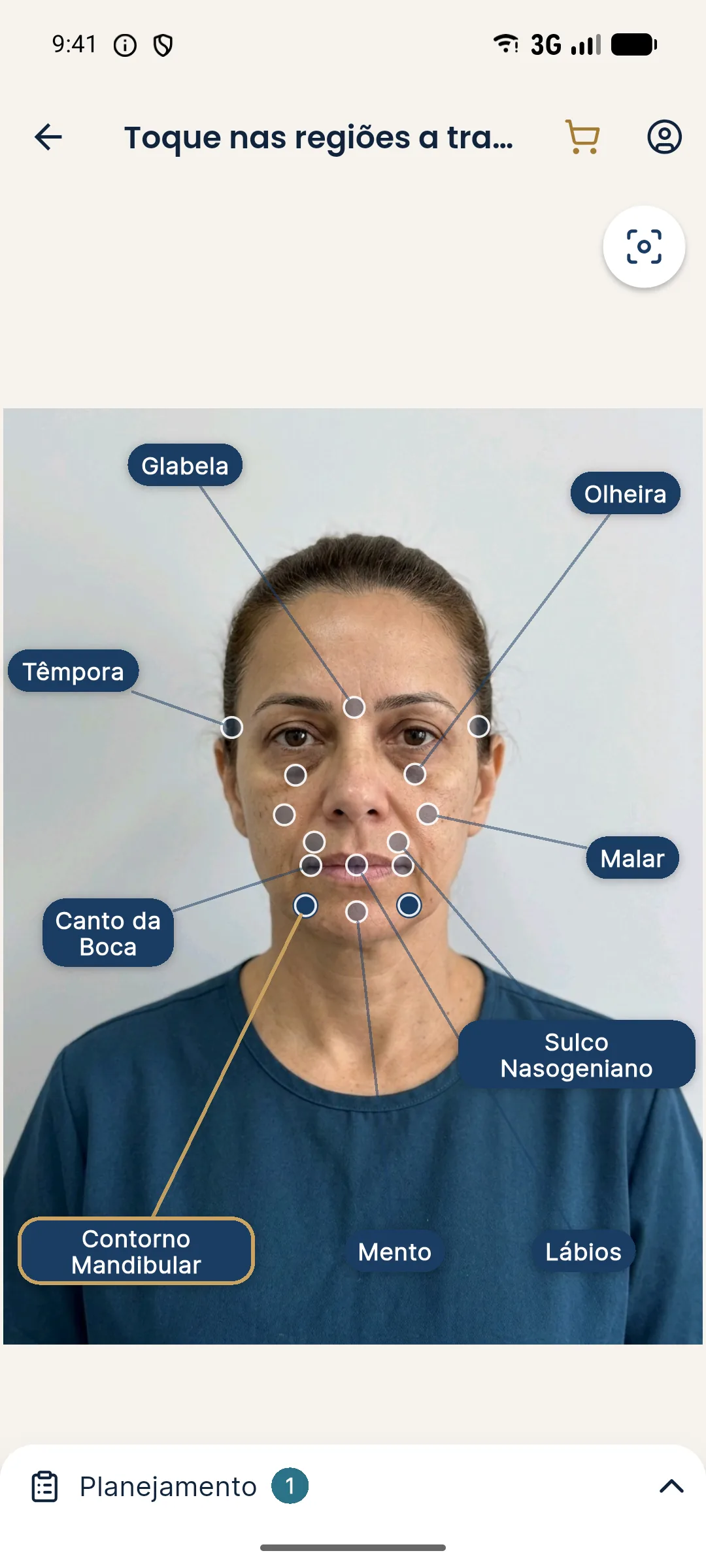
The simulation helps show the change in contour the plan can produce and, above all, calibrate expectations. In Harmy, the Jawline point lets you mark the volume and compare before and after on the slider.
Since the projection starts from the front photo, it is worth agreeing with the patient that the angle and the line in profile do not appear there and are left to the clinical assessment. The projection is illustrative and may differ from the actual result.
Risks and precautions
The jawline is an area where anatomy demands respect. The marginal mandibular branch and nearby vascular structures, such as the facial artery, call for anatomical knowledge and proper technique. The mandibular ligament and the layer of skin and fat influence how the product settles.
Possible complications include swelling, bruising, asymmetry, palpable irregularities, nodules and, more rarely, vascular compromise. Hyaluronidase must be available when hyaluronic acid is used, and the patient needs to know when to contact the clinic.
When the jaw is not the focus
There are patients in whom the best plan does not even start at the jaw:
- Recent weight loss or use of medications that change the face, where proportions will still stabilize. See facial volume loss after weight loss.
- Malocclusion or an altered bite, which change support. See deep bite and receding chin.
- The face of someone who trains hard, where the masseter and low body fat change the reading. See face of someone who trains hard.
- Vague concern, where the patient cannot say what bothers him. See vague concern: how to investigate.
How to handle the follow-up
In staged plans, revisit the contour with the same standardized photos, comparing light, position and expression. Ask the patient what changed in his perception, not just in what you see. If the result fell short of what was agreed, record it and agree on the next step without hurry. If the jaw ended up more marked than the patient wanted, the approach may be to observe and, when indicated, use hyaluronidase on hyaluronic acid. The patient's images follow the informed consent and the LGPD (Brazil's data protection law).
A well-assessed male jawline has the shortest plan: less product, more clarity about the cause and a frank conversation about what harmonization can do. The result is always individual and varies from person to person.
Frequently asked questions
Can a man's jawline be defined with filler?
In selected cases, the professional may assess volumizing the contour, at his or her discretion after assessment. First you need to separate what is bone, fat and skin, because each cause calls for a different approach.
Is an undefined jawline always a lack of volume?
No. It can be fat over the contour, laxity, a double chin, a receding chin or a barely marked masseter. Treating only the contour in one of these cases may not solve the concern.
What is the difference between the male and female contour?
In general the male contour has a more defined mandibular angle and a straighter line, and the female is softer. These are tendencies, and the plan follows the patient's face, not a rule.
Can jaw filler in a man look artificial?
It can, if the volume exceeds the anatomy or creates a line that is too hard and too symmetric. That is why the plan is usually conservative and done in stages, with reassessment.
Harmy images are illustrative simulations generated by AI from the patient's photo to support the conversation between practitioner and patient. They are not a promise of results. Indication, technique, product and volume are solely the decision of the licensed practitioner. This content is for information only and does not replace a clinical assessment.