
Round Face: Assessment and What Harmonization Can Change

 BeforeSimulation
- Nerve
- Highlighted area
Quick facts
- Concern
- The face looks round, without angles and with very prominent cheeks
- Separate
- Bone width, cheek volume and lack of chin projection
- What harmonization does
- Creates the look of length and defines the contour, without changing the base shape
- Caution
- Filling the cheek in a round face tends to make it rounder still
The patient arrives with a reference photo of an oval face and one sentence: "I wish my face were slimmer." When you look at their face, what you see is circumference: forehead and jaw about as wide as the cheeks, a chin that is not very defined, soft angles. It is a round face, and the honest question is how much of it is bone and how much is volume.
This page guides the assessment and shows where orofacial harmonization can influence how the shape is perceived, without promising something the skeleton does not allow.
What a round face is
We call a face round when its width is close to its height and the contour has no defined angles. It is a face type, not a problem. See face type and facial anthropometry. In general, three factors combine:
- Bone: wide zygomatic arches and jaw rami, with a barely marked jaw angle.
- Volume: cheeks with abundant fat, especially in the lower part of the midface.
- Projection: an underprojected chin, which makes the lower third look short.
All three can appear together or separately. One patient may have narrow bones and full cheeks, another the opposite. The approach changes according to which predominates.
How to assess: bone, volume or projection
The assessment starts with standardized photos, frontal and profile, with hair pulled back and a neutral expression. Next, the rule of fifths is applied to estimate relative width. See also face width by the fifths.
| Finding | Suggests | Note |
|---|---|---|
| Large bizygomatic width, even in a thin face | Wide bone | Facial harmonization has little influence |
| Soft cheek that rises when smiling | Cheek volume | Consider buccal fat and other causes |
| Recessed chin in profile | Lack of projection | The chin can help |
| Barely marked jaw angle | Soft contour | Defining the jawline |
| Bulky masseter when clenching the teeth | Muscular component | Assess toxin |
The reasoning on proportion is in round face, thin versus full and in planning a round face. For profile reference points, see reference lines of the aesthetic profile.
The illusion of length
Facial harmonization does not change bone shape, but it changes what the eye reads. The eye perceives the relation between dimensions, so increasing the apparent height or defining angles can change how the whole is read.
Chin projection. Chin filler can increase projection and the height of the lower third, which contributes to a visually longer face. It is the most cited tool for a round face, as long as the profile justifies it. See planning chin projection and small chin.
Jawline definition. Jawline filler can mark the angle and the lower line, giving a touch of contour to a face that has none. In a very wide face, the tool should be used with care, because lateral volume can widen. See barely marked jaw angle.
Cheekbone with caution. Lateral volume on the cheekbone widens the face, while forward projection can bring light to the front and slim the contour. Fine adjustment is at the discretion of the qualified professional, and the rule is to start from the minimum.
Targeted reduction. If the masseter contributes to the width, toxin can be considered. If cheek fat is the dominant factor, the conversation involves other approaches, including surgical ones. See buccal fat removal or harmonization.
Timeline of a plan for a round face
Each stage changes how the next one reads. That is why the plan should never be fully closed on the first day.
Combinations worth discussing
See how the areas influence each other:
- Chin and jawline: a projected chin improves the contour design, and the jawline gains line. See chin and jawline: combining in the plan.
- Cheekbone and jawline: balance between upper and lower width. See cheekbone and jawline: combining in the plan.
- Chin and double chin: when there is submental buildup, the chin helps delimit the angle. See chin and double chin: combining in the plan.
Risks
Chin and jawline procedures carry risks of swelling, bruising, asymmetry, irregularities and, more rarely, serious vascular complications. The facial artery and the submental artery are structures to know. Hyaluronidase must be available with hyaluronic acid. See also safety and complications: overview.
There is also a communication risk: promising a "slim" face is promising a result, which is not allowed. Always describe the goal as smoothing and balance, never as transformation.
How Harmy enters the conversation
A round face is one of the cases where the visual projection makes the biggest difference, because patients often imagine a result that does not match what the technique delivers. Harmy shows the effect of volume on the Chin and the Jawline from a front-facing photo.
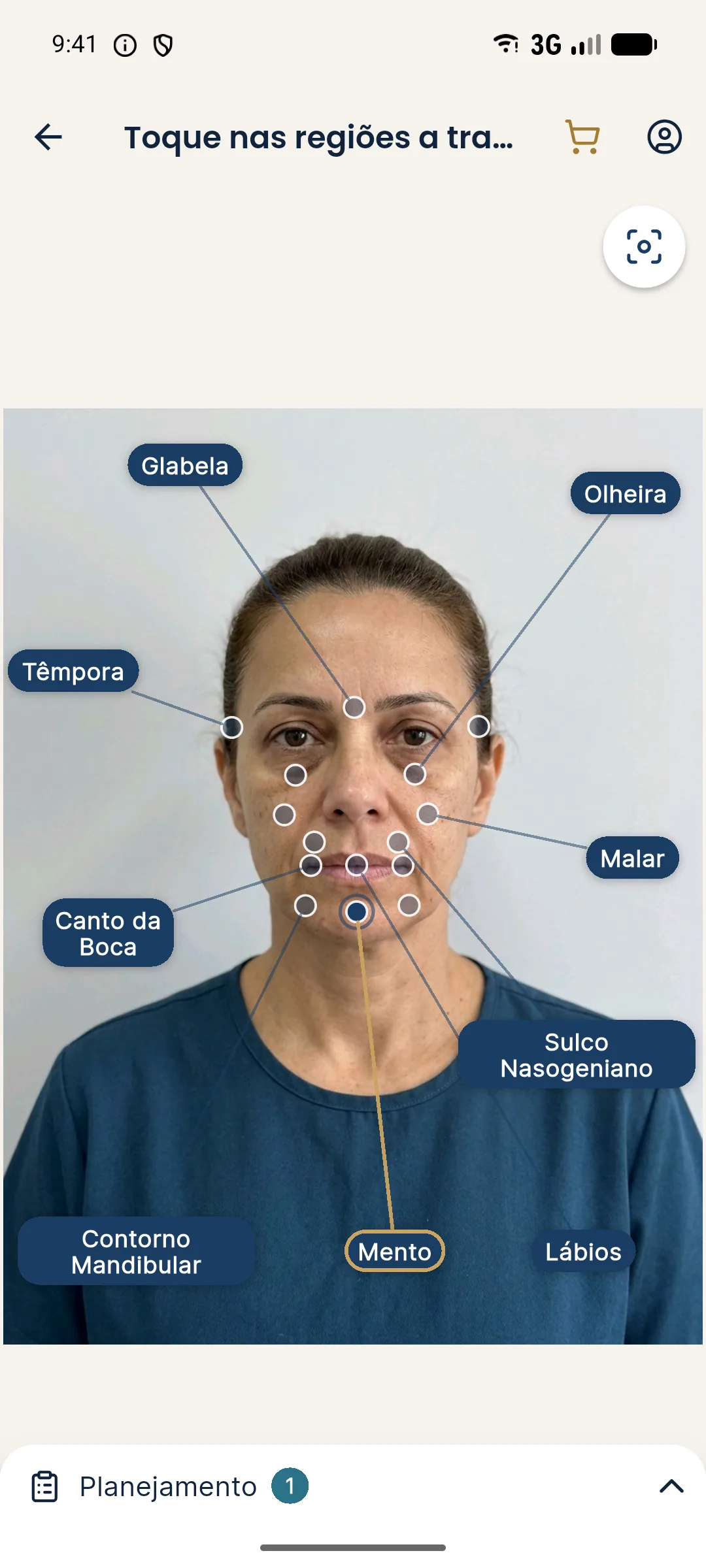
A useful strategy: generate one version with the Chin only and another with the Chin plus the Jawline, and show both. The patient understands what each area adds and whether the change matches what they are after. For the "Full harmonization" shortcut, the chin comes with 1.5 ml and the jawline with 2 ml, both at Moderate intensity, but with a round face it is worth starting with less and adjusting.
Record keeping
Record the assessed shape, the frontal, profile and three-quarter photos, the explanations given about limits and the stages agreed on. If the plan includes a surgical referral, note the guidance. Volumes and techniques are at the discretion of the qualified professional, after assessment and in line with the rules of their professional council in Brazil.
Frequently asked questions
Can a round face be slimmed with facial harmonization?
You can influence how the shape is perceived with chin projection, jawline definition and targeted volume reduction. The base shape, set by bone, does not change with injectables.
Does filling the chin lengthen a round face?
In many cases, chin projection improves proportion and creates a sense of length. The decision depends on the assessment of the profile and the lower third.
Can I fill the cheekbone in a round face?
With caution. In an already wide face, lateral volume on the cheekbone can widen it even more. Assess forward projection and the goal before adding anything.
Is buccal fat removal the way to go for a round face?
It is a surgical procedure with its own indication, which must be evaluated by a qualified professional. Facial harmonization works with other tools and has limits.
Harmy images are illustrative simulations generated by AI from the patient's photo to support the conversation between practitioner and patient. They are not a promise of results. Indication, technique, product and volume are solely the decision of the licensed practitioner. This content is for information only and does not replace a clinical assessment.