
Man with a deep nasolabial fold: assessment

 BeforeSimulation
- Highlighted area
Quick facts
- Concern
- Man who feels the fold between nose and mouth is deep, heavy or "aging"
- Components
- Midface support, nasolabial compartment fat, skin and smile dynamics
- Male-specific trait
- Thicker skin, a beard close to the fold, and a fold often accepted as part of the face
- Risk
- High vascular risk area, with branches of the facial and angular arteries
The nasolabial fold (smile lines) is one of the first concerns a man brings when he decides to seek orofacial harmonization (HOF), usually because he says his face looks "heavy" or "older." The fold that runs from the side of the nose down to the corner of the mouth is part of every face. What changes over time is its depth, its shadow and how it connects to the rest of the midface.
The general page for the fold is deep fold from nose to mouth, with the procedure in nasolabial fold filler. Here the focus is the male reading and the decision to treat the fold or its cause.
What forms the fold and why does it deepen?
The fold is the boundary between the nasolabial compartment and the cheek. With age, cheek fat descends, the midface loses support and the cheek skin advances over the fold, deepening the shadow. The nasolabial compartment and the action of the levator labii superioris muscle also play a part.
In men, three particularities enter the assessment: the skin is thicker and firmer, the beard reaches close to the fold and facial fat is distributed differently. In many men the fold is seen as part of the character of the face, and the patient wants to "soften," not "erase."
| Component | Sign | General direction |
|---|---|---|
| Midface descent | Empty or dropped cheek, deeper fold | Assess midface support first |
| Nasolabial fat | Volume above the fold, a full "crease" | Caution: volume can accentuate it |
| Skin and loss of elasticity | Fold that persists without expression | Skin quality, biostimulation |
| Smile dynamics | Fold marked only when smiling | Understand what is movement and what is a fixed fold |
| Asymmetric fold | One side deeper | See fold different on one side |
A practical test: lifting the midface
A simple gesture during the consultation helps decide the order of the plan. With the patient facing the mirror, gently lift the cheek with your fingertips, without stretching the skin of the fold. If the fold clearly improves, the cause is strongly related to midface descent and support may come first. If the fold stays, it is more local and the reasoning may include the fold itself.
This reasoning is detailed in treating the fold or the cause of the fold and in nasolabial fold or cheekbone. Combining the two areas in the plan is covered in combining nasolabial fold and cheekbone in the plan.
Care with the male plan
When the decision is to fill the fold, a few guidelines help keep the result natural.
- Less product than you would think. A deep fold with a sagging cheek may have a stronger indication for support than for filling the fold.
- Avoid volume in the crease. Too much volume over the fold can accentuate nasolabial fat, turning the concern into another one.
- Preserve the dynamics. The fold moves with the smile. A plan that ignores the dynamics can produce a stiff mouth.
- Reassess with the beard. Someone with a dense beard may read differently clean-shaven. See harmonization and beards.
- Quantity in stages. The ml decision belongs to the professional, after assessment. See the question on how many ml in the nasolabial fold as guidance for the conversation, not as a protocol.
For the bigger picture of harmonization in men, see male orofacial harmonization and men and facial harmonization.
Simulating the fold before deciding
The simulation helps show that a subtle softening already changes how the fold reads, and lets you compare it with the option of also treating the midface. In Harmy, the Nasolabial Fold point is marked on the front photo.
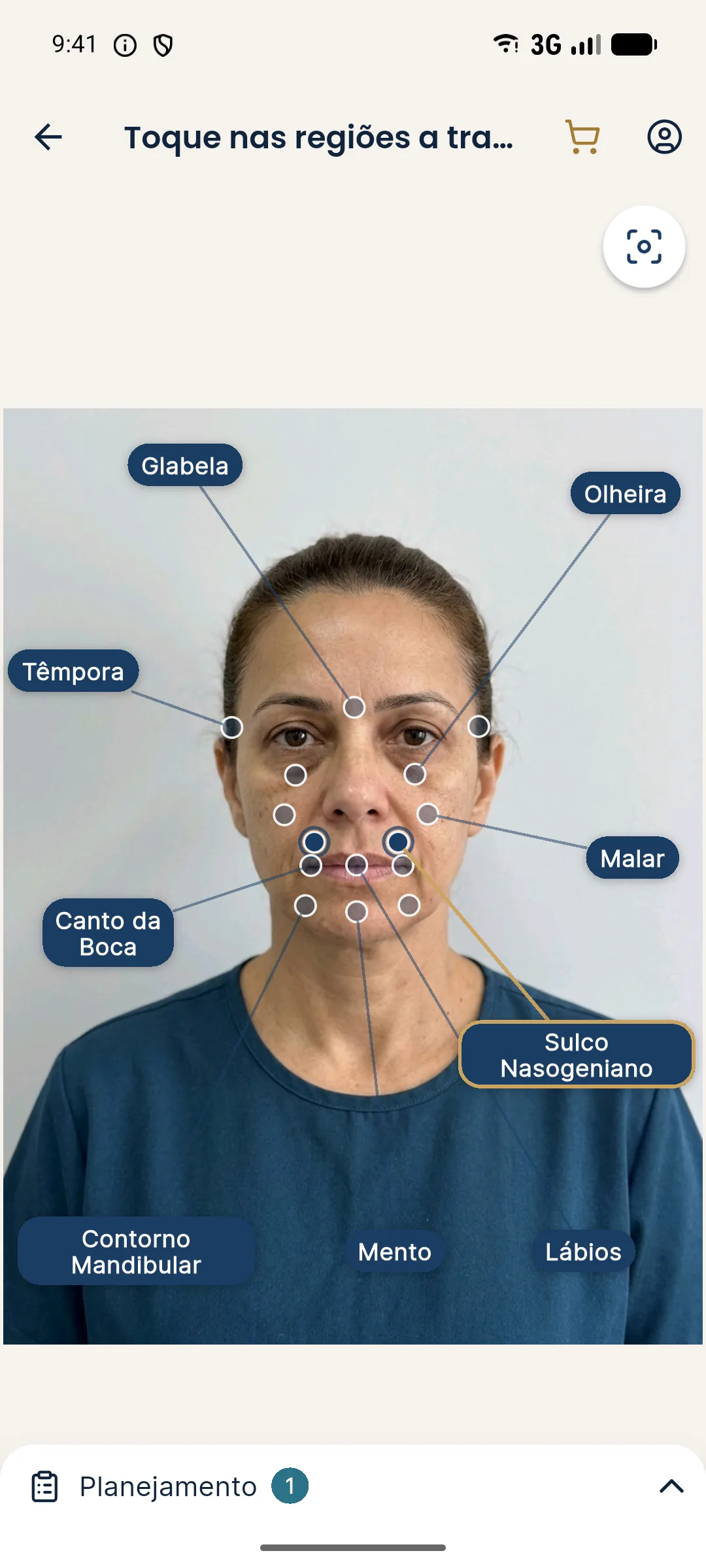
For the conversation with the patient, see explaining the nasolabial fold to the patient.
Risks: a high vascular risk area
The nasolabial fold is a high vascular risk area. The facial artery and the angular artery run close to the fold, with anastomoses that connect to the circulation of the nasal and orbital regions. It sits within the so-called danger triangle of the face.
Possible complications include swelling, bruising, asymmetry, irregularities, nodules and, rarely but seriously, vascular occlusion with skin necrosis and visual impairment. Hyaluronidase must be available for any hyaluronic acid injection, and the professional must know the protocol for recognition and management. The specific picture is in vascular occlusion in the nasolabial fold.
When the fold is not the target
- Fold as a consequence of a sagging cheek. See sagging cheeks and midface ptosis.
- A concern about heaviness, not about the fold. A heavy, full face may have a different root. See heavy face.
- Associated marionette lines, which change how the lower face reads. See deep marionette lines.
- Threads or biostimulator as a support option. See deep fold: filler or threads.
Follow-up
Schedule the follow-up after the swelling has settled, with photos under the same conditions. Ask how the patient sees his expression when smiling and speaking, because that is where an over-treated fold shows. If there is a nodule, irregularity or asymmetry, the approach should be guided by the assessment, including the use of hyaluronidase when indicated. The use of the images follows informed consent and the LGPD (Brazil's data protection law).
In a man, a well-managed nasolabial fold is almost invisible as an intervention: the fold remains, only softer. Results vary from person to person and cannot be guaranteed.
Frequently asked questions
Should a man's nasolabial fold be filled completely?
Generally not. Erasing the fold completely usually leaves the face looking artificial, and on a male face a soft fold is part of the expression. The goal is usually to reduce depth, at the professional's discretion.
Does filling the fold solve it, or is it better to treat the midface?
It depends on the cause. If the fold appears because the midface has dropped, treating the support may reduce the fold without filling it. The assessment sets the order.
Does the beard get in the way of assessing the fold?
It can, because it covers part of the contour and changes how light reads. It is worth assessing both clean-shaven and with the beard, and explaining to the patient that the reading changes.
Does nasolabial fold filler carry risk?
Yes. It is a high vascular risk area, with the facial and angular arteries nearby. The professional must know the anatomy and keep hyaluronidase available.
Harmy images are illustrative simulations generated by AI from the patient's photo to support the conversation between practitioner and patient. They are not a promise of results. Indication, technique, product and volume are solely the decision of the licensed practitioner. This content is for information only and does not replace a clinical assessment.