
How the Chin Changes the Way a Smile Reads

 BeforeSimulation
- Nerve
- Highlighted area
Quick facts
- Concern
- A smile that looks short, hard or unbalanced because of the chin
- Key reading
- The chin is the lower frame of the smile, and its position changes how the lip and mouth read
- Supporting measure
- Frontal photo smiling and in profile, mentolabial angle and lower lip line
- Limit
- The chin does not correct the dental arch, and dental problems need a dental assessment
People looking at a smile usually look at the teeth, but the face reads a smile as a whole: lips, teeth, cheeks and chin. A recessed chin makes the mouth look "pushed" forward. A very projected chin can harden the smile. When the patient complains about the smile and the teeth are fine, it is worth looking at the chin.
This page shows how the chin takes part in how a smile reads and how to assess the two together. For the assessment of the smile itself, see smile analysis in HOF and smile asymmetry. For the chin on its own, small chin and recessed chin.
Why does the chin matter for how a smile reads?
The chin supports the lower lip and defines the lower third of the face. When we smile, the lips part, the cheeks rise and the chin serves as the lower contour. The relationship between the lower lip and the chin, seen in profile through the mentolabial angle, changes how the smile is perceived.
In a harmonious profile, the lower lip, the mentolabial fold and the pogonion form a smooth curve. When the chin is recessed, the fold deepens and the lower lip looks too big. When it is very projected, the fold disappears and the chin "invades" the smile. In both cases, the patient feels that "the smile does not match the face".
What to look for in the smiling photo
The frontal photo smiling reveals details that rest hides. Look at:
- Smile symmetry: if one side rises more, the asymmetry may come from the muscle, the lip or the chin.
- Lower lip line relative to the edge of the upper teeth.
- Buccal corridor, the dark space at the side of the smile. See buccal corridor and smile.
- Height of the lower third and the proportion between philtrum, lip and chin.
- Chin contraction when smiling, which produces dimples and texture.
- Gum exposure, which can be treated by other routes. See toxin for a gummy smile.
Reading thirds and proportions helps decide whether the adjustment belongs in the chin, the lip or both. The relationship between them is detailed in lips and chin: combining in the plan.
Recessed chin and lower lip: what happens?
In patients with a recessed chin, the lower lip often looks protruding or turned outward, and the mentolabial fold is deep. The smile takes on a "missing chin" look in profile photos and videos. Projecting the chin, in those cases, can restore a smoother curve to the lower lip and the fold.
The point of caution is that the lip often settles after the chin gains support. That is why it is not advisable to treat chin and lip at the same time without a reassessment. See protruding lower lip and drooping lower lip.
| Chin pattern | Effect on the smile | Clinical question |
|---|---|---|
| Recessed | Protruding lower lip, deep fold | Does the lip need volume or does the chin need projection? |
| Balanced | Smooth curve between lip and chin | Is there anything to adjust, or does the concern come from elsewhere? |
| Very projected | Hard smile, dominant chin | Does the proportion call for toning down emphasis rather than adding volume? |
| Active muscle | Dimples when smiling | Toxin or support adjustment? |
Can the chin make the smile worse?
Yes, if poorly planned. An overly projected chin creates a heavy lower third and pulls attention away from the smile. Poorly distributed volume can lengthen the chin and close the space between the lower lip and the chin. And if the patient smiles with a "puckered" chin, the texture can become visible. That is why the assessment must be dynamic, not only static.
In terms of safety, the chin area is well vascularized, with a risk of bruising, swelling, asymmetry and, rarely, vascular complication. Hyaluronidase must be available, and the patient must be informed. See safety and complications.
How to treat chin and smile together
In general, the rule is one step at a time, with reassessment. The chin is usually the starting point, since it is structural, and the lip comes later if there is still a concern. The mouth corners can also take part, when the smile looks "sad" at rest. See downturned mouth corners.
The combined plan can follow the logic described in lips and mouth corners: combining in the plan and in plan for a harmonious smile. Record the before and after photos of the chin, at rest and smiling, to compare the effect on the smile.
What does Harmy show here?
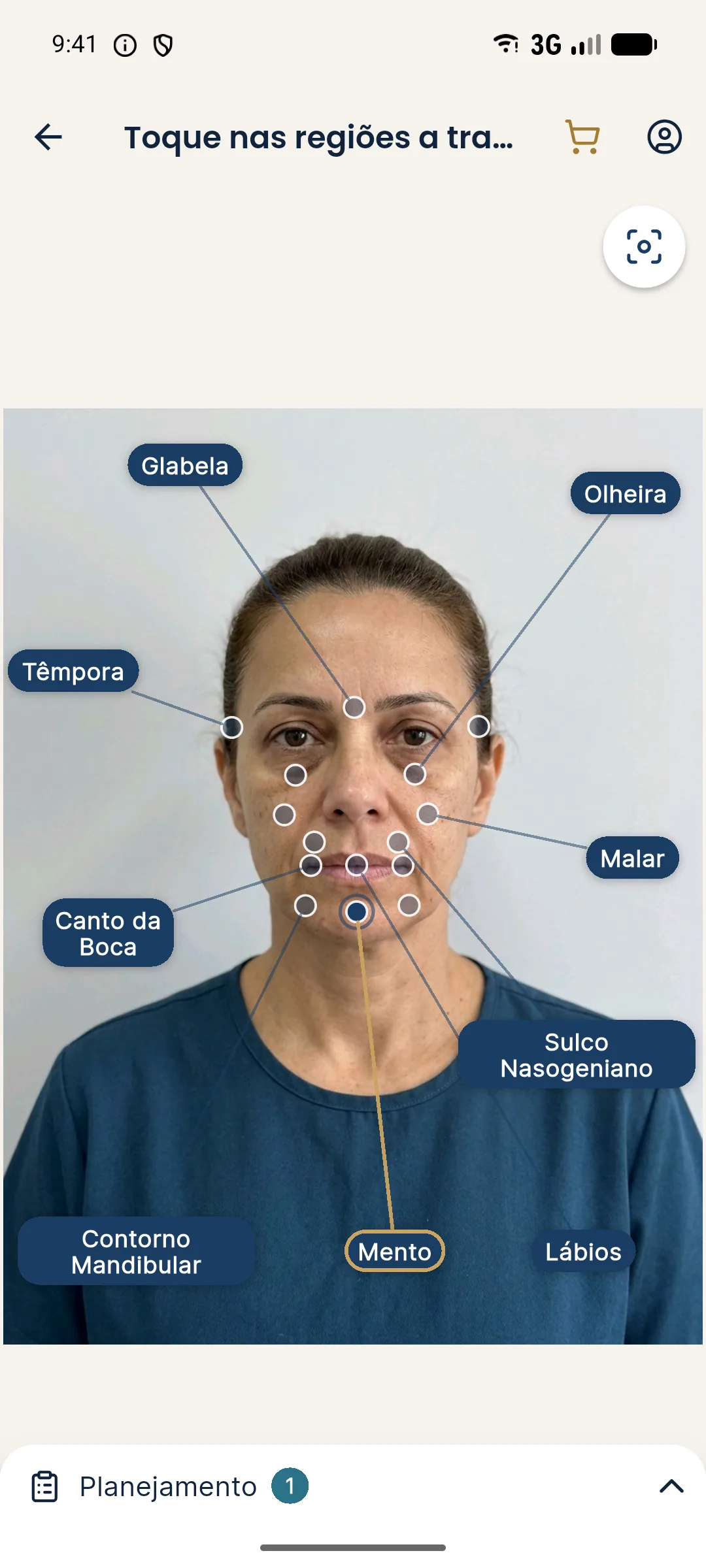
The projection in Harmy uses the frontal photo and shows the change in chin contour with the lips at rest. The app does not simulate the smile or the profile. Even so, the image helps discuss the proportion of the lower third. If the patient is smiling in the photo, the projection keeps the expression, because the prompt forbids changing the expression.
When to refer
Referral to the dentist or orthodontist is appropriate when there is an open, deep or cross bite, marked gum exposure, tooth wear or obvious misalignment. HOF can work alongside, but it does not replace the underlying treatment. For the flow, see referring patients in HOF.
Record keeping
Save the smiling and resting photos, the plan as a range, the chosen order and what was explained about limits. At follow-up, repeat the same photos. The history per patient keeps the sessions side by side, and standardized clinical photography describes how to standardize light and pose.
Frequently asked questions
Does the chin affect how a smile looks?
Yes. The chin is the base for the lower lip and defines part of the proportion of the lower third. A recessed or very projected chin changes how the smile reads, even when the teeth are fine.
Does chin filler improve the smile?
It can improve the harmony between the lower lip and the chin, which changes how the smile reads. It does not change tooth alignment or gum exposure.
What is the relationship between the lower lip and the chin in a smile?
The lower lip rests on the curve of the chin. When the chin is small, the lower lip can look protruding, and the mentolabial fold gets deeper, which creates shadow and tension.
When is the smile problem dental rather than facial?
When there is tooth misalignment, excessive gum exposure or bite changes. In those cases, the dentist or orthodontist assesses first, and HOF can complement.
Harmy images are illustrative simulations generated by AI from the patient's photo to support the conversation between practitioner and patient. They are not a promise of results. Indication, technique, product and volume are solely the decision of the licensed practitioner. This content is for information only and does not replace a clinical assessment.