
Sad or dull smile: what to assess

 BeforeSimulation
- Muscle
Quick facts
- Concern
- The smile looks small, drooping or lifeless, and the face stays serious when smiling
- Structures
- Zygomaticus, angle elevator, depressors, mouth corners and lip volume
- What to look at
- Direction of the corners, tooth display, smile arc and buccal corridor
- Caution
- Perioral toxin can change the smile and speech; assessment in motion is mandatory
Some patients smile, but the smile "does not arrive". The corner of the mouth rises little, the teeth show little, the eyes do not take part and the face stays serious. Others say their smile is "sad", as if the corner of the mouth pulled down even at a moment of joy.
A smile involves muscles, volume, teeth and bones, and not everything belongs to orofacial harmonization. This page helps assess what is visible, separate the parts and order the plan, with attention to work shared with dentistry.
What makes up a smile
A smile is a choreography. Several muscles raise and move the corner of the mouth, the upper lip rises and exposes the teeth, the lower lip follows the arc of the incisors, and the cheekbone area projects.
The main muscular players are:
- Zygomaticus major: pulls the corner of the mouth up and back.
- Levator anguli oris: raises the corner.
- Depressor anguli oris: pulls the corner down, in opposition.
- Upper lip elevators: expose the teeth.
- Modiolus: the lateral muscle knot where several fibers meet and which organizes the movement.
When the forces that raise are weaker than those that lower, the smile loses breadth. When the volume or position of the lips does not keep up, it loses design. See smile analysis in HOF and plan for a harmonious smile.
The signs that make a smile look dull
| Sign | What is seen | Possible cause |
|---|---|---|
| Downturned corners | Inverted "U" mouth at rest and when smiling | Active depressor, volume loss |
| Little tooth display | "Shy" smile | Long or barely mobile upper lip |
| Thin lips | Smile without design | Low volume and loss of contour |
| Flat cheekbone | Cheek does not rise when smiling | Loss of midface projection |
| Absent or excessive buccal corridor | Dark lateral space | Width of the arch and lips |
| Asymmetry | One side rises more | Uneven tone and habits |
Some of these signs belong to dentistry, such as tooth shape and the smile arc. Others belong to the soft tissues. See buccal corridor and smile, smile arc and lower lip curve and smile that shows little tooth.
How to assess
When the findings suggest a dental or gum cause, planning should be shared with the dentist. HOF does not replace dental treatment, and vice versa. See gummy smile: beyond toxin and veneers and smile planning in HOF.
What facial harmonization can adjust
Each area contributes in its own way, and the choice depends on the dominant sign. All at the discretion of the qualified professional.
Mouth corners. Mouth corner filler can soften the slant and the shadow, helping the smile look lighter. See downturned mouth corners.
Lips. Lip filler can improve contour and volume, and with them the design of the smile, as long as the lip follows the movement. Too much volume stiffens the smile. See lips and mouth corners: combining them in the plan.
Cheekbone. Projecting the cheekbone gives the smile a "base" that rises with it. See cheek without volume when smiling.
Toxin. The depressor anguli oris can be treated in selected cases, and toxin can also be used in smile design. Because this is an area of delicate movement, the risk of asymmetry is real. See botulinum toxin and smile design and stiff smile after toxin.
Marionette lines and chin. Lines running from the corners down to the chin reinforce the sad look. See deep marionette lines and sad mouth.
Timeline of a plan
Risks
In the perioral area, risks include swelling, bruising, asymmetry, nodules, irregularities and, more rarely, a serious vascular complication, because of the labial arteries. Toxin in the area can cause an asymmetric smile and difficulty speaking and sucking. Hyaluronidase must be available whenever hyaluronic acid is used. See complications with botulinum toxin and safety and complications: overview.
How Harmy fits in
Harmy simulates volume at the Mouth Corner, Lips and Cheekbone points from a frontal photo. It shows the static effect of volume, but it does not simulate smile movement or toxin in the smile.
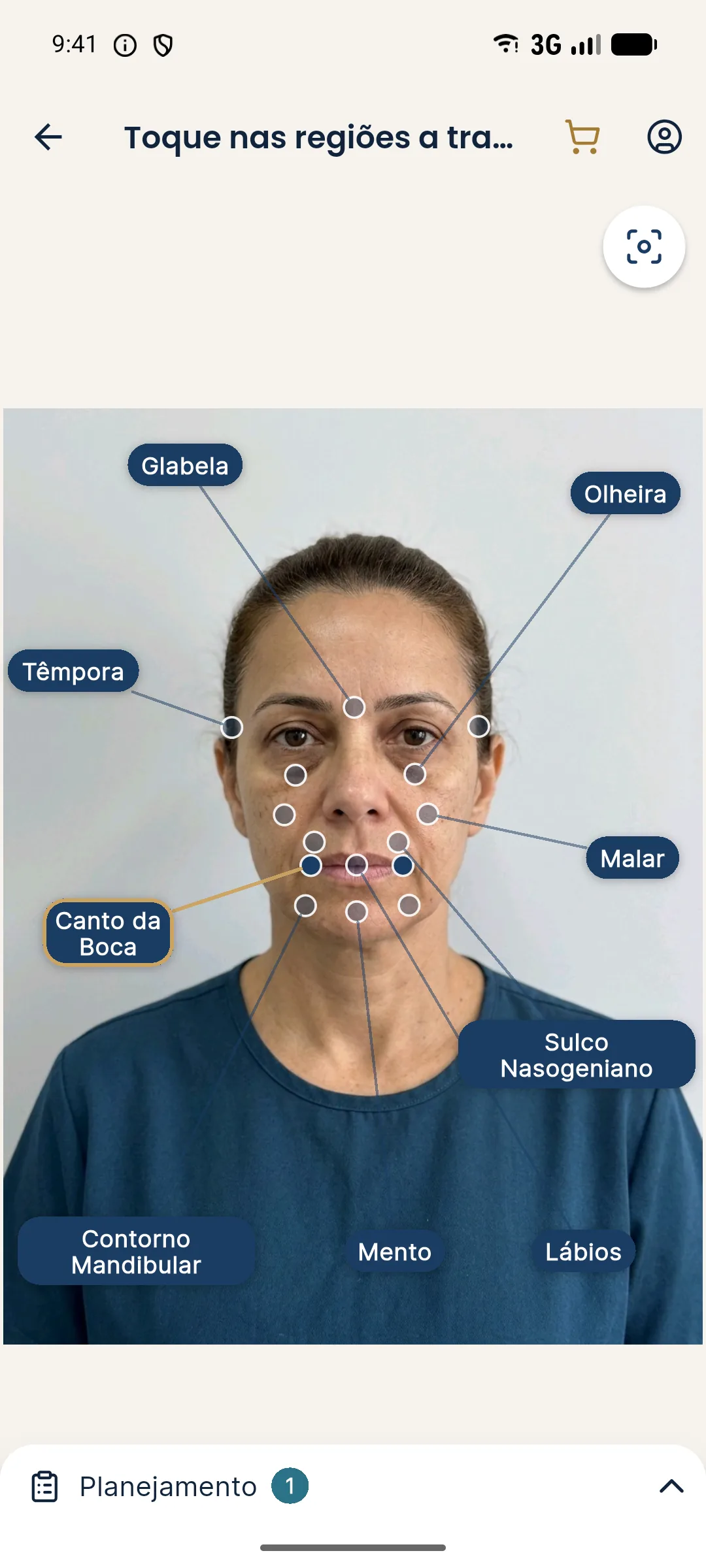
Let the patient know that the projection shows the mouth at rest, and that the effect on the smile depends on real movement. See the simulation does not show movement.
Record keeping
Record the video (with consent and safe storage), the classification, the shared care with dentistry and the proposed stages. Volumes and techniques are at the discretion of the qualified professional, after assessment and in line with the rules of their professional council in Brazil.
Frequently asked questions
Why does my smile look dull?
It may be the direction of the mouth corners, little tooth display, thin lips, insufficient volume in the cheek area, or a combination of these. Assessment in motion identifies the dominant one.
Can facial harmonization improve the smile?
In selected cases, adjustments to the lips, mouth corners and cheekbone can soften the look. Teeth and gums belong to dentistry, and planning is usually shared.
Does toxin change the smile?
It can. Muscles that raise and lower the mouth corners affect the design of the smile, and an unbalanced dose can leave it asymmetric or stiff.
What is the smile arc?
It is the curve formed by the edges of the upper teeth in relation to the lower lip. A well-matched arc usually gives the impression of a younger smile.
Harmy images are illustrative simulations generated by AI from the patient's photo to support the conversation between practitioner and patient. They are not a promise of results. Indication, technique, product and volume are solely the decision of the licensed practitioner. This content is for information only and does not replace a clinical assessment.